How Long Does a Patient Wait for a Bed? ED Boarding, Discharge, and Transport
By Natalie Evenson, MSN, BSN, RN, SANE-A – Guest Writer · October 1, 2026
JAMA: 53.6% of general-medicine admissions boarded 4+ hours. CMS median ED visit: 162 minutes. How discharge transport ties to boarding before ECAT.
ED boarding is the wait after the decision to admit until the patient leaves the ED for an inpatient bed. When discharges stall on logistics (rides, DME, home health, post-acute placement), beds stay occupied and boarding rises upstream. For case management, patient flow, and hospital ops leaders, the usable question is which outflow levers move before ECAT reporting hardens. This piece covers the fresh boarding numbers, why capacity expansion is getting harder to fund, how transport fits the outflow chain, and what ECAT will measure starting in 2027.
The numbers hospitals are watching
A JAMA research letter published around mid-August 2026 (Janke and colleagues) analyzed roughly 492,000 general-medicine admissions across 56 emergency departments in 17 health systems (June 2024 to May 2025). 53.6% boarded four hours or longer awaiting an inpatient bed. Cite that figure: more than half of general-medicine admissions in the sample waited at least four hours for a bed.
A related but distinct gap: about 17.3% of patients requested for general-medicine admission waited four hours or longer without inpatient management starting. Secondary coverage sometimes frames handoff delay among boarders as “nearly a quarter.” That handoff metric is not “nearly a quarter of admitted patients wait four-plus hours for a bed.” Keep the numbers separate.
Separately, CMS Care Compare / Timely and Effective Care data for October 1, 2024 through September 30, 2025 put the national median ED visit time at 162 minutes. An Axios map by Jim Sergent visualizes that CMS extract, with a District of Columbia callout of 323 minutes.
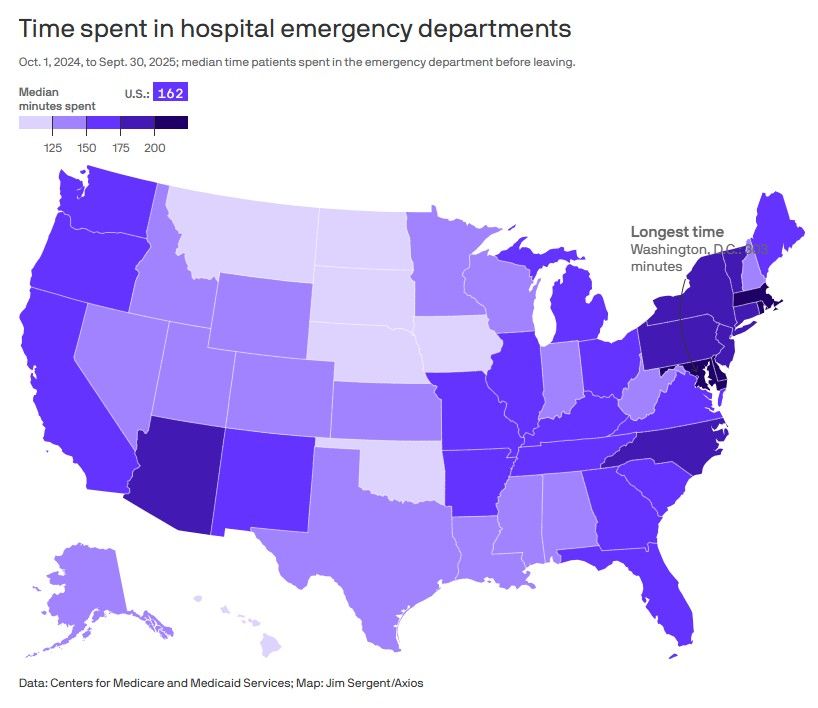
These are mechanism and capacity signals: occupied beds, wait clocks, and variation across hospitals and geographies. Case management and patient-flow leaders already feel the pressure in boarding dashboards and ED length-of-stay reviews. This article does not translate those figures into clinical-outcome promises in VectorCare’s voice. Mechanism and economics only.
Why boarding is often a discharge problem
Boarding is often framed as an ED staffing or bed-count problem. AHRQ’s Summit to Address Emergency Department Boarding (technical report after the October 8, 2024 summit) frames causes as hospital-wide: delayed inpatient discharges, administrative barriers such as prior authorization, and post-acute capacity limits outside the ED walls. The AHRQ newsletter summary is explicit that solutions must go beyond the ED.
Medically ready does not equal bed free. A patient cleared for discharge or transfer still occupies the bed until the ride, equipment, or receiving placement completes. EVS can turn the room only after departure. That occupied bed is the missing input for the next admission; upstream, the ED boards.
For the broader patient-flow frame, see hospital throughput to improve patient flow. For the discharge-logistics problem surface, see discharge delays. This piece stays on boarding, discharge logistics, transport, and the ECAT clock.
Capacity expansion is getting harder to justify
Adding beds and staff is the classic response to boarding. Economics make that harder to justify as the only near-term lever.
Under current law, a remaining Medicaid Disproportionate Share Hospital (DSH) reduction of $8 billion for FY2028 is scheduled for October 1, 2027, unless Congress acts. Congress eliminated the FY2026 and FY2027 cuts; the FY2028 line remains in statute. Treat it as scheduled under current law, not a settled political outcome (AHA Medicaid DSH fact sheet, updated February 2026).
When safety-net and high-Medicaid-share hospitals face scheduled supplemental-payment pressure, the realistic near-term lever is often outflow: move medically ready patients off the floor so admitted ED patients can move. Every hour a discharge-eligible patient waits on a ride is an hour an admitted ED patient may board. That is bed-utilization economics, not a claim that transport software replaces capacity planning or that every hospital should defer capital projects.
For cost depth, see transportation, discharge delays, and bed days and the hidden cost of discharge delays.
No ride available when you need it
A skilled nursing placement or a ride home only frees the bed when transportation is coordinated and available. The clinical plan can be finished while case management is still in a phone-and-fax loop: call vendor one, wait on hold, try vendor two, update a whiteboard, lose context at shift change.
Parallel logistics block the same bed. Late DME or an unconfirmed home-health start keeps the patient in place even when transport is theoretically “arranged.” The bed stays occupied; the next admission boards. Ops teams that only measure “transport ordered” miss the true lag between medical readiness and departure.
Tracked requests with ETAs on a network / rails model change the mechanism: one request, credentialed match, visible status, completion the unit can see. VectorCare’s identity here is logistics rails and network coordination, not a broker and not a transport company.
ECAT puts boarding on the clock
CMS’s Emergency Care Access and Timeliness (ECAT) eCQM (CMS1244, Hospital OQR) assesses the share of ED encounters with at least one access or timeliness gap. One explicit numerator gap is boarding longer than 240 minutes from decision-to-admit to ED departure for admitted patients (ED observation stays excluded from that boarding criterion per eCQI).
Ops calendar:
- Voluntary reporting for CY2027
- Mandatory reporting beginning CY2028
- CY2030 payment determination (and subsequent years)
Other gaps include treatment-room wait over 60 minutes, left without being seen, and ED length of stay over 480 minutes. Boarding is the gap that most directly connects inpatient outflow to the public quality clock.
Before mandatory reporting, audit decision-to-admit to ED departure, and separately audit how often discharge-eligible inpatients wait on transport, DME, or post-acute logistics. Capture who owns the request, when it went out, and when the bed actually cleared. That is measurement readiness for a public quality clock, not fear copy.
What a hospital transportation strategy looks like in practice
A practical transportation strategy is workflow, not a vendor phone tree:
- Request early from the chart once discharge or transfer is planned.
- Match to credentialed network capacity at the right transport level.
- ETA and status visible to case management and the unit.
- Complete so bed release ties to confirmed departure, not a hoped-for callback.
When that loop sits inside the EHR (for example via SMART on FHIR), logistics delay becomes measurable next to clinical readiness.
For the product surface (request, network match, status), start with hospital patient transportation software. For how discharge transport delays burn bed days, see discharge delays. Soft next step: hospitals and health systems and request a demo.
Under-claim: software helps when it turns phone trees into tracked requests with ETAs and completion. It does not replace bed management or clinical judgment. It is the rails layer that keeps outflow moving when medically ready patients wait on logistics. Hospitals that already run strong bed-management tools still need a last-mile coordination path so “ready to leave” becomes an empty bed on the same shift. That is where transport strategy earns its place before ECAT makes boarding public.
Frequently Asked Questions
What is ED boarding?
ED boarding is the time after the decision to admit until the patient physically leaves the emergency department for an inpatient bed. It is a hospital-wide outflow problem when inpatient beds stay occupied by patients who are medically ready but still waiting on logistics such as rides, DME, or post-acute placement.
How do discharge delays cause ED boarding?
When discharge-eligible inpatients cannot leave, the bed they occupy is unavailable for the next admission. That backlog shows up in the ED as boarding after the admit decision. AHRQ’s boarding summit framing places causes hospital-wide, including discharge delays, administrative barriers, and post-acute limits, not ED staffing alone.
What is CMS ECAT and when does reporting start?
ECAT (Emergency Care Access and Timeliness, CMS1244) is a Hospital OQR eCQM that tracks ED access and timeliness gaps, including boarding longer than 240 minutes from decision to admit to ED departure. Reporting is voluntary for CY2027, mandatory for CY2028, with payment determination implications in CY2030.
How does patient transportation affect boarding and bed release?
A skilled nursing placement or a ride home only frees the bed when transportation is available and coordinated. Delays in that last mile keep the inpatient bed occupied and push boarding upstream for the next admission. Tracked network requests with ETAs make that lag visible and actionable.
What does the JAMA boarding study actually measure?
In a JAMA research letter (Janke et al., ~August 2026), among roughly 492,000 general-medicine admissions across 56 EDs in 17 systems (June 2024 to May 2025), 53.6% boarded four hours or longer awaiting an inpatient bed. A separate figure (~17.3% of admission requests waiting four-plus hours without inpatient management) is a handoff metric, not a substitute for the boarding rate.
Why does capacity expansion get harder as DSH cuts approach?
Under current law, an $8 billion Medicaid DSH reduction for FY2028 is scheduled for October 1, 2027, unless Congress acts. When supplemental payments face scheduled cuts, adding beds and staff is harder to fund as the only answer. Optimizing discharge outflow, including transport coordination, is a more realistic near-term capacity lever for many hospitals.
How is boarding different from total ED length of stay?
Boarding starts at the decision to admit and ends when the patient leaves the ED for an inpatient bed. Total ED length of stay runs from ED arrival to ED departure for the visit. ECAT treats them as separate numerator gaps (boarding >240 minutes; ED LOS >480 minutes), with observation-stay exclusions on those criteria.
Where should hospitals start if median ED visit time is climbing?
Start by separating clocks: total ED visit time, decision-to-admit to ED departure (boarding), and inpatient logistics lag after medical readiness (transport, DME, home health, post-acute). Measure the discharge logistics queue, request rides earlier from the EHR, and treat network status as part of bed release. Soft next step: review discharge delays, hospital patient transportation software, and request a demo if the gap is last-mile coordination.
Related reading and next step
- Hospital throughput to improve patient flow
- Transportation, discharge delays, and bed days
- The hidden cost of discharge delays
- Discharge delays
- Hospital patient transportation software
- Hospitals and health systems
- SMART on FHIR / in the EHR
- Request a demo
If your team is mapping boarding metrics to discharge transport before ECAT mandatory reporting, request a demo.