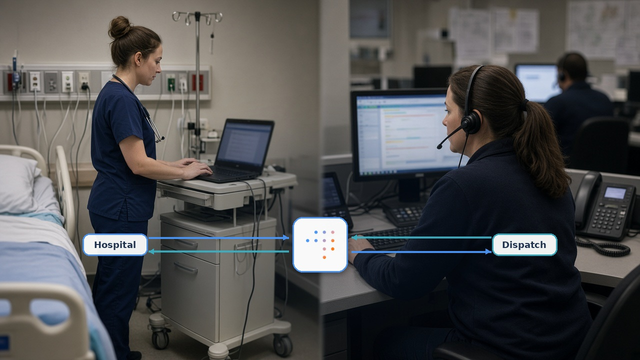
Home health referral at discharge: send it once, close the loop
By Daniel Smith, Guest Writer · October 12, 2026

How hospital staff send a home health referral at discharge, track the agency answer and book the ride home, from the web app, mobile app or EHR.
A home health referral is the order and packet a hospital sends to a home health agency. The agency uses it to accept the patient and set a start-of-care date. The referral is done when the agency accepts and the start of care is on the record. Sending the fax is only the first step.
Until that yes comes back, the ride home and the DME have to wait.
What a home health referral includes
The packet gives the agency what it needs to say yes. Most agencies ask for the same core items:
- The home health order, signed by the physician.
- Face-to-face documentation, when the payer requires it.
- The medication list.
- The discharge summary.
- Insurance details.
- The patient's choice of agency.
Each agency can ask for more. Use the agency's own referral form when it has one. When a page is missing, intake has to call back.
The scene at the hospital desk
The patient is medically ready at 11. The family picked an agency yesterday. The case manager sends the packet and then calls intake to confirm they got it. The line is busy, so she leaves a message.
Then the day moves on. She has other patients. The nurse asks if the patient can go. The family asks when the nurse visit starts. Transport asks what time to come. Each answer depends on one thing she does not have yet: a yes from the agency.
She calls again. Intake needs the updated med list. She sends it. Now she waits for a second yes. The ride home stays unbooked, because nobody wants to send a patient home with no start of care set.
The scene at the intake desk
On the other side, an intake team gets referrals from many hospitals at once. Each one comes in by fax, email, phone or text.
A home health and hospice intake lead described her day to us this way:
"In any given day, there's probably an average of 50 emails and probably 50 [secure texts]. I'm like, there's got to be a better way to do this."
Her field staff add to the load. They visit hospitals and patients, so they are often away from a computer. "That's why I think they default to email and [secure texts]," she said, "because they'll just send messages."
The DME adds another thread. She told us about a recent case on her daily call. A patient was going home from the hospital, and her team had to call the hospital back to make sure the DME was there. The DME company was calling them too. "They're calling back and forth constantly."
Both desks work hard. Each one works from its own inbox. No system shows the status of the referral.
Where the referral stalls
No one owns the answer
The agency can accept, decline, or ask for more documents. Often that answer comes back by phone to whoever picked up. If the case manager is in a family meeting, the answer sits in a voicemail. The patient's record still says "referral sent."
The packet is incomplete, so intake asks again
A missing signature or an old med list stops the referral. Intake asks for it, the hospital sends it, and the clock starts over. Each round trip is another call or another fax. Each one pushes back a discharge that was ready.
The ride and the DME run on a different thread
Transport and equipment are booked by different people, often on different days. The ride can arrive before the agency says yes. The oxygen can arrive after the patient. When these steps live in separate calls, no one sees that they conflict until the patient is home.
Close the loop: one order, one status
Phone, fax and email still work. Every agency can receive them, and they need no setup. The cost is that the status lives in people's heads. A shared order moves the status onto one record. The same people still make the decisions.
Here is a fair way to compare the two. With phone and fax, the case manager knows the referral left the building. She learns the answer when someone calls back. With a shared order, she can open the record and see if the agency accepted or declined. The work to build the packet is the same either way. What changes is the follow-up.
A shared order fits best when a hospital sends many referrals to a set group of agencies. It fits less well for a one-time referral to an agency that does not use VectorCare. In that case, the phone and the fax are still the right tools, and staff should record the answer on the patient's record by hand.
Send the referral once
Staff build the order once in the VectorCare web app or mobile app. Where the EHR supports SMART on FHIR, they can start it from the chart through SoFaaS. The order goes to the agency the patient chose. Staff who are away from a desk can send and check it from the mobile app.
The agency answers on the same record
Home health agencies on VectorCare receive the order and answer on the Hub. Rural hospitals can reach home health vendors on the VectorCare network the same way. The agency accepts or declines, and hospital staff see that status on the same order. Nobody has to call to find out.
Book the ride home on the same order
Once the agency says yes, staff can book the ride home from the same place. At one VectorCare client, the average time to schedule a ride went from 31 minutes to 3. That figure is for ride scheduling only. Transport waits can cause discharge delays, so it helps to book the ride on the same record as the referral.
What VectorCare does not do
VectorCare is software. It is not a home health agency, a broker or a transport company. The hospital chooses and contracts with its agencies and transport providers. The agencies decide whether to accept a patient, and they deliver the care. VectorCare does not replace clinical judgment or the physician's order. It gives both desks one order to work from. For more on how these handoffs fit together, read our guide to patient logistics, or see VectorCare for hospitals.
A short checklist for case managers
Use this before you tell the family a time:
- The patient's choice of agency is recorded.
- The packet is complete, and the order is signed.
- The referral is sent to the chosen agency.
- The agency has accepted.
- The start-of-care date is set.
- The ride home is booked.
- The DME delivery is confirmed.
- Each status is on the patient's record.
If a line is still open, give the family a time range, and say why.
Frequently Asked Questions
What is a home health referral?
A home health referral is the order and packet a hospital or physician sends to a home health agency. The agency uses it to accept the patient and set a start-of-care date.
What should a home health referral include?
It usually includes the home health order, the face-to-face note when required, the medication list, the discharge summary, insurance details and the patient's agency choice. Each agency can ask for more.
Who sends the home health referral at discharge?
Usually the case manager or discharge planner sends it. The physician signs the orders.
When is a home health referral complete?
It is complete when the agency accepts the patient and the start-of-care date is on the record. Sending the packet is only the first step.
Can staff send a home health referral from a phone?
On VectorCare, yes. Staff can send the order from the mobile app or the web app, or from the EHR where it supports SMART on FHIR. The agency answers on the same order.
Is VectorCare a home health agency or a broker?
No. VectorCare is the software. The hospital chooses and contracts with its agencies, and the agencies deliver the care.
If your case managers spend the afternoon calling intake for a yes, request a demo and we will show you the order from both desks.