How One Ambulance Provider Brought Transport Ordering Into Epic
By Daniel Smith, Guest Writer · October 2, 2026 · Updated October 8, 2026
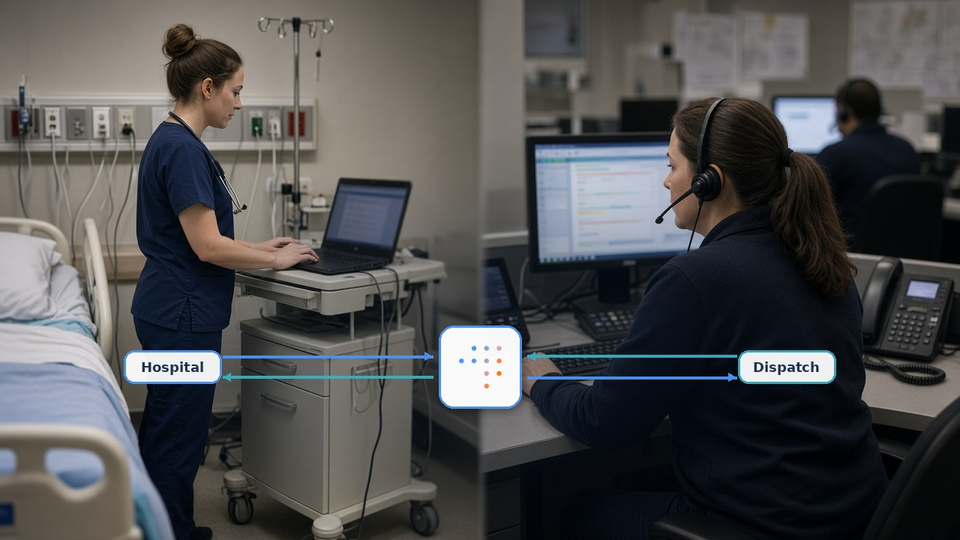
How transport providers can embed ordering directly in the EHR with VectorCare SoFaaS using SMART on FHIR, FHIR R4, and Epic deployment packaging to protect existing business and win new health system accounts.
A regional ambulance provider wanted to make it easier for hospital teams to request, manage, and track transportation without asking staff to leave the patient chart.
The company brought its ordering experience into Epic using VectorCare SoFaaS™ (SMART on FHIR as a Service), a secure technology layer. It kept ownership of its operations, vehicles, crews, customer relationships, and trip fulfillment while giving care teams a simpler way to access its service.
Why It Made the Change
The provider already handled the hard parts of patient transportation: trained crews, ambulance operations, dispatch, clinical protocols, payer requirements, and day-to-day coordination with hospitals.
But its ordering workflow lived outside the EHR.
For hospital staff, requesting a trip meant leaving Epic, opening another portal, logging in, and entering patient information again. That added steps for care coordinators, discharge planners, nurses, and transfer-center teams, especially during high-volume transitions of care.
The provider also saw a larger business risk. Health systems were increasingly asking vendors to fit into the EHR workflow. A standalone portal could make the provider harder to use, even when its on-road service was strong.
The company made the change for two reasons:
- Protect existing hospital relationships. It wanted current customers to continue working with the provider while gaining a more streamlined ordering experience.
- Compete for a new health-system business. It needed a credible answer when prospective customers asked whether transport ordering could begin inside Epic.
What It Did
Rather than building every EHR integration component internally, the provider used the secure technology layer to connect its transport experience to Epic.
That allowed the company to retain control of the pieces that made its business unique:
| The ambulance provider retained | The secure technology layer supported |
|---|---|
| The ordering and trip-management experience | Secure app launch from Epic |
| Dispatch, crews, vehicles, and operations | Patient and encounter context for the request |
| Transport fulfillment and service quality | Authorized, controlled data access |
| The hospital customer relationship | Separation between health-system environments |
| Its brand and commercial model | Audit support and Epic submission preparation |
The company did not become an EHR software company. It continued operating as the ambulance provider. The integration simply made its service easier to access from inside the hospital's normal workflow.
How It Worked
The provider designed the experience around a familiar care-team workflow.
- A staff member opened the patient chart in Epic. The hospital added the provider's app to its Epic environment.
- The staff member launched the transport app from the chart. Instead of navigating to a separate website, the user opened the provider's ordering experience from the patient or encounter they were already working on.
- The request began with available patient context. The app received the information needed to start the transport request, reducing repetitive entry.
- Staff managed the request in the Epic workspace. The provider's app supported the transport workflow, including request review, visibility, and management from within the EHR environment.
- The provider fulfilled the trip. The request flowed to the provider's operations team, which dispatched the appropriate vehicle and crew and completed the transportation service.
The secure connection used commonly adopted healthcare standards:
- SMART on FHIR to open the app securely from the patient chart.
- FHIR R4 to provide the patient and encounter details needed to begin a request.
- OAuth to control authorized access to information.
- Tenant isolation to keep each hospital environment separate.
- Audit support to help support oversight and security.
- Epic submission packaging to prepare the application for the appropriate Epic review path.
What Changed
The provider shifted its story from:
"Use our portal to request transportation."
to:
"Open our transport service from the patient chart you are already using."
For hospital teams, that meant fewer workflow switches and less repetitive information entry.
For the provider, the integration created a more durable position with existing customers and a stronger story for new opportunities. It could demonstrate that it understood not only transportation operations, but also how hospital teams wanted to work.
The company's service model did not change. Its teams still managed dispatch, crews, vehicles, clinical readiness, coverage, and fulfillment. The difference was where the ordering process started. On VectorCare, hospital staff can also order in the web app or mobile app.
What It Did Not Claim
The provider was careful to set realistic expectations.
An EHR connection did not guarantee a fixed Epic approval or go-live date. Epic and each health system controlled their own review, contracting, security, change-management, and implementation processes.
The integration also did not replace clinical judgment, hospital discharge planning, dispatch operations, or vehicle availability. It made the transport provider's service easier to reach inside the EHR. It did not eliminate the real-world work required to deliver a trip.
The Takeaway
This ambulance provider did not pursue EHR integration because it wanted to become a software company.
It did it because the EHR had become the front door to the hospital workflow.
By bringing its transport ordering experience into Epic, the provider made it easier for care teams to use its service, helped protect key health-system relationships, and strengthened its ability to compete for new business while remaining fully responsible for the transportation operation behind every trip.
Frequently Asked Questions
What is VectorCare SoFaaS?
SoFaaS™ (SMART on FHIR as a Service) is VectorCare's compliant SMART on FHIR runtime. It gives healthcare vendors and transport partners SMART launch, OAuth, FHIR R4, tenant isolation, audit support, and Epic Showroom packaging without building that stack alone. The partner still owns UI, ops, and the customer relationship.
Is VectorCare the transport provider in this pattern?
No. VectorCare provides the SoFaaS / SMART on FHIR rails. The transport service provider fulfills trips and owns the customer relationship. VectorCare is not a broker and not a transport company.
What does the transport provider still own after an EHR embed?
The provider owns the app UI care teams see, day-to-day ops and fulfillment, and the health-system customer relationship. SoFaaS covers the compliant runtime and packaging path into Epic. Responsibility stays split on purpose.
How does embedding in the EHR help defend existing hospital accounts?
When health systems require in-chart ordering, a portal-only provider risks losing renewals even with strong on-road performance. An embedded SMART experience keeps staff in the EHR and keeps the provider as the named fulfillment partner for the current book.
How does the same embed help win new health-system business?
Prospects increasingly evaluate whether transport shows up inside the chart. A packaged SMART experience and Showroom path let the provider sell "open from the patient you are on" instead of "add another portal." That changes competitive position for new logos.
Does SoFaaS guarantee an Epic Showroom listing in a fixed number of weeks?
No. SoFaaS prepares the Epic Showroom submission package. Epic's review queue sets the listing date.
What results has this setup shown?
At one client, staff took 31 minutes on average to schedule a ride. After ordering moved into the chart, the average dropped to 3 minutes. This story does not report trip counts or revenue.
How should a transport provider start a partnership conversation?
Start at vectorcare.dev. Choose SoFaaS, For vendors, or Talk to us. We will walk you through SMART launch and Epic packaging.