Hospital to home care: three handoffs that must meet at the door
By Daniel Smith, Guest Writer · October 28, 2026

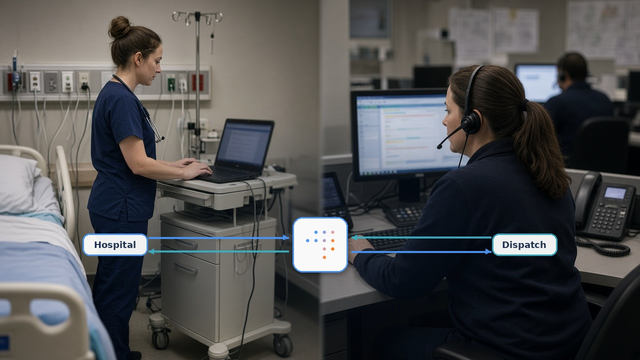
Hospital to home care is complete when three handoffs meet at the door: the home health visit, the ride home and the equipment. Here is how to put them on one record.
Hospital to home care is the move of a patient from a hospital bed to care at home. It is complete when three things meet at the door: the home health visit is accepted, the ride home is booked, and the equipment is confirmed. Each one usually runs on its own phone call or fax. VectorCare is software that puts all three on one request, used by 2,500+ healthcare facilities.
The medicine is done. The logistics are not.
What hospital to home care means
Hospital to home care is a handoff, not a place of care. It starts when the physician decides the patient can go home with support. It ends when the patient is home and the agency, the ride and the equipment are in place.
Many people do this work. The case manager or discharge planner runs the handoff. The physician signs the orders. The patient chooses the home health agency. The agency, the ride provider and the DME supplier each confirm their own part.
In clinical terms, the move from hospital to home is one of the transitions of care. Each person has a clear job. The problem is that each job has its own status, and nobody sees all three at once.
Hospital to home care is not hospital at home
The two terms sound alike, but they mean different things. Hospital at home gives acute care in the patient's home instead of a hospital bed. Hospital to home care is the handoff out of the hospital after the stay. This article is about the handoff.
The scene at the door
The discharge order is signed at 10. The patient is dressed and sits on the edge of the bed. The bag is packed.
The case manager sent the home health referral at 8. The agency has not answered. She left a message with intake.
The ride is a callback. Transport said they will call back with a time. Then they called and said "two hours out."
The oxygen is "on the way." Nobody can say if it will be at the house before the patient.
The family asks for a time. The nurse asks for a time. Nobody can give one. The case manager has three open threads and a phone in her hand.
No one did anything wrong. The patient is ready. The door is not.
Three handoffs when discharging to home care
When discharging to home care, three handoffs must meet at the same time. If one is late, the patient waits.
1. The home health visit
The hospital sends a home health referral to the agency the patient chose. The agency reviews it and accepts or declines. Then the agency sets the start of care. Until the agency says yes, the rest of the plan is a guess. The referral post covers the packet and how to close the loop with the agency.
2. The ride home
Some patients go home with family. Many need a wheelchair van, a stretcher van or an ambulance. Staff have to book the ride home at the right level of service and for the right time. When the ride is a phone call, the time can change and nobody on the unit knows. At one VectorCare client, the average time to schedule a ride went from 31 minutes to 3 minutes. That figure is for ride scheduling only.
3. The equipment
The patient may need oxygen, a hospital bed, a walker or other DME at home. The supplier must deliver it and set it up before the patient arrives, or at the same time. If the oxygen comes after the patient, the family has a problem on the first night.
Why care transitions stall on logistics
Each handoff runs on its own thread. The referral goes by fax. The ride goes by phone. The DME goes by a second phone call, often to a different person.
So there are three statuses. Each status lives in someone's head, a voicemail or a sticky note. The case manager has to call each party to learn where things stand. When one thread moves, the others do not know.
This is why a patient can be medically ready and still not leave. The delay is in the threads, not the medicine. Ride waits can cause discharge delays.
The fix is not more calls. The fix is one place where all three threads meet.
Put the three handoffs on one record
Hospital to home care works better when the referral, the ride and the equipment sit on one request. Here is how that works on VectorCare.
- Start one request where staff work. Staff use the VectorCare web app, the mobile app, or the EHR where it supports SMART on FHIR. Staff away from a desk can send and check the request from the mobile app.
- Send the referral to the agency the patient chose. Home health agencies on VectorCare receive the request and answer on the Hub. Hospital staff see the answer on the same record.
- Add the ride and the DME to the same request. The ride and the equipment order each show their own status next to the referral.
- Check the status before you give the family a time. The case manager opens one record. She sees if the agency accepted, if the ride is booked and if the DME is confirmed.
See how hospital teams run home health care coordination on one request.
The people and the decisions stay the same. What changes is the follow-up. The case manager does not call three parties to learn three answers.
VectorCare is software. It is not a home health agency, a broker or a transport company. The hospital chooses and contracts with its agencies, ride providers and suppliers. The agency decides whether to accept a patient, and it delivers the care. VectorCare does not replace the physician's order or clinical judgment. It gives every party one request to work from. For more on how these handoffs fit together, read our guide to patient logistics.
A short check before the patient leaves
Ask three questions before you give the family a time:
- Did the agency accept, and is the start of care set?
- Is the ride home booked at the right level of service?
- Is the equipment confirmed for delivery to the home?
If one answer is no, give the family a time range, and tell them why.
Frequently asked questions
What is hospital to home care?
It is the move of a patient from a hospital stay to care at home. It is complete when the home health visit is accepted, the ride home is booked and the equipment is confirmed.
Is hospital to home care the same as hospital at home?
No. Hospital at home gives acute care in the patient's home instead of a hospital bed. Hospital to home care is the handoff out of the hospital after the stay.
Who coordinates hospital to home care?
Usually the hospital case manager or discharge planner. The physician signs the orders, the patient chooses the agency, and the agency, the ride provider and the DME supplier each confirm their part.
Do your case managers spend the afternoon on three phone threads for one patient? Request a demo, and we will show you the referral, the ride and the DME on one request.