NEMT electronic verification: what H.R. 10618 would ask of each trip
By Daniel Smith, Guest Writer · October 29, 2026
H.R. 10618 is a proposed bill. If enacted, it would require electronic verification for Medicaid NEMT trips on or after January 1, 2027. Here is what that means for each trip record.
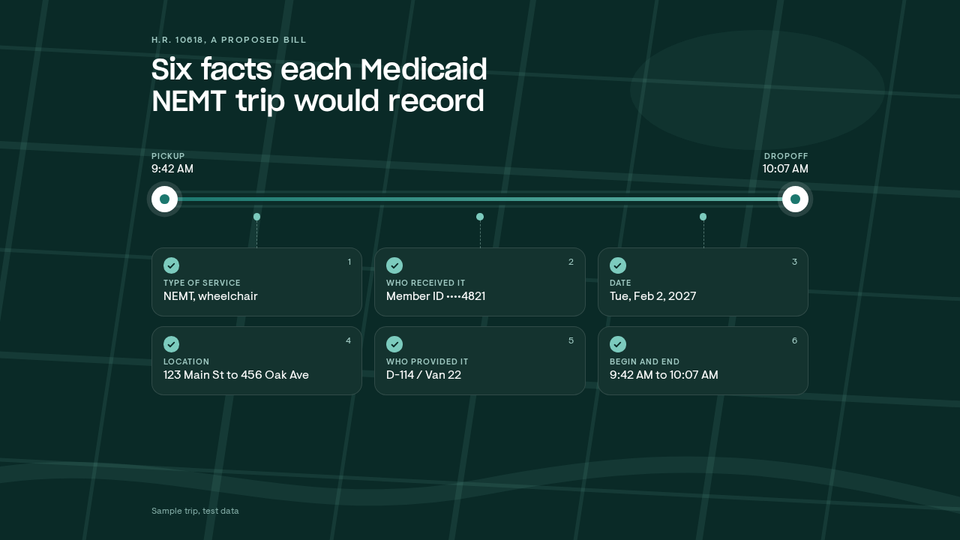
H.R. 10618, the STOP Medicaid Fraud Act of 2026, is a proposed bill. If it becomes law, states would have to require electronic verification of Medicaid non-emergency transportation and applied behavior analysis services furnished on or after January 1, 2027. Each service would be verified for the six data elements of electronic visit verification (EVV), which Medicaid already requires for personal care and home health visits.
Status as of October 29, 2026: introduced September 28, 2026 and referred to the House Committee on Energy and Commerce.
The bill would require nothing today. It can change, and it may not pass. But it shows what Congress could ask of each NEMT trip record. This post maps the six facts onto one ride.
What H.R. 10618 says
All facts below come from the bill text and congress.gov.
- Name. The "Strengthening Tools for Oversight to Prevent Medicaid Fraud Act of 2026," or the "STOP Medicaid Fraud Act of 2026."
- Sponsor. Rep. Gabe Evans (R-CO-8). Rep. Jeff Crank (R-CO-5) and Rep. Lauren Boebert (R-CO-4) signed on as cosponsors on October 5, 2026.
- Status. Introduced. It has not passed either chamber.
- Services. "Non-emergency transportation services and applied behavior analysis services" under a state plan or a waiver. This post covers transportation only.
- The rule. A state would have to require an electronic verification system for these services furnished on or after January 1, 2027.
- If a state is not in compliance. The HHS Secretary would send a notice. Within 90 days, the state would send a corrective action plan. The plan would show how the state would comply within 1 year of the notice.
- How states would build it. The bill uses the current EVV setup rules in section 1903(l)(2). The state would consult with providers so the system is minimally burdensome, takes into account systems already in use in the state, and follows HIPAA privacy and security law. The state would also take input from beneficiaries, family caregivers, providers and others. Providers would get the chance to train.
- Exemption. A state would be exempt if, on the date the bill becomes law, it already requires electronic verification of these services. The exemption would last while the state keeps that requirement.
What the bill does not say
- It does not name GPS or any other technology. It names only the facts to verify.
- It does not say how "location" or a begin and end time applies to a trip that moves between two places.
- It does not say if a state that verifies only transportation, and not applied behavior analysis, is exempt. That question is open.
If the bill becomes law, CMS guidance would have to fill these gaps.
How electronic visit verification works today
Electronic visit verification (EVV) is the current Medicaid rule for home care visits. Section 12006 of the 21st Century Cures Act added it to section 1903(l) of the Social Security Act. It applies to personal care services from January 1, 2020 and to home health care services from January 1, 2023. The CMS EVV page explains the program.
Section 1903(l)(5)(A) lists six facts to verify for each visit. H.R. 10618 points to the same six. VectorCare does not run personal care or home health EVV.
The six facts, applied to one NEMT trip
The left column is the statute. The middle column is our reading of how each fact could apply to a ride. CMS has not issued guidance on this. The right column is what a VectorCare trip record holds today.
| Fact in 1903(l)(5)(A) | What it could mean for a trip | What the VectorCare trip record holds |
|---|---|---|
| Type of service performed | The level of service: ambulatory, wheelchair or stretcher | Level of service recommended from the record, with overrides logged |
| Individual receiving the service | The member on the order | The member on the order, with eligibility checked at the order |
| Date of the service | The trip date | The date of service on the order and the completion record |
| Location of service delivery | The pickup and the dropoff | GPS-timestamped pickup and dropoff |
| Individual providing the service | The driver, and the vehicle | The assigned driver and vehicle, from credentialed providers |
| Time the service begins and ends | Pickup time and dropoff time | Pickup and dropoff time stamps |
The bill does not require GPS. GPS is how VectorCare records pickup and dropoff. A state could choose a different method.
Each completed trip on VectorCare has one record. It holds the order, the eligibility check, the provider and its credentials, the GPS pickup and dropoff, and signed forms. Where the program requires a PCS form, staff complete it with an electronic signature on the order. Orders start in the VectorCare web app, the mobile app or the EHR, through SMART on FHIR where the EHR supports it. See how the checks work on NEMT fraud, waste and abuse prevention.
Why a GPS point alone does not prove a ride
A location point shows where a device was. It does not show that a member rode, or that the ride was ordered. GPS data can be faked. Read why a GPS trail alone is not proof. On VectorCare, GPS is one signal. It is tied to the order, the assigned driver and vehicle, the time stamps and the completion record. Trips with no qualifying appointment, missing proof, or mileage variance are flagged before claims pay.
Who keeps the trip record
In many programs, the broker holds the trip data. The state sees the result, not each step.
VectorCare is software rails and a network. It is not a broker or a transportation provider. Keep your broker or not. VectorCare works with a broker program or with directly contracted providers, with the same trip record in each case. If a broker joins, leaves or is replaced, the state keeps every order and trip record. See state Medicaid transportation integrity and NEMT trip requests, with a broker or without one.
A record that starts in the clinical workflow is easier to trust than one built from a fax. Read about ending fax in NEMT.
What states, plans and providers can check now
Gaps in trip records are not new. A 2021 HHS OIG audit of one state's NEMT program found that 86 of 100 sampled service lines did not comply with certain federal and state requirements. For all 100 sample items, driver and vehicle records were not well documented. OIG recommended matching each ride to a medical service on the same day.
This is preparation, not compliance. There is no rule yet. Three questions to start:
- Can you produce all six facts for a sampled trip?
- Who holds the record: the state, the plan, the broker or the provider?
- Is the record made at the order, or rebuilt after the trip?
For program integrity units, VectorCare gives a per-trip evidence packet, standing reports on documentation rates and GPS coverage, and provider scorecards built from verified trips.
This post is not legal advice. For how the bill would apply to your program, ask your counsel or your state Medicaid agency.
Frequently asked questions
What is the STOP Medicaid Fraud Act?
H.R. 10618 is a proposed federal bill, introduced September 28, 2026. It would require states to use electronic verification for Medicaid non-emergency transportation and applied behavior analysis services.
Is H.R. 10618 law?
No. As of October 29, 2026, it is a proposed bill. It was introduced and referred to the House Committee on Energy and Commerce, and it has not passed either chamber.
When would electronic verification for NEMT start under H.R. 10618?
If enacted, it would apply to non-emergency transportation services furnished on or after January 1, 2027. A state found out of compliance would have 90 days to send a corrective action plan, and 1 year from the notice to comply.
What does electronic verification have to confirm for each trip?
The bill uses the six EVV facts in current law: the type of service, the person who receives it, the date, the location, the person who provides it, and the begin and end time. How each fact applies to a moving trip would need CMS guidance.
Which states would be exempt from H.R. 10618?
A state that already requires electronic verification of these services when the bill becomes law would be exempt while it keeps that requirement. The bill covers NEMT and ABA, and it does not say if a state that verifies only NEMT is exempt.
Does H.R. 10618 require GPS?
No. The bill does not name GPS or any other technology. It lists six facts to verify, including the location of service delivery and the start and end times. GPS time stamps at pickup and dropoff are one way to capture them.
How does VectorCare verify an NEMT trip?
Each trip starts from an order with eligibility and level of service checked. It goes to credentialed drivers and vehicles. It closes with GPS-timestamped pickup and dropoff, and signed forms where the program requires them, on one trip record.
Next step
See how a trip record holds each fact. Or read about state Medicaid transportation integrity.
Sources