Why Hospital Evacuation Plans Fail at the Transport Layer
By Daniel Smith, Guest Writer · May 18, 2026 · Updated September 28, 2026
Most hospital evacuation plans look great on paper. The binder is thick. The drill is annual. The MOUs are signed. Then a wildfire jumps a ridge or a hurricane bends north, and the gap between the plan and the operation becomes painfully visible — usually at the transport layer.
The plan says ambulances will arrive. It does not say which vendor has units available at 3 a.m., what level of care those units can carry, which receiving facility has accepted the patient, or whether any of that information lives in the same system as the patient's medical record. That is where mass movement events fall apart.
The Compliance Floor Is Not the Operational Ceiling
The CMS Emergency Preparedness Rule (42 CFR 482.15) requires hospitals to maintain safe evacuation procedures, transportation arrangements, identification of evacuation locations, and primary and alternate means of communication with external assistance. The rule also mandates resource inventories and vendor or MOU documentation for re-supply and patient transfer, with the training and testing program reviewed at least every two years.
The rule sets the floor. It does not describe how a 200-bed hospital actually moves 200 patients at 2 a.m. with half the staff already under evacuation orders. That gap — between the audit-ready binder and the operational reality — is where every recent post-incident report ends up pointing.
A Vendor List Is Not a Vendor Network
ASPR TRACIE has reviewed hospital evacuations from Sandy through Helene. The pattern is consistent. Reports cite multiple cases of poor regional coordination of hospital resources during disaster-induced evacuations and recommend pre-event mapping of critical care capacity, specialty resources, and ground and air transport — reported into a centralized command structure that can dispatch based on volume, severity, and special needs.
That recommendation has been in print for over a decade. It keeps appearing in After-Action Reviews because the underlying infrastructure to execute it has not existed. A folder of signed MOUs is not a dispatchable network. A spreadsheet of vendor phone numbers, updated quarterly, is not a real-time view of capacity. When a fire is in the parking lot, nobody is opening SharePoint.
The Transport Layer Is Where Plans Break
During the January 2025 Eaton Fire in Los Angeles County, Huntington Hospital in Pasadena remained operational while the fire burned through nearby neighborhoods. Within three days, roughly half of the hospital's staff were under their own evacuation orders. Nearby skilled nursing facilities evacuated seniors by ambulance as embers swirled around the loading bays.
Huntington did not evacuate. But the regional system around it bent under the load. Ambulance units were pulled from interfacility transport queues into evacuation duty, and nobody had a live picture of where the units were or what they were carrying. The system functioned because individual coordinators worked the phones for three days straight, not because the infrastructure worked.
The 2012 Hurricane Sandy NICU evacuation, still cited in current CHEST consensus statements on critical care evacuation, surfaced the same pattern at a higher acuity. Clinical teams knew how to package a critically ill neonate. Finding the right transport, at the right level of care, at the right moment in the queue, with a receiving NICU that had an open isolette — that was the failure mode. Not clinical preparedness. Logistical visibility.
Patient-by-Patient Decisioning at Scale
The CHEST consensus statement on ICU evacuation describes a three-stage timeline: no immediate threat, evacuation threat, and evacuation implementation. At every stage, the underlying question is the same — which patient goes where, on what vehicle, with what crew, accepted at which facility, in what sequence.
A 200-bed hospital does not face one of those questions. It faces 200 of them, simultaneously, with constraints that change every fifteen minutes. ICU patients need critical care transport. NICU patients need temperature-controlled transport with specialized crews. Ambulatory med-surg patients can move via NEMT or contracted shuttle. The mix matters, and the mix has to match the vendor inventory in real time.
Children's National ran NICU evacuation drills between 2015 and 2017 and dropped evacuation times from 21 minutes to 16 minutes for a single 66-bed unit. That improvement matters. It also assumes a single unit, full staffing, daylight, and no competing events elsewhere in the building. A real mass movement event pulls every unit at once, with reduced staff, often at night, with the regional ambulance pool already drawing down.
How VectorCare Approaches Mass Movement
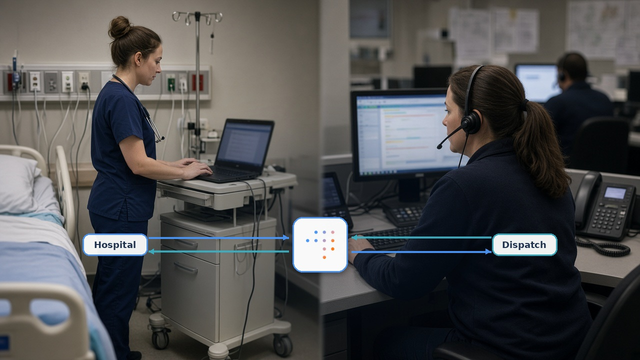
VectorCare's Mass Movement application is built on SMART on FHIR and runs inside Epic. The patient census, acuity, special needs, and equipment requirements flow from the EHR — not from a parallel spreadsheet that is already stale before the first ambulance arrives.
Before an event, the hospital's vendor network — ground ambulance, critical care transport, air ambulance, NEMT for ambulatory patients — is mapped against vehicle types, crew certifications, regional coverage, and surge availability. The MOUs the CMS rule requires become a dispatchable network rather than a binder.
During an event, dispatch runs against the live network. Each leg of every patient's movement ties back to the medical record. Receiving facilities see the same view the sending hospital sees. The command center is looking at one screen, not five.
After the event, the timeline assembles itself. Every dispatch, every patient movement, every MOU activation, every receiving acceptance — all in one report, ready for regulators, for the After-Action Review, and for the next plan revision. That post-incident view is most of the work that does not get done today because the data lives in seven different places.
None of this replaces the hospital's evacuation plan. It turns the plan into an operating system. The rails, not the train.
The Path Forward
The compliance baseline catches up to operational reality one disaster at a time. Coastal hospitals learned this lesson after Sandy. California hospitals are learning it now. Hospitals on the Gulf already know it, and they are pushing for better infrastructure because the next named storm is always closer than the last drill.
Patient transport infrastructure has to be treated like critical infrastructure — mapped, wired into the EHR, exercised against the live system, and ready before the alarm. A static binder is not infrastructure. A live network is.
Explore how VectorCare's Mass Movement application helps health systems turn evacuation plans into operational infrastructure inside Epic — because the difference between a good plan and a successful evacuation is whether the transport layer works when it matters.