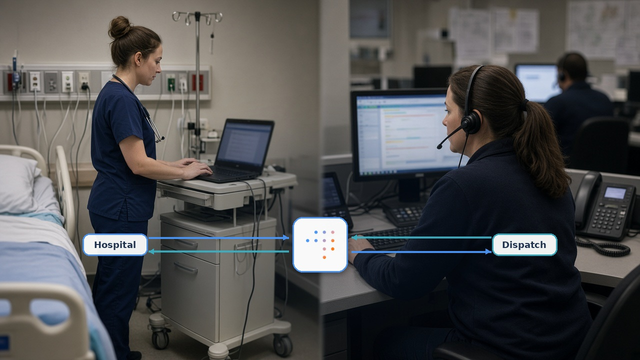
Where the First Hour Goes in Interfacility Air Ambulance Dispatch
By Daniel Smith, Guest Writer · April 29, 2026 · Updated September 16, 2026
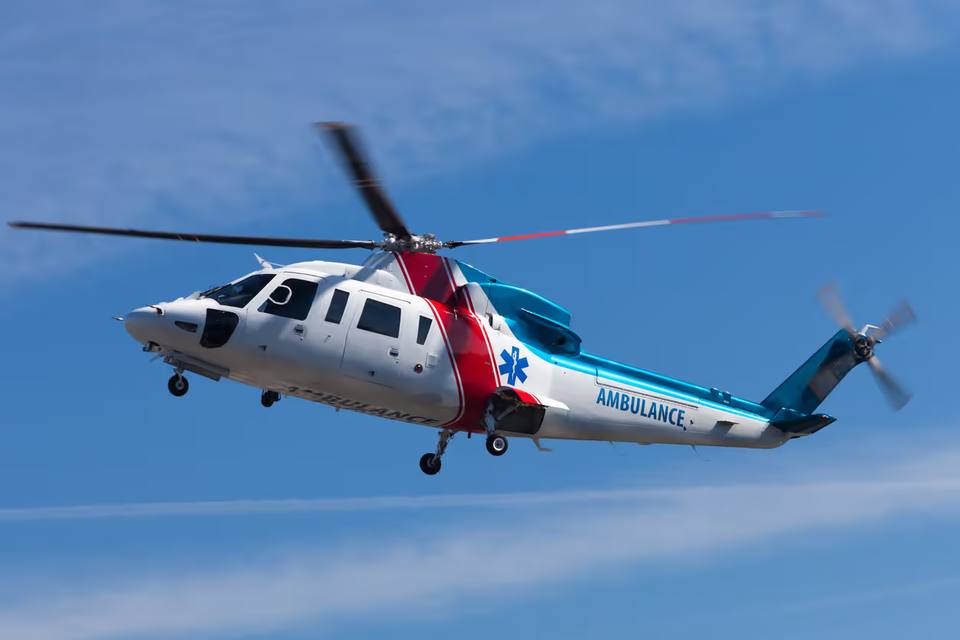
I worked a transfer center desk for an hour last month. A community hospital had a STEMI in their ED. They wanted air transport to a tertiary center 84 miles away. The clock on door-to-balloon was already running.
The receiving cath lab said yes in under two minutes.
Wheels were not up for fifty-three.
That gap is the part of interfacility air ambulance dispatch nobody likes to talk about. Bed acceptance moves fast. Plane finds runway slowly. Then the patient sits while the workflow catches up.
This is what happens inside that hour. Where the time goes. Why the phone tree survives in 2026. And what changes when you replace the workflow with an instrumented one.
What "interfacility air ambulance dispatch" actually means
Interfacility air ambulance dispatch is the coordination work between the moment a sending hospital decides a patient needs air transport and the moment the aircraft lifts. It is not the flight. It is not the bed acceptance. It is the operational seam in between.
Most hospitals run this seam through a transfer center. Bigger systems route everything through a central comms center. Smaller hospitals still hand it to the charge nurse with a phone and a printed list of carrier numbers.
The work itself looks like this. Confirm bed acceptance and accepting MD. Choose the airframe based on distance, weather, weight. Source a provider with the right airframe available now. Confirm crew configuration (BLS, ALS, CCT, neonatal, ECMO). Coordinate ground legs on each end. Verify weather minimums and IFR/VFR. Capture insurance and authorization. Hand off the patient record to the flight crew. Track the asset and update both EDs in real time.
In a fast hospital with a strong transfer center, that takes 30 to 45 minutes. In a slower one, it takes 90 minutes or more. The variance is operational, not clinical.
Where the time actually goes
I asked five flight coordinators and three transfer center directors to walk me through their last ten interfacility air dispatches with a stopwatch on the timeline. Sample size is what it is. The pattern was consistent.
Provider sourcing: 12 to 25 minutes. Calling carriers one at a time. Waiting for them to check fleet availability. Getting a "let me call you back" twice. Realizing the first carrier on the list is offline for crew rest. Restarting at carrier two. This is the single biggest time sink and the easiest one to instrument.
Weather and airframe decision: 5 to 15 minutes. Rotor or fixed-wing. Weather minimums per carrier. Pilot discretion. Many transfer centers still pull METARs in a separate browser tab while the carrier asks the same questions on the phone.
Crew and configuration confirmation: 5 to 10 minutes. ECMO requires a specific crew. Neonatal needs an isolette. CCT means an additional RN. The phone conversation re-validates information the EHR already knows.
Authorization and payer: 5 to 20 minutes. Sometimes ten minutes. Sometimes the carrier insists on a Letter of Authorization before lifting. CMS Interpretive Guidelines do not require pre-auth for emergent transports, but commercial payer rules vary, and risk-averse compliance teams hold the plane.
Patient handoff: 5 to 10 minutes. Verbal report from sending physician to flight medical control. Often duplicated when the flight crew arrives. Repeated again when receiving service rounds.
These are not theoretical numbers. Association of Air Medical Services member data and the published interfacility transport literature put national median dispatch-to-launch times for non-urgent interfacility flights between 35 and 50 minutes for organized programs, and well past 60 for ad hoc coordination. For STEMI transfers, the door-to-balloon clock sits at 90 minutes by AHA guideline. Every minute lost in dispatch is a minute the receiving cath lab cannot recover.
Why the phone tree still wins in 2026
Three reasons.
First, interfacility air ambulance dispatch lives at the intersection of three systems that historically do not talk: the sending hospital EHR, the receiving hospital EHR, and the carrier's CAD. None of them speak FHIR to each other natively. Most carriers run dispatch software designed for 911 response, not for interfacility coordination.
Second, the people doing the work are good at the phone tree. A flight coordinator with twelve years on the desk knows which carrier answers fast, which one is honest about ETA, which one cancels at the gate. That tacit knowledge is real, and it has not had a digital equivalent.
Third, contracts. Many hospitals signed exclusive provider agreements years ago. The phone tree is a one-name list. There is nothing to instrument when the answer is always carrier A.
That last one is changing. CMS price transparency rules, the air ambulance cost data the No Surprises Act now requires carriers to report, and the multi-provider Air Ambulance Marketplace model are pushing health systems toward open networks. Once you have more than one carrier on the menu, the phone tree starts to break under its own weight.
What instrumented dispatch looks like
The ingredients are not exotic. They have been sitting in adjacent industries for years.
A live availability layer. Each contracted carrier publishes airframe status, crew config, ETA from base, and quote in near real time. A dispatcher sees four options instead of dialing four phones. Commercial logistics moved here a decade ago. Healthcare is finally arriving.
SMART on FHIR in the EHR. The transfer center launches a dispatch app inside Epic or Oracle Health, pre-loaded with the patient context. Weight, current vitals, clinical needs, sending unit, accepting service, accepting MD, payer. The dispatcher does not retype anything. The carrier does not ask for it twice.
One log of record. Time stamps captured at each handoff. Who confirmed what at what minute. Reportable to QA, the medical director, the ED chief, and the system COO without anyone exporting a spreadsheet.
Closed-loop status. When the aircraft lifts, both EDs see it. When weather scrubs the rotor and a fixed-wing reroute happens, the receiving service is in the loop before the patient asks why.
This is the architecture VectorCare's Air Ambulance Marketplace runs on. Not because it is novel. Because it is the obvious shape of the work once you stop assuming a phone tree.
What changes when you fix this
Three numbers move.
Dispatch-to-launch falls. In customer programs we have stood up, the median has moved from the 45 to 60 minute range to under 25. The variance is what really matters. The 90-minute outlier flights stop happening. Those are the ones that turn into M&M cases.
Cost transparency improves. When four carriers quote on the same patient profile in the same screen, the unit-economics conversation changes. Some carriers come down. Some get cut. Health systems we work with renegotiate contracts within the first quarter on data they did not previously have.
Documentation gets stronger. The transfer center used to track this in three places: the EHR note, a paper log, and the dispatcher's memory. The instrumented version writes once. Joint Commission survey teams find the documentation faster, and the medical director gets quarterly trend data without a separate request.
What the first 60 days actually look like
Health systems sometimes assume this is a multi-quarter integration. It is not. The Air Ambulance Marketplace is a SMART on FHIR app. Standing it up looks like this.
Days 1 to 14. Connect Epic or Oracle Health. Configure the carrier panel. Define the dispatch SOP. The app already knows your bed board, your accepting services, and your payer mix.
Days 15 to 30. Shadow operation. The transfer center runs the marketplace in parallel with the phone tree. Coordinators see both. Time stamps capture both. Differences become a training input.
Days 31 to 60. Cut over. The phone tree becomes the backup. Carriers without the integration get a deadline. Reporting becomes the standard operating tool for the medical director and the COO.
The work is not the technology. The work is the change management. We have done this enough times to know which workflows resist and which ones snap into place quickly.
What to do this quarter if you run a transfer center
Pull your last 50 air dispatches. Time-stamp them at four points: decision, carrier confirmed, wheels up, wheels down. The distribution will tell you most of what you need to know.
If the median dispatch-to-launch is over 30 minutes, you have a workflow problem, not a clinical one.
If the variance is over 20 minutes, you have a coordination problem, not a carrier problem.
If you are doing this in 2026 and your transfer center has more than two browser tabs open during a dispatch, the phone tree is costing you more than you have measured.
The fix is not heroic. It is just instrumentation.