The Three Layers of Healthcare Logistics Intelligence
By Daniel Smith, Guest Writer · April 21, 2026 · Updated September 16, 2026

The Architecture of Optionality
Most healthcare IT implementations are all-or-nothing. You buy a system, implement it, and hope it solves your problem. If it doesn't, you're trapped. Rip and replace is expensive. Switching costs are high. You're locked in.
There is a different approach. Design for optionality—the ability to add capability incrementally, with each layer enabling the next, and each layer increasing switching costs in your favor.
This is the three-layer model.
Layer 1: FHIR Integration (Data In and Out)
The foundation is connectivity. FHIR is the industry standard for healthcare data exchange. It's not sexy. It's not AI. But it's critical.
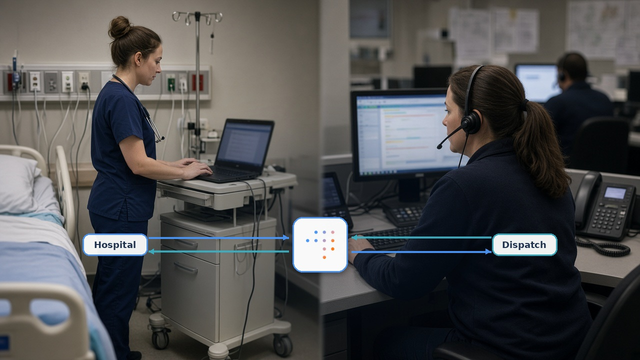
What it does: FHIR integration connects your EHR—Epic, Cerner, whatever you use—to your logistics system. It reads scheduled procedures, patient demographics, acuity information, location data. It pushes back transport status, real-time location, arrival confirmations.
Why it matters: Without this, your transport system is an island. Drivers call back updates via radio. Nurses manually log transport status into Epic. Information is always stale. The EHR doesn't know when a patient is actually in transport. The transport system doesn't know when a procedure was rescheduled.
With FHIR integration, data flows bidirectionally in real time. The EHR becomes the source of truth for demand. The transport system becomes the source of truth for execution and status.
Switching cost: Once FHIR integration is in place, you've solved the connectivity problem. Your data is flowing. Replacing this layer alone means rebuilding integrations, which is non-trivial. This is your first lock-in point.
Timeline: 4–8 weeks to design, integrate, test, and validate FHIR connections.
Layer 2: Workflow Automation (Rules-Based Logic)
The second layer is rule-based automation. This is where operational logic lives.
What it does: Rules define how the system should behave. When a surgical procedure is scheduled, automatically generate a transport request. When a patient is marked as ready for pickup in the EHR, trigger a priority alert. When an ambulance is within 5 minutes of arrival, notify the receiving unit. When on-time performance drops below SLA for two consecutive days, escalate to operations leadership.
These aren't hard-coded. They're configurable. You write the rules. You modify them. You version them. You see what changed and when.
Why it matters: Human coordination works until it doesn't. When volume exceeds capacity, or when something changes, humans miss stuff. A rule-based system doesn't forget. It executes consistently. It scales without proportional increase in overhead.
Real example: At one health system, manually coordinating dialysis transport pickups was causing 12% to miss their SLA. The main issue: clinicians updated patient readiness in Epic, but dispatchers weren't always notified. The fix: a simple rule. When readiness status changes in Epic, automatically send a transport request with priority flagged. Within one week, on-time rate climbed to 94%. The rule did what three coordinators couldn't do—it never forgot to check.
Switching cost: Once you've encoded your operational logic in rules, migrating those rules to another system is possible but not trivial. You've also started building organizational memory—the logic documents how your organization actually works. The cost of switching isn't just technical; it's operational. You'd have to rebuild this institutional knowledge somewhere else.
Timeline: 6–12 weeks to identify core rules, implement them, test, and stabilize.
Layer 3: Autonomous Optimization (Self-Improving Agents)
The third layer is where autoresearch lives. This is continuous optimization.
What it does: Once FHIR integration is flowing data and rules are executing your operational logic, the system has enough context to optimize. Agents continuously analyze performance, identify failure modes, propose policy changes, test them, and measure impact. They do this daily, without human intervention.
The policies they improve aren't just routing rules. They're all the parameters that define how your transport network operates: priority queues, time estimates, acceptable wait thresholds, when to call additional vehicles, how to handle exceptions.
Why it matters: Rules are static. Optimization is dynamic. Your network changes constantly. Demand patterns shift seasonally. Staff turnover creates new constraints. Construction reroutes traffic. Weather varies. A rule that was optimal in January might be suboptimal in July. A policy tuned for normal capacity might fail under surge.
Autonomous optimization adapts continuously. It's like having a full-time operations analyst who runs experiments daily and tells you what works.
Real impact: In healthcare, a 5% improvement in on-time arrival compounds into 15–20% improvement in OR utilization, which compounds into meaningful revenue and compliance gains. But getting that 5% improvement requires daily, granular tuning. No human operation manages that at scale. Autoresearch does.
Switching cost: This is where switching costs become asymmetric. After six months of continuous optimization, your system has accumulated six months of contextual learning. Every adjustment has been tested against your specific network, your specific demand patterns, your specific constraints. You have institutional memory encoded in your policies.
A competitor could deploy the same framework. But they'd start at zero. They'd need six months to catch up to where you are. By then, you've optimized another six months further. The gap doesn't close—it widens.
Timeline: 8–12 weeks to set up agents, define metrics, build simulators, and run initial optimization cycles. But the value compounds over months and years.
Why This Sequence Matters
You could theoretically try to skip to Layer 3 and ignore Layers 1 and 2. It wouldn't work. Layer 3 requires high-quality data flowing reliably (Layer 1) and trustworthy operational logic (Layer 2). Without those, autonomous optimization has no foundation.
Conversely, you don't need Layer 3 to benefit from Layer 2. Rule-based automation alone solves real problems and improves outcomes. Many health systems would benefit enormously from just getting Layer 2 right.
But the architecture is designed so that each layer enables the next. You start with connectivity. You build rules on top of that connectivity. Then you build optimization on top of those rules.
Each layer increases your switching cost—not in a negative way, but as a natural consequence of solving problems and building value. After Layer 1, you've solved connectivity. After Layer 2, you've encoded your operations. After Layer 3, you've built six months of accumulated optimization that no other system has.
The Institutional Memory Advantage
Here's what most people miss about continuous optimization: it's not just about squeezing out percentage-point improvements. It's about building institutional memory.
When a new operations director comes in, they need to learn how the system works. What are the constraints? What are the trade-offs? Why do we do things this way? With a rule-based system, some of that is documented. With an optimized system, it's baked in.
Your system has learned—through thousands of micro-experiments—what policies work in your network. Why certain routes perform better at certain times. Which constraints are hard and which are soft. Where the real bottlenecks are. This knowledge is valuable and it's yours.
When staff turnover happens, when volume patterns change, when new facilities open—your system adapts. It doesn't require hiring a consultant or rebuilding from scratch. It iterates toward optimal performance in the new environment.
This is the strategic advantage of the three-layer model. Not automation for its own sake. But automation that learns and improves continuously, building your organization's unique operational knowledge over time.