Administrative spending hit $950 billion in 2019, accounting for 15–25% of total U.S. healthcare expenditures. Healthcare automation platforms exist to reclaim that waste—and the organizations moving fastest are the ones that understand which automation categories actually matter for their operations.
This guide covers the major types of healthcare automation platforms, the workflows they address, how to evaluate them, and why patient logistics automation is a category that most guides miss entirely.
Key Takeaways
- Administrative costs consume 15–25% of total U.S. healthcare spending, with $21 billion in additional savings still available through full automation
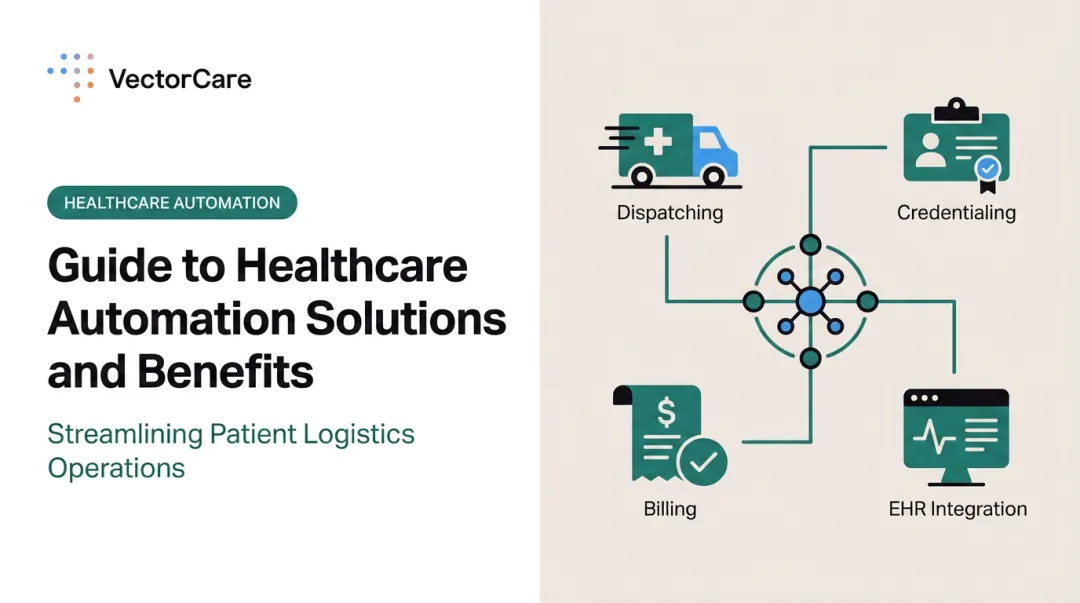
- Healthcare automation spans five distinct categories: clinical workflow, revenue cycle, patient engagement, compliance, and patient logistics
- Physicians spend nearly half their office time on EHR and desk work—not on patients
- Patient logistics automation is the most overlooked category—yet transport delays drive longer stays, readmissions, and worse outcomes
- EHR integration and HIPAA compliance are non-negotiable requirements for any automation platform worth evaluating
What Is a Healthcare Automation Platform?
A healthcare automation platform is software that uses AI, machine learning, robotic process automation (RPA), and system integrations to perform repetitive clinical and administrative tasks without constant manual intervention. The result is fewer errors, lower costs, and clinical staff spending time on patients instead of paperwork.
The distinction between basic automation and intelligent automation is the first thing to clarify when evaluating platforms:
| Type | What It Does | Example |
|---|---|---|
| Basic (rule-based) | Executes pre-defined if/then logic | Auto-sending appointment reminders |
| Intelligent (AI-driven) | Makes decisions from real-time data | Matching transport modality to patient acuity |
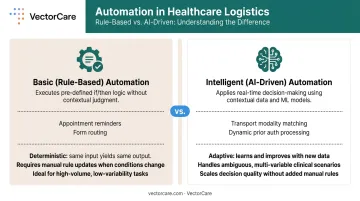
Basic tools are faster than manual processes. Intelligent platforms go further: they handle routine decisions autonomously, adjust to changing conditions in real time, and coordinate workflows across multiple systems at once — without a human in the loop for each step.
The 2025 CAQH Index found that U.S. healthcare avoided $258 billion in administrative costs in 2024 through electronic transactions—but a remaining $21 billion opportunity still exists through full automation of manual and partially manual transactions. Organizations still relying on rule-based tools or manual workflows are leaving the most significant portion of that savings on the table.
Types of Healthcare Automation Platforms
Clinical Workflow Automation
These tools reduce documentation burden for clinicians through AI scribes, ambient documentation, clinical decision support, and EHR workflow optimization. Primary beneficiaries are physicians and advanced practice providers who spend disproportionate time on documentation rather than direct care.
Ambulatory physicians spend nearly 49% of their office-day time on EHR and desk work, compared to just 27% on direct patient contact. Ambient AI scribes address this directly by generating structured clinical notes from recorded encounters, reducing after-hours charting and burnout risk.
Revenue Cycle Automation
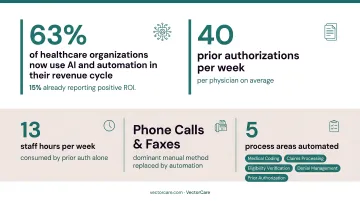
This covers medical coding, claims processing, eligibility verification, denial management, and prior authorization—and it consistently delivers strong ROI given the volume of manual steps involved.
63% of healthcare organizations now use AI and automation in their revenue cycle, with 15% already reporting positive ROI. Prior authorization alone is a significant driver: physicians complete an average of 40 prior authorizations per week, consuming 13 hours of staff time—most of it on phone calls and faxes that automation can replace.
Patient Engagement and Communication Tools
These platforms automate intake forms, appointment reminders, post-visit follow-ups, and satisfaction surveys. The dual benefit: no-show rates drop and front-desk workload drops with them. Digital intake forms that auto-populate EHRs also reduce downstream claim denial risk by catching eligibility issues before the appointment.
Compliance and Security Automation
As healthcare organizations add more vendors and expand their automation footprint, compliance exposure grows. In 2024, HHS OCR recorded 663 large breach notifications affecting over 242 million individuals. Business associates represented only 16% of breach reports yet accounted for 85% of affected individuals.
Compliance automation tools handle HIPAA control monitoring, audit readiness, and evidence collection. At an average cost of $7.42 million per healthcare breach (IBM 2025), the financial exposure makes this a category no health system can afford to ignore.
Patient Logistics Automation
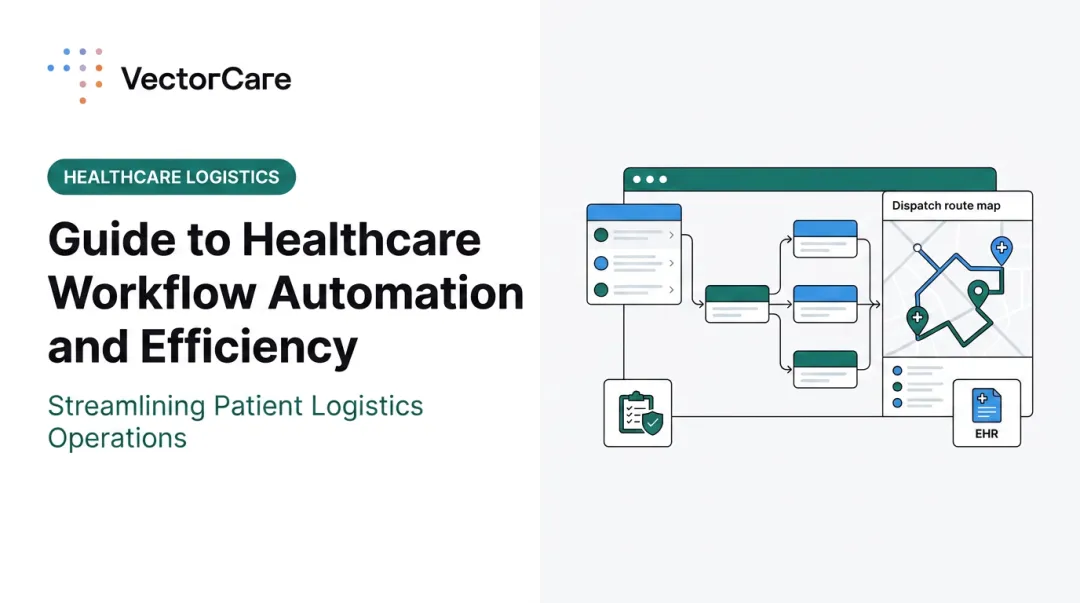
The four categories above address documentation, billing, engagement, and compliance. What most automation guides miss is patient logistics automation—the coordination, dispatching, and tracking of patient transport, discharge planning, and care transitions. Most guides overlook it entirely, despite its direct measurable impact on length of stay, bed availability, and readmissions.
Key Use Cases: Where Automation Delivers the Most Value
Automated Scheduling and Intake
Self-scheduling portals and digital intake forms that auto-populate EHRs do two things simultaneously: they reduce front-desk friction and they catch eligibility issues before claims are submitted. Insurance verification before the appointment eliminates a significant share of denials that otherwise require expensive rework downstream.
AI-Assisted Clinical Documentation
AI scribes generate structured notes from recorded clinical encounters. The burnout data here is striking: clinicians spending six or more hours weekly on after-hours EHR charting are 2.43 times more likely to report burnout. A JAMA Network Open study found that ambient AI scribes reduced burnout from 51.9% to 38.8% in just 30 days of use.
That's not a productivity metric. That's a retention metric—and staff attrition is one of the most expensive operational problems in healthcare.
Revenue Cycle and Prior Authorization Automation
Manual prior authorization is expensive at every level. The numbers tell the story:
- Manual PA costs $6 per transaction and 22 minutes of staff time; electronic processing cuts that to 11 minutes
- At 40 PAs per physician per week, that time savings compounds fast
- 95% of physicians say PA delays care, and 79% report it sometimes leads to treatment abandonment
Automation here isn't just about efficiency. When delays cause patients to abandon treatment, it becomes a clinical problem.
Patient Transport and Care Transition Coordination
Manual phone-based transport dispatching creates delays that cascade through bed availability and discharge timelines. Delayed discharges affect nearly 30% of older hospital patients, and an extra bed day can increase daily hospital expenses by 30.7%—with the average U.S. community hospital stay costing $14,101 per patient (2019).
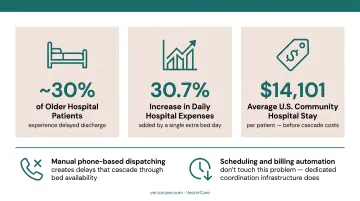
Scheduling and billing automation don't touch this problem. Closing it requires dedicated coordination infrastructure for transport and care transitions.
The Overlooked Category: Why Patient Logistics Automation Matters
Patient movement—from transport requests to dispatch to care transitions—is routinely treated as a scheduling issue. It's actually an infrastructure problem.
When transport coordination is manual and siloed, bottlenecks don't stay in the logistics department. They ripple through bed availability, discharge times, ED throughput, and care quality. A single missing transport confirmation can push a discharge to the following day.
What Patient Logistics Automation Actually Does
This is a distinct technical category, not just a scheduling tool:
- Automated dispatching that broadcasts transport requests to provider networks at once, rather than calling vendors sequentially
- Real-time provider matching across ground ambulance, NEMT, air medical, and other modalities
- EHR-integrated order creation that auto-populates patient data from the clinical record
- In-transit patient monitoring to maintain clinical oversight during transport
- Dynamic pricing through competitive multi-provider networks
- Compliance tracking across all transport handoffs
None of these capabilities exist in general clinical or administrative platforms, which are built for documentation and transactions, not physical care coordination.
The Clinical and Financial Stakes
Extended emergency department stays are estimated to incur an additional $6.8 million in hospital costs over a three-year period. Readmission risks rise when patients are discharged without timely transport, DME, or follow-up care in place. These are metrics operational leaders are accountable for.
VectorCare as a Purpose-Built Example
VectorCare's platform illustrates what dedicated patient logistics automation looks like at scale. Serving 2,500+ healthcare facilities, the platform's A.D.I. (Automated Dispatching Intelligence) has saved more than 100,000 hours for healthcare systems and suppliers by replacing manual dispatching decisions with automated, real-time provider matching.
The platform's SMART on FHIR integration with Epic EHR automatically extracts patient demographics, insurance information, encounter data, and clinical context, eliminating redundant data entry. Scheduling takes less than 3 minutes vs ~31 minutes by phone (90% reduction). Partner facilities have reported a 90% reduction in scheduling time (from 31 minutes to under 3 minutes).
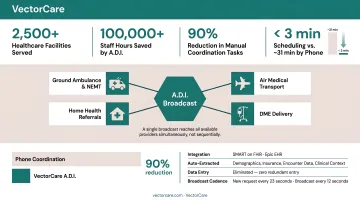
What makes this distinct from general automation categories is the operational scope. Through a single interface embedded in the clinician's existing EHR workflow, VectorCare coordinates:
- Ground ambulance and NEMT
- Air medical transport
- DME delivery
- Home health referrals
VectorCare's broadcast model sends a transport request to all available providers at once rather than sequentially.
That's not scheduling. That's infrastructure.
Key Features to Look for in a Healthcare Automation Platform
EHR Integration and Interoperability
Any platform that creates a new data silo defeats the purpose of automation. The platform must connect reliably with your existing EHR—Epic, Oracle Health, Meditech—through standards like FHIR or HL7, with data flowing bidirectionally.
Key questions for vendors:
- Do you have pre-built connectors for our EHR?
- What is your typical integration timeline?
- Does data write back to the medical record automatically, or require manual reconciliation?
As of 2021, roughly 96% of U.S. non-federal acute care hospitals have a certified EHR (ONC). The real question is whether the platform works inside your existing EHR without manual workarounds.
Security requirements follow directly from integration depth—the more data a platform touches, the more rigorously it needs to protect it.
HIPAA Compliance and Security Standards
Require a Business Associate Agreement from any vendor that touches protected health information. It's a federal legal requirement under HIPAA, not an optional add-on to negotiate away.
Beyond the BAA, look for:
- Encryption at rest and in transit
- Role-based access controls
- Audit logging
- SOC 2 Type I or HITRUST certification
A HIPAA-secure cloud-based architecture should be a standard feature, not a premium add-on. Given that healthcare data breaches average $7.42 million in total cost (IBM 2025), security rigor has direct financial implications.
Once security is confirmed, operational visibility becomes the next critical layer.
Scalability, Reporting, and Real-Time Visibility
Automation without visibility creates a different problem: you can't improve what you can't measure. Operational leaders need dashboards that show what's working, where bottlenecks persist, and whether the platform is delivering ROI.
Platforms should provide:
- Real-time operational dashboards
- KPI tracking (no-show rates, denial rates, transport coordination time, on-time performance)
- Analytics that support continuous improvement, not just task completion
How to Implement Healthcare Automation: A Practical Framework
Step 1: Audit and Prioritize Workflows
Before selecting any platform, document your highest-volume, most error-prone manual processes. Rank automation candidates by two variables: impact and implementation complexity.
High-volume, lower-complexity workflows—scheduling, intake, eligibility verification—typically produce the fastest, most measurable wins. Start there. Build organizational confidence before tackling more complex integrations.
Step 2: Plan for Integration and Staff Adoption
Technology selection is one factor. According to McKinsey research on change management, up to 60% of change projects fail due to poor organization, and many clinical staff experience new systems as additional burden rather than relief, particularly when implementation is rushed or poorly communicated.
What reduces adoption failure:
- Clear communication about why workflows are changing
- Training that's role-specific, not generic
- Internal champions with contextual workflow knowledge (external contractors often fail here)
- Clinical governance that gives staff a voice in configuration decisions
Step 3: Define KPIs and Optimize Continuously
Before go-live, establish measurable targets for each workflow area you're automating:
- Scheduling: No-show rate, intake completion rate
- Revenue cycle: Claim denial rate, days in AR, prior auth turnaround time
- Patient logistics: Transport coordination time, on-time performance, length of stay
- Clinical documentation: After-hours charting time, note completion rate
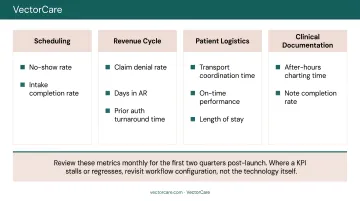
Review these metrics monthly for the first two quarters post-launch. Where a KPI stalls or regresses, that's your signal to revisit workflow configuration — not the technology itself, but how it's been mapped to your specific processes.
Frequently Asked Questions
What is healthcare automation?
Healthcare automation is the use of AI, machine learning, RPA, and system integrations to perform repetitive clinical and administrative tasks without manual intervention. It covers scheduling, billing, clinical documentation, care coordination, and patient transport: any workflow where human time is consumed by rule-based or repetitive steps.
What are the main types of healthcare automation platforms?
The five major categories are clinical workflow automation, revenue cycle automation, patient engagement tools, compliance and security automation, and patient logistics automation. Most organizations benefit from a combination depending on where their highest-volume pain points are.
How does healthcare automation improve patient outcomes?
Automation reduces delays in scheduling, transport, discharge, and prior authorization, cuts errors in documentation and coding, and frees clinical staff for direct patient care. Faster, more accurate coordination translates to shorter length of stay, fewer readmissions, and more timely care delivery.
What should organizations look for when selecting an automation platform?
Prioritize platforms that offer:
- EHR integration capability
- HIPAA compliance with a signed BAA
- Scalability for growing volume
- Real-time reporting dashboards
- Proven outcomes in workflows matching your highest-priority problems
Reference checks with peer organizations matter more than vendor demos.
Is healthcare automation HIPAA compliant?
Compliance depends entirely on the vendor. Organizations must require a Business Associate Agreement from any vendor handling PHI, and verify that the platform meets HIPAA's administrative, physical, and technical safeguards. SOC 2 Type I or HITRUST certification provides additional evidence of security rigor.
How is patient logistics automation different from general healthcare automation?
Patient logistics automation addresses the coordination, dispatching, and real-time tracking of patient transport and care transitions across ground, air, and non-emergency modalities. Clinical documentation and billing platforms aren't built for multi-provider dispatch, real-time transport matching, or DME and home health coordination — gaps that directly affect length of stay and discharge efficiency. Platforms like VectorCare are purpose-built for this layer of care.