Introduction
Hospital operations run on a brutal math problem. Administrative expenses across U.S. hospitals totaled $166.1 billion — representing 17% of total hospital expenses — according to a 2025 analysis of Medicare Cost Reports. Meanwhile, physicians spend 7.3 hours every week on purely administrative tasks, and nurses document 600 to 800 data points per 12-hour shift. That's not care. That's paperwork.
Healthcare automation addresses this directly: replacing manual, error-prone coordination with software and AI that handles routine tasks faster, more accurately, and without wearing people down.
This guide covers what healthcare automation actually is, which areas deliver the most measurable impact, why patient logistics remains one of the most underautomated categories, and what a successful implementation requires. Whether you're evaluating your first automation project or scaling an existing program, every section is built around what actually works — not what sounds good in a vendor pitch.
Key Takeaways
- U.S. hospital administrative costs exceed $166 billion annually — automation targets this directly
- The highest-ROI automation categories include scheduling, billing, patient intake, and patient logistics
- Patient logistics is foundational infrastructure — treating it as a scheduling problem leaves significant efficiency gains on the table
- Staff adoption succeeds when automation visibly removes tedious tasks — not when it threatens roles
- Phased implementation with clear success metrics protects ROI and builds organizational confidence
What Is Healthcare Automation?
Healthcare automation uses software, AI, and intelligent workflow systems to handle routine, rule-based, or repetitive tasks across clinical and administrative operations — reducing manual intervention while improving speed, accuracy, and consistency.
The Main Technology Types
Modern healthcare automation isn't a single tool. It's a stack of complementary technologies:
- Robotic Process Automation (RPA): Rule-based bots that handle repetitive digital tasks like data entry, eligibility checks, and form processing
- AI and machine learning: Systems that learn from data to flag anomalies, predict outcomes, or optimize decisions over time
- Workflow orchestration platforms coordinate people, systems, and processes into trackable, end-to-end sequences
- EHR-integrated systems (such as SMART on FHIR applications) embed directly into clinical environments, eliminating the need to switch between tools
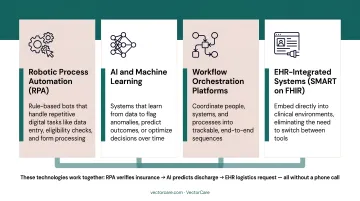
These technologies work together rather than in isolation. An orchestration platform might trigger an RPA bot to verify insurance, which feeds data into an AI model predicting discharge timing. That model then initiates an EHR-connected logistics request — all without a coordinator picking up the phone.
The Full Care Continuum
A common misconception is that automation only applies to front-desk scheduling or back-office billing. The reality spans the entire patient journey:
- Patient intake and registration
- Appointment scheduling and reminders
- Clinical documentation and EHR data entry
- Transport and discharge coordination
- Revenue cycle and claims processing
- Post-discharge follow-up and care transitions
Organizations that automate only one department — billing, say, while leaving discharge coordination manual — still absorb the delays and errors that coordinated automation would eliminate.
Key Benefits of Healthcare Automation
Reduced Administrative Burden
The AMA reported in 2025 that physicians averaged 7.3 hours per week on administrative tasks in 2024, with 22.5% spending more than 8 hours per week in the EHR after hours. Nurses face similar pressure — a 2022 study found documentation consumed 19.5% of total nursing time.
Automation addresses this by handling data entry, status tracking, and routine communication automatically — freeing clinical staff for direct patient care.
Cost Reduction
The financial case for automation is concrete. Two figures illustrate the scale:
- McKinsey estimated administrative simplification could save up to $265 billion annually across U.S. healthcare
- Targeted patient logistics automation — like VectorCare's platform — generates over $500,000 in annual savings for a 250-bed hospital with 25 daily transports through reductions in coordination labor, transport inefficiencies, and communication delays
Improved Patient Experience
When coordination runs on automation, patients feel it. Press Ganey analysis of 6.5 million U.S. patient encounters identified "nurses kept you informed" and "staff worked together" among the top drivers of patient likelihood to recommend — both areas where consistent, automated workflows make a measurable difference. Automated appointment reminders alone reduce no-show rates meaningfully: a 2022 randomized study of 390,064 scheduled visits found targeted text reminders reduced no-shows with a relative risk of 0.89.
Data Accuracy and Compliance
Standardized, automated workflows reduce transcription errors, enforce documentation requirements, and create auditable records of every action. Platforms built with HIPAA-compliant architecture — including secure data transmission and full audit trail capabilities — lower regulatory exposure in ways manual processes cannot. When an error does occur, automated logs make it traceable; in manual workflows, it often isn't.
Staff Burnout Reduction
A 2023 JAMA Health Forum survey of 15,738 nurses and 5,312 physicians found burnout in 47% of nurses and 32% of physicians. Among those, 74% of physicians and 57% of nurses cited excessive EHR time as a contributing factor.
The U.S. Surgeon General has identified administrative burden as a systemic driver of health worker burnout. In that same survey, 40% of nurses said they'd leave their current hospital within a year if they could.
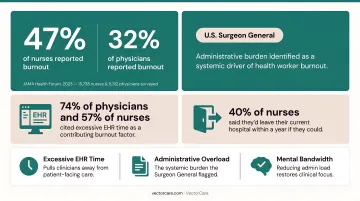
Reducing that administrative load doesn't just improve retention numbers — it gives clinicians back the mental bandwidth to do the work they trained for.
Key Areas Where Healthcare Automation Delivers Results
The highest-impact implementations start by identifying high-volume, error-prone, or delay-causing processes — not by automating everything at once.
Scheduling and Patient Flow
Automated scheduling systems reduce no-shows, fill cancellations, and optimize provider utilization without constant staff intervention. Automated reminders via text or email cut inbound phone volume at the front desk while improving attendance rates. Research on reminder systems is consistent: baseline non-attendance rates often range from 15% to 30%, and simple automated reminders reduce non-attendance by as much as 44% in some settings.
Beyond reminders, intelligent scheduling tools optimize appointment slot allocation based on provider availability, visit type, and patient priority, replacing manual calendar management that creates bottlenecks during staff shortages.
Revenue Cycle Management
Billing, claims processing, eligibility verification, and payment follow-up are high-volume, error-sensitive workflows where automation delivers consistent ROI. HFMA, citing Kodiak Solutions benchmarking, reported initial claim denials reached nearly 12% in 2024 — and the AHA estimates hospitals spend nearly $20 billion annually appealing denied claims.
Automation addresses those denial drivers at the source:
- Verifies eligibility before the patient is seen
- Validates claims against payer rules before submission
- Triggers follow-up automatically when claims age past set thresholds
McKinsey has estimated automation and analytics could eliminate $200 to $360 billion in U.S. healthcare spending across RCM and related functions.
Patient Intake and EHR Documentation
Digital intake forms that auto-populate EHR records eliminate duplicate data entry, a process that currently introduces errors and consumes staff time at every point of care.
FHIR-based interoperability ensures patient data flows accurately across systems, so a record entered at intake doesn't need to be re-entered at discharge, transport coordination, or follow-up scheduling.
Clinical Decision Support
AI-powered tools surface care gaps, flag incomplete documentation, and support treatment planning at the point of care. Integrated with remote monitoring devices or wearables, these systems give clinicians better data context without adding chart review time, so clinicians spend less time locating information and more time using it.
Patient Logistics Automation: The High-Impact Area Most Organizations Overlook
Patient logistics — coordinating transport, home health, DME, and non-emergency medical transfers — has long been treated as a scheduling problem. It's actually an infrastructure problem. That mismatch is expensive.
A 2024 review confirmed that delayed discharge is associated with extended length of stay, higher readmissions, and significant operational bottlenecks. One analysis cited extended ED length of stay adding $6.8 million in costs over three years at a single facility. Early, coordinated discharge planning can reduce readmissions by 22%. Every day a patient waits for transport coordination that could have been automated is a day of unnecessary cost and risk.
How Intelligent Logistics Automation Works
Traditional patient logistics runs on phone calls. A coordinator identifies a need, works down a provider list, leaves messages, waits for callbacks, confirms availability, and manually documents the outcome — a process that takes roughly 31 minutes per request.
VectorCare's approach replaces that chain with automated broadcasting: a single request submitted from within the EHR is simultaneously sent to every eligible, credentialed provider in the network. The request reaches every eligible provider at once, giving the coordinator real-time options including aircraft type, availability, range, and capability.
Total time from request to confirmed transport: less than 3 minutes, compared to roughly 31 minutes of sequential phone calls — a 90% reduction.
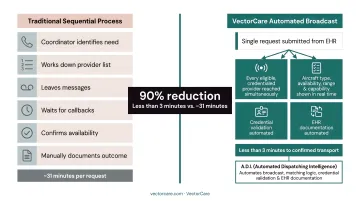
VectorCare's A.D.I. (Automated Dispatching Intelligence) extends this further, automating not just the broadcast but the matching logic, credential validation, and EHR documentation that surround each transport event.
The Role of EHR Integration
When logistics platforms connect directly to EHR systems through SMART on FHIR standards, the operational gains compound. Patient demographics, mobility needs, insurance details, and destination data populate automatically the moment a coordinator initiates a request from within the patient's chart. There's no re-entry, no faxing, no hunting through records.
VectorCare's integration with Epic, for example, reduces scheduling time from 31 minutes to less than 3 minutes for standard transport coordination, and the entire transaction is written back to the medical record automatically, maintaining a complete audit trail without additional documentation work.
Quantified Outcomes
These results are documented across VectorCare's hospital and health system partners:
- VectorCare's A.D.I. has saved healthcare systems over 100,000 hours by automating dispatching workflows
For organizations still relying on phone-based coordination, these numbers represent recoverable cost and capacity. The infrastructure to replace that process exists today.
How to Successfully Implement Healthcare Automation
Start With High-Impact, High-Volume Processes
Don't automate everything at once. Identify the workflows that consume the most staff time or introduce the most delays and errors. Define measurable success metrics before selecting tools — reduction in coordination time, claim denial rate, length of stay, or transport costs are all concrete, trackable targets. A focused pilot on a single workflow or unit generates ROI data that justifies broader rollout.
The 80/20 principle applies directly here: roughly 80% of your operational gains will come from automating 20% of your processes (typically the highest-volume, most repetitive tasks).
Ensure Integration and Compliance From the Start
Automation tools that don't connect to your existing EHR and clinical systems create new data silos rather than eliminating them. Before committing to any vendor, confirm they meet these baseline requirements:
- HIPAA-compliant data handling with encryption and full audit trail capabilities
- FHIR-standard architecture, ideally SMART on FHIR applications that embed directly in Epic or other EHR environments
- Bi-directional data exchange that eliminates parallel entry or manual syncing with clinical systems
Standalone tools that require duplicate data entry create as much friction as the problems they're meant to solve.
Drive Staff Adoption
A technically sound automation implementation can still fail if staff don't trust or use it. Three practices that work:
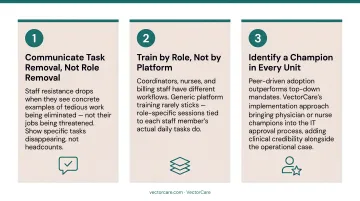
- Communicate that automation removes tedious tasks, not roles. Staff resistance drops when they see concrete examples of work being eliminated rather than their jobs being threatened.
- Train by role, not by platform. Coordinators, nurses, and billing staff have different workflows — generic training rarely sticks.
- Identify a clinical or operational champion within each unit. Peer-driven adoption outperforms top-down mandates. VectorCare's implementation approach recommends bringing physician or nurse champions into the IT approval process, adding clinical credibility alongside the operational case.
The Future of Healthcare Automation
The near-term trajectory is toward AI agents taking on increasingly complex tasks — proactive patient outreach, predictive scheduling, autonomous care coordination, and real-time transport dispatching. Grand View Research projects the global AI in healthcare market to reach $505 billion by 2033, growing at a 38.9% CAGR from 2026 onward. The market for medical automation broadly was estimated at $52 billion in 2024, projected to reach $88 billion by 2030.
That growth doesn't land evenly — interoperability determines which organizations can actually capture it. Recent ONC data shows the gap is closing fast:
- Hospitals engaging in all four interoperable exchange domains rose from 28% in 2018 to 43% in 2023
- FHIR-based patient access APIs grew from 62% to 74% of outpatient settings in a single year (2021 to 2022)
As FHIR matures, automation platforms that operate across EHR systems, transport networks, payers, and post-acute providers will move from competitive advantage to operational necessity.
Organizations already running on connected, standards-based infrastructure won't need to rebuild when the next generation of AI capabilities arrives — they'll just extend what's already working.
Frequently Asked Questions
What is healthcare automation?
Healthcare automation uses software and AI tools to handle routine administrative and operational tasks, including scheduling, billing, documentation, and care coordination, reducing manual effort and improving speed, accuracy, and patient outcomes. It spans clinical and administrative workflows across the full care continuum.
What is the 80/20 rule for automation?
The 80/20 rule suggests that 80% of the operational value from automation comes from automating 20% of processes, typically the highest-volume, most repetitive tasks.
Which healthcare processes should be automated first?
Start with high-volume, error-prone, or delay-causing workflows:
- Appointment scheduling
- Claims processing and eligibility verification
- Patient intake and EHR documentation
- Care coordination and patient logistics
These offer the fastest, most measurable ROI.
What are the biggest challenges to implementing healthcare automation?
The most common barriers include:
- Poor integration with existing EHR systems
- Staff resistance to change
- Unclear success metrics
- HIPAA and data security compliance complexity
Phased implementation, starting with a single workflow, combined with strong vendor integration support resolves most of these.
How does healthcare automation improve patient outcomes?
By reducing delays in scheduling, transport, and care transitions, and freeing clinical staff to focus on direct patient care rather than administrative coordination, automation leads to shorter hospital stays, fewer readmissions, and faster access to appropriate post-acute care.
What is patient logistics automation?
Patient logistics automation uses technology to coordinate patient transport, interfacility transfers, home health services, and non-emergency medical services, replacing manual phone-based dispatch with intelligent, real-time systems. Platforms like VectorCare automate the full logistics chain, from EHR-integrated request initiation through provider matching, dispatch, tracking, and documentation.