Introduction
Picture a patient cleared for discharge at 10 a.m. By noon, she's still in her bed — not because of any clinical issue, but because the transport coordinator is on hold with a vendor, the receiving SNF hasn't been notified, and the DME equipment hasn't been ordered. Downstream, two incoming patients are boarding in the ED with nowhere to go.
This is healthcare logistics failure in its most common form. It doesn't announce itself as a crisis. It builds across phone calls, missed handoffs, and disconnected systems until it becomes one.
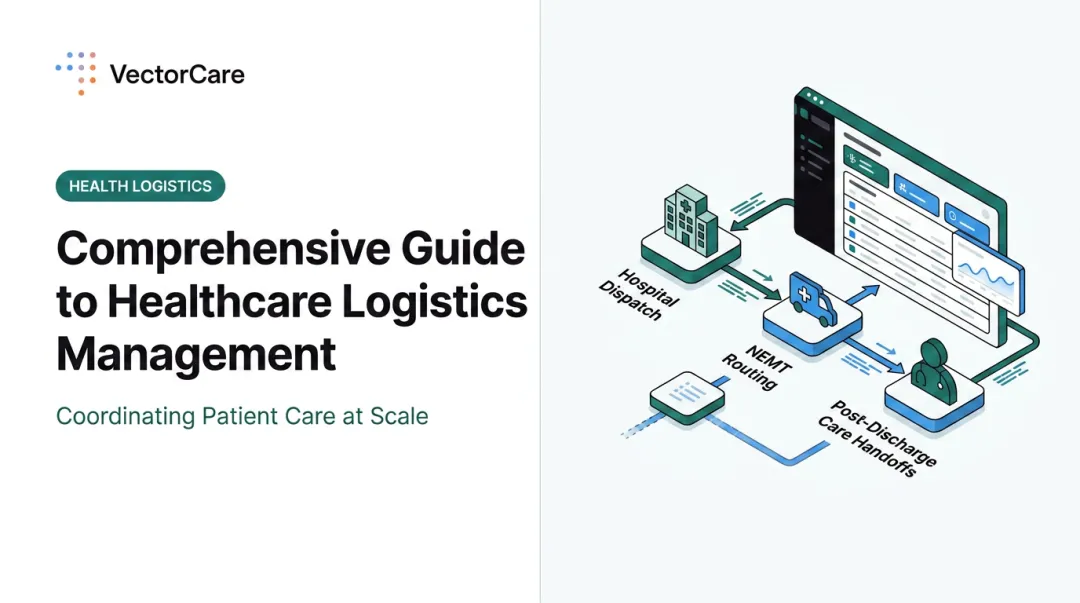
Healthcare logistics encompasses two distinct domains: how organizations manage medical supplies, pharmaceuticals, and equipment; and how they coordinate the movement of patients across care settings. Most health systems invest heavily in the first. The second (patient logistics) often runs on phone calls, faxes, and institutional memory.
This guide covers both: a working definition of healthcare logistics, a breakdown of its two core branches, the most pressing operational challenges, how technology is closing the gap, and what to look for when evaluating a platform.
Key Takeaways:
- Healthcare logistics has two branches — supply chain and patient logistics — and most organizations underinvest in the latter
- Fragmentation across siloed systems drives delays, missed handoffs, and avoidable readmissions
- 30% of US hospitals remain not fully interoperable, making manual coordination the default
- AI-driven dispatch, FHIR integration, and unified platforms have the strongest evidence behind them
- Evaluate solutions on total outcome impact, not just subscription cost
What Is Healthcare Logistics?
Healthcare logistics is the coordinated management of everything a health system needs to function: medical supplies, pharmaceuticals, equipment, and patients themselves. Every clinical decision depends on it at the operational level — a surgeon can't operate without the right instrument, and a patient can't recover at home without a ride there and the right equipment waiting for them.
What separates healthcare logistics from commercial logistics is the stakes. A delayed shipment in retail costs revenue. A delayed shipment of a critical medication — or a missed patient transport — costs something harder to recover.
Two Distinct Domains
Most people associate healthcare logistics with supply chain: procurement, warehousing, distribution. That's accurate, but incomplete. The field divides into two branches:
- Healthcare supply chain logistics — the movement and storage of physical goods (drugs, devices, consumables, equipment) from manufacturer to point of care
- Patient logistics — the coordination of people across care settings, including transport, home health visits, DME delivery, NEMT, and inter-facility transfers
Both domains fail regularly, yet supply chain logistics tends to attract the larger share of operational investment and technology attention. Patient logistics failures — delayed discharges, missed transports, poor care transition handoffs — are equally consequential for bed capacity, length of stay, and readmission rates.
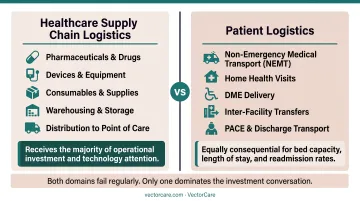
The Two Pillars of Healthcare Logistics: Supply Chain and Patient Logistics
Healthcare Supply Chain Logistics
Supply chain logistics covers everything from procurement through last-mile delivery to care sites. Healthcare Ready defines it as a network of systems, components, and processes ensuring medicines and healthcare supplies are manufactured, distributed, and delivered to patients. The WHO frames it as an end-to-end function integrating procurement, transport, and warehouse management.
The clinical stakes are direct. A peer-reviewed 2022 review identified product delays and drug shortages as patient-harm risks, with ASHP documenting 220 ongoing drug shortages by August 2022. A Cardinal Health survey found 40% of healthcare providers had canceled surgical cases due to missing supplies, and 69% had experienced case delays from unavailable materials — though that data is from 2018 and vendor-sponsored, so it's best read as directional rather than definitive.
The cost exposure is significant. Guidehouse estimated $25.7 billion in unnecessary annual US hospital supply chain spending, with the average hospital carrying a 17.4% savings opportunity. AHRMM notes supply costs are typically a hospital's second-largest expense after labor.
Key supply chain logistics functions include:
- Inventory procurement and vendor management
- Temperature-controlled storage and distribution
- Pharmaceutical cold chain management
- Regulatory compliance (FDA CGMP/GxP, HIPAA where PHI is involved)
- Expiration tracking and shortage substitution
- Last-mile delivery to care sites
Patient Logistics as Healthcare Infrastructure
Patient logistics is an infrastructure problem. Health systems that treat it as a scheduling function consistently struggle with discharge throughput, bed availability, and care continuity — and the downstream effects compound quickly.
As VectorCare CEO David Emanuel has articulated, when patient flow is managed as an afterthought, the consequences ripple across the entire system. A missed transport affects bed turnover, a delayed DME delivery extends length of stay, and a poor handoff to a SNF increases readmission risk.
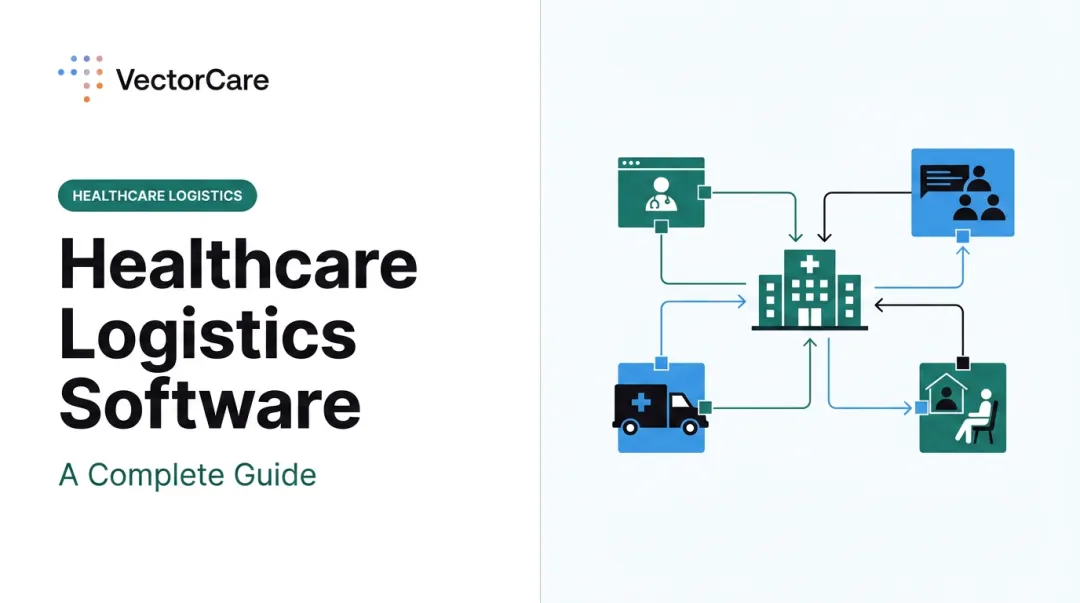
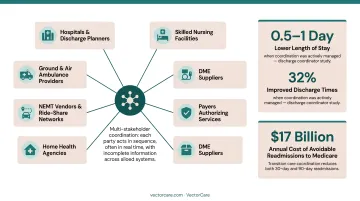
The coordination challenge is multi-stakeholder by nature. A single care transition touches:
- Hospitals and discharge planners
- Ground and air ambulance providers
- NEMT vendors and ride-share networks
- Home health agencies
- Skilled nursing facilities
- Payers authorizing services
- DME suppliers
Each party needs to act in sequence, often in real time, with incomplete information flowing across siloed systems. The coordination failure is structural, not individual.
The outcome data makes the case for treating this as strategic infrastructure. A discharge coordinator study reported 0.5 to 1 day lower length of stay and 32% improved discharge times when coordination was actively managed.
A transition care coordinator model reduced both 30-day and 90-day readmissions — meaningful given that avoidable readmissions cost Medicare approximately $17 billion per year.
Key Challenges Facing Healthcare Logistics Today
Fragmentation and Manual Coordination
Most healthcare organizations still coordinate transport, vendor services, and care transitions through phone calls, faxes, and disconnected software. The result: phone tag, missed handoffs, and delays that compound across a care episode.
VectorCare's internal data shows care coordinators spend an average of 31 minutes per logistics call — and typical discharge workflows require toggling between 4–6 separate systems. That's not a technology preference problem. It's an infrastructure gap.
The ONC's 2023 interoperability data confirms the scale: 30% of non-federal acute care hospitals were not fully interoperable, and only 17% sent summary-of-care records to most or all long-term and post-acute providers.
Manual coordination persists because the systems to replace it aren't fully connected.
Regulatory Compliance and Data Security
Patient logistics workflows frequently involve protected health information — transport orders, diagnosis details, discharge documentation, appointment types. That creates HIPAA obligations beyond what a simple delivery service would face.
HHS guidance distinguishes between vendors that merely transport PHI (conduits, not business associates) and those that access or process it as part of their service. Patient logistics platforms that pull clinical context, manage care transition records, or integrate with EHRs require formal Business Associate Agreements and must support:
- Role-based access controls
- Audit logs and event timestamping
- Encrypted data transmission
- Retention compliant with Security Rule requirements
Legacy systems make this documentation labor-intensive. Modern platforms handle it by design.
Visibility and Real-Time Tracking Gaps
Without live status on transport and vendor fulfillment, care teams operate on assumptions rather than facts. The downstream costs add up fast.
Specific consequences include:
- Care teams can't prepare for patient arrivals, increasing room turnover delays
- Discharge planning becomes reactive instead of coordinated
- Bottlenecks go undetected until they've already caused hours of delay
- Bed management decisions get made on stale data, compounding capacity pressure
Cost Pressure and Workforce Constraints
Healthcare organizations are simultaneously reducing operational costs and absorbing staff shortages. Manual logistics tasks pull clinical and administrative staff away from direct care. A time-and-motion study across 36 hospitals found medical-surgical nurses spent **20.6% of their time on care coordination** — a category that includes logistics-adjacent tasks that technology can reduce.
The AMA's 2025 prior authorization survey found physicians and staff spending an average of 13 hours per week on prior authorizations alone. While not transport-specific, it illustrates how administrative coordination overhead accumulates across a healthcare system.
Scaling Across Complex Networks
A single missed transport in a multi-facility health system doesn't stay contained. It affects bed availability at the sending facility, readiness at the receiving one, and scheduling for downstream vendors. Most point solutions can't coordinate across that chain — they handle one function at one facility and create handoff gaps everywhere else.
How Technology and Automation Are Transforming Healthcare Logistics
AI-Driven Dispatch and Automated Workflows
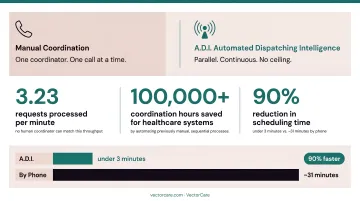
Manual transport coordination — calling vendors, checking availability, negotiating timing, sending confirmations — has a hard ceiling on throughput. One coordinator can handle one call at a time.
AI-powered dispatching removes that ceiling. VectorCare's Automated Dispatching Intelligence (A.D.I.) processes 3.23 requests per minute — a throughput level no human coordinator can replicate. A.D.I. has saved healthcare systems more than 100,000 hours of coordination time by automating what was previously a manual, sequential process.
The operational shift is significant: scheduling takes less than 3 minutes, vs ~31 minutes by phone (90% reduction), when AI handles matching providers, negotiating timing, and sending confirmations.
EHR Integration and Data Interoperability
SMART on FHIR standards allow logistics platforms to embed directly into EHR environments like Epic, pulling patient demographics, insurance details, and clinical context automatically. The coordinator doesn't switch platforms — they submit a transport request from within Epic, with patient data already populated.
ONC data shows more than two-thirds of hospitals enabled patient access through FHIR-based apps as of 2022, reflecting a broad shift toward standardized integration. VectorCare has its own SMART on FHIR integration with Epic. Separately, the Medical Transfer Protocol app on the Epic Showroom is built and owned by Priority Dispatch Corp on their SoFaaS platform.
Before this integration, coordinators manually transcribed vitals and patient information before initiating a transport request. After: the data is already there, and scheduling takes less than 3 minutes, vs ~31 minutes by phone (90% reduction).
Real-Time Visibility and Communication Tools
Effective real-time visibility means more than a dot on a map. In practice, it includes:
- Live transport status accessible to all care team members
- Automated notifications pushed to receiving facilities
- Centralized dashboards surfacing delays and bottlenecks
- Two-way communication between coordinators, vendors, and clinical staff — within a single platform rather than scattered across text chains and phone calls
VectorCare's platform centralizes every logistics event — from standing order creation to patient pickup — into a single interface, replacing the multi-system toggling that currently characterizes most discharge coordination workflows.
Unified Platforms vs. Point Solutions
That visibility only holds when the underlying data comes from one place. When transport coordination, home health scheduling, DME delivery, vendor credentialing, and payment reconciliation all live in separate tools, every handoff between them is a potential failure point.
Integrated platforms eliminate those gaps.
VectorCare's modular architecture — covering workflow orchestration (Hub), vendor credentialing (Trust), billing and invoicing (Pay), analytics (Insights), automated dispatch (A.D.I.), and EHR integration (Connect) — gives organizations one unified record across the full logistics lifecycle. Fewer handoffs mean faster cycle times and cleaner operational data.
Predictive Analytics and Business Intelligence
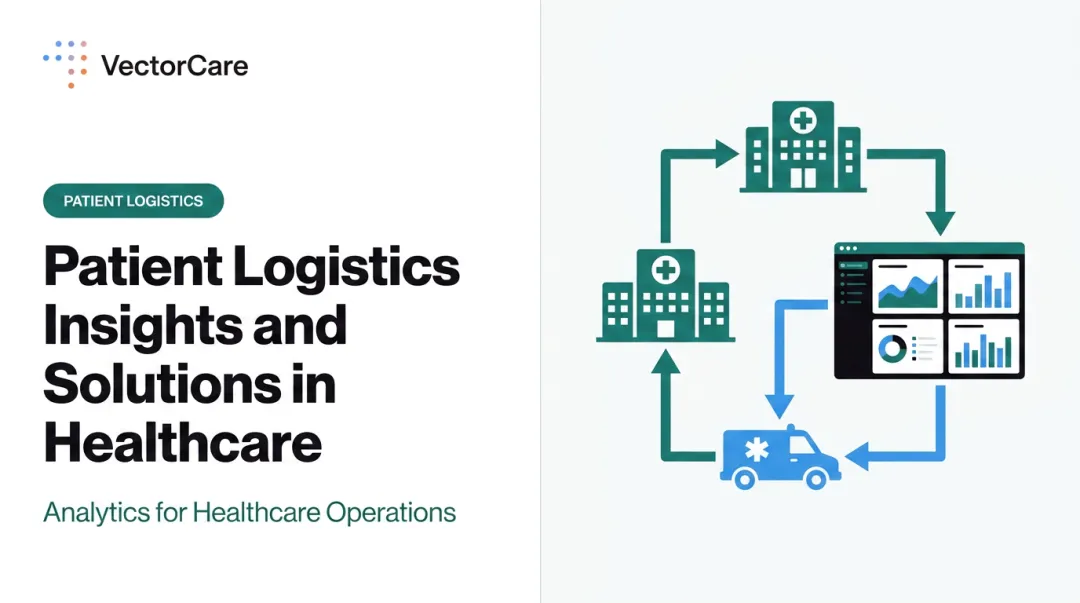
McKinsey estimates that high-performing health system supply chains can reduce supply spend by up to 10% through better analytics and spend optimization. The same principle applies to patient logistics: when organizations have clean data on transport performance, vendor utilization, cost-per-trip, and discharge delays, they can make decisions based on patterns rather than incidents.
VectorCare's Insights module tracks on-time rates, discharge delay attribution, cost per modality, and vendor performance — giving operational leaders the data to act before delays compound into extended length of stay or avoidable readmissions.
Key Features to Look for in a Healthcare Logistics Solution
Not every platform that handles scheduling qualifies as a healthcare logistics solution. When evaluating options, weight these criteria:
| Feature | Why It Matters |
|---|---|
| Automated dispatching | Eliminates manual provider matching and confirmation overhead |
| Real-time tracking and notifications | Enables receiving teams to prepare; surfaces delays before they cascade |
| EHR integration (FHIR-based) | Removes duplicate data entry; embeds logistics into clinical workflows |
| Unified vendor/provider network | Breadth determines whether you can actually fulfill requests at volume |
| HIPAA-compliant infrastructure | Non-negotiable where PHI is involved — verify BAA support and audit trail capabilities |
| No-code workflow configuration | Different facility types need different workflows; avoid solutions that require engineering to reconfigure |
| Integrated billing and invoicing | Payment reconciliation should close within the same platform, not a separate process |
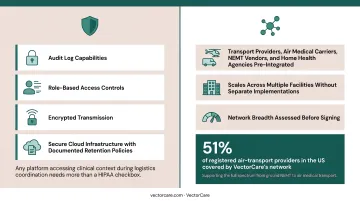
Any platform that accesses clinical context during logistics coordination needs more than a HIPAA checkbox. Before committing, verify audit log capabilities, role-based access controls, encrypted transmission, and secure cloud infrastructure with documented retention policies.
Network breadth deserves equal scrutiny. Before signing, assess how many transport providers, air medical carriers, NEMT vendors, and home health agencies are pre-integrated — and whether the platform scales across multiple facilities without requiring separate implementations. As a reference point, VectorCare's network covers over 51% of registered air-transport providers in the US, supporting the full spectrum from ground NEMT to air medical transport.
How to Choose the Right Healthcare Logistics Solution for Your Organization
Start With a Logistics Audit
Before evaluating platforms, map where your manual coordination tasks concentrate. Specific questions worth answering:
- Which handoffs break down most frequently — and between which stakeholder groups?
- Where does coordination time go: transport scheduling, DME ordering, billing reconciliation?
- Which staff carry the highest administrative burden from logistics tasks?
This diagnostic determines which platform capabilities should be weighted most heavily in your evaluation. A hospital where discharge delays are the primary pain point needs different prioritization than a payer managing NEMT networks at scale.
Evaluate Total Outcome Impact, Not Software Cost
Subscription price is the wrong metric. The real question is what downstream value the platform creates — and those numbers add up fast. Shorter length of stay, reduced coordination labor, fewer missed transports, and faster payment reconciliation each represent measurable savings that dwarf most SaaS licensing costs.
Organizations using VectorCare's integrated platform have reported:
- Over $500,000 in annual savings for a 250-bed hospital with 25 daily transports
- 90% reduction in manual coordination tasks
Ask vendors for outcome data from comparable facilities, not just feature lists.
Factor In Implementation and Change Management
Selecting the right platform only gets you partway there — implementation determines whether it actually delivers. Evaluate:
- How quickly can the platform deploy within existing EHR environments?
- Does configuration require engineering support, or can operational teams manage it?
- What onboarding and training resources are included?
VectorCare's SoFaaS (SMART on FHIR as a Service) architecture typically deploys within existing Epic environments in 8–12 weeks rather than the many months custom integrations require — because it runs on APIs Epic already supports, without custom interface development at each facility. That matters for health systems that can't absorb a multi-quarter implementation cycle.
Frequently Asked Questions
What does healthcare logistics do?
Healthcare logistics manages the coordinated movement of medical supplies, pharmaceuticals, equipment, and patients across the care continuum — ensuring the right resources reach the right place at the right time. It underpins every clinical workflow at the operational level, from surgical supply availability to post-discharge transport.
What are the main types of healthcare logistics?
The two primary branches are operational logistics (dispatch coordination, vendor management, EHR integration, and real-time tracking) and patient logistics (transport coordination, NEMT, home health scheduling, DME delivery, and care transition management). Most healthcare organizations must manage both effectively.
What are the biggest challenges in healthcare logistics?
The most persistent challenges are fragmentation across siloed systems, manual coordination overhead, lack of real-time visibility into transport and vendor status, HIPAA compliance demands on data handling, and the difficulty of scaling coordination across multi-facility or multi-payer networks without creating new handoff gaps.
How does technology improve healthcare logistics operations?
AI-driven dispatch, FHIR-based EHR integration, real-time tracking, and unified platforms collectively reduce manual tasks, close communication gaps, and generate data teams can act on. The result is higher volume handled with fewer errors, lower labor costs, and faster cycle times across the entire logistics operation.
What is patient logistics and why does it matter?
Patient logistics covers the coordination of all non-clinical services surrounding a patient's care journey — transport, home health, DME delivery, inter-facility transfers. When treated as infrastructure rather than a scheduling task, it directly reduces length of stay, lowers readmission risk, and improves care continuity across the full episode.
How do healthcare logistics solutions reduce operational costs?
Automation eliminates manual coordination hours, real-time visibility prevents costly delays and missed transports, integrated vendor management reduces redundant spend, and unified billing reconciliation accelerates revenue cycles. Each savings category builds on the next — and the combined impact consistently exceeds what any single workflow fix can deliver.