Introduction
Physicians now average 57.8 hours of work per week, with over 20 hours consumed by indirect patient care and administrative tasks — documentation, prior authorization, order entry — rather than seeing patients. Nurses spend nearly a quarter of every shift interacting with EHRs rather than delivering bedside care. And patients wait longer than necessary for discharge, not because their clinical needs are unresolved, but because the logistics behind their care haven't caught up.
This is an infrastructure problem, not a staffing one. Hiring more people to manage manual workflows doesn't fix the underlying friction — it just adds cost.
This guide covers the practical side of healthcare workflow automation: which workflows to prioritize, how to build automation on top of existing technology rather than replacing it, how to measure results, and where patient logistics fits in — an area that carries significant operational impact but remains largely manual in most health systems.
Key Takeaways
- Healthcare workflow automation reduces administrative burden across scheduling, billing, intake, and care coordination
- Highest-ROI workflows: patient transport coordination, insurance and claims processing, and EHR data management
- Patient logistics is still among the most manual, fragmented workflows — and it directly drives length of stay and readmissions
- Successful implementation starts narrow: one well-defined workflow, a baseline metric, and a clear feedback loop
What Is Healthcare Workflow Automation?
Healthcare workflow automation uses technology — including AI, robotic process automation (RPA), and integrated digital platforms — to replace or augment manual, repetitive processes across clinical and administrative operations.
This extends well beyond scheduling reminders. A mature automation layer covers entire operational ecosystems: how a patient moves from referral to discharge, how a claim travels from submission to reimbursement, or how a transport request flows from an EHR to a provider network without a single phone call.
The Automation Spectrum
Automation in healthcare falls into three distinct layers, each serving a different operational need:
- Rule-based automation (RPA): Handles predictable, high-volume tasks with defined logic — eligibility checks, appointment reminders, form routing
- AI-driven decision-making: Manages complex routing, pattern recognition, and dynamic prioritization — such as matching a patient to the right transport modality based on clinical acuity
- Integrated platform automation: Connects disparate systems (EHR, billing, logistics, provider networks) so data flows without manual re-entry
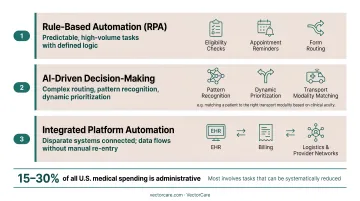
Together, these layers address the administrative burden that has grown alongside staffing shortages, rising patient volumes, and expanding regulatory requirements. Administrative spending already accounts for 15–30% of all U.S. medical spending — and most of it involves tasks that can be systematically reduced.
Healthcare Workflows with the Highest Automation ROI
The best place to start is where volume is high, the process is rule-based, and manual handoffs are actively costing money or slowing patient access. Four workflows consistently deliver measurable returns.
Scheduling and Patient Access
No-shows represent a direct hit to revenue and utilization. The average no-show rate across specialties is approximately 23%, and much of it is preventable.
Automated scheduling addresses this through:
- Self-service booking across web, app, and phone channels
- Multi-channel reminders (SMS, email, voice) with customizable timing
- Waitlist management that fills canceled slots automatically
- High-risk patient targeting with personalized outreach
Lower front-desk burden, better slot utilization, and fewer missed appointments translate directly to recovered revenue.
Insurance Eligibility and Claims Processing
Manual claims work is expensive. A single manual claim-status inquiry averages 24 minutes and approximately $12 per transaction — for a provider processing 5,000 inquiries monthly, that's $60,000 in administrative cost alone.
Automating this layer means:
- Real-time eligibility verification at point of scheduling
- Automated prior authorization submission and tracking
- Rules-based claims routing that reduces manual portal logins
- Denial flagging with automated appeal workflows
95% of physicians report care delays tied to prior authorization burdens. Automation doesn't eliminate the process, but it removes the human bottleneck from it.
EHR Data Management and Clinical Documentation
Nurses spend approximately 23–25% of every shift on documentation tasks rather than direct patient care. Across a 12-hour shift, that's roughly 3 hours of administrative overhead per nurse per day.
Automated EHR workflows reduce this through:
- Digital intake forms that sync directly to patient records (no transcription)
- Automated result routing to the appropriate care team member
- Compliance-driven document management with audit trails
- Discharge documentation templates pre-populated with encounter data
Faster, more accurate documentation means clinicians spend less time at the keyboard and more time at the bedside — where the care actually happens.
Care Coordination and Post-Visit Follow-Up
CMS caps Hospital Readmissions Reduction Program payment reductions at 3% — a penalty that hits hardest when follow-up care falls through the cracks. Research confirms that outpatient follow-up within 30 days is associated with reduced 30-day readmissions.
Automation closes the follow-up gap through:
- Structured post-discharge check-in sequences (automated calls, texts, or portal messages)
- Medication refill reminders tied to prescription timelines
- Chronic care outreach for high-risk patient cohorts
- Escalation triggers when patients don't respond or report symptoms
Patient Logistics: The Most Overlooked Automation Opportunity in Healthcare
Most health systems have invested in scheduling software, billing automation, and EHR workflows. Far fewer have addressed what happens between those systems: the coordination of transport, transfers, home health, NEMT, and DME across care transitions.
Patient logistics is still largely managed by phone calls, faxes, and spreadsheets. The infrastructure simply hasn't required anything else — until recently. The operational cost of that model, though, is real and measurable.
Why Manual Logistics Hurts More Than It Looks
Delayed discharge doesn't just inconvenience patients. Nearly 30% of older individuals experience delayed discharge, and an extra bed day can increase daily hospital expenses by 30.7%. UK NHS data shows delayed-discharge costs ranging from £200 to £565 per patient per day — and the primary driver is often fragmented coordination, not unresolved clinical need.
Transport delays compound this. When care coordinators manage transport through phone-based processes — verifying patient data, reaching providers, confirming ETAs — the administrative load becomes unsustainable. Scheduling takes less than 3 minutes, vs ~31 minutes by phone (90% reduction) when platforms like VectorCare automate that coordination layer.
How Automated Patient Logistics Works
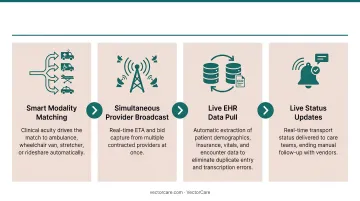
A purpose-built patient logistics platform replaces the phone-and-spreadsheet model with an integrated coordination layer:
- Matches patients to the right modality — ambulance, wheelchair van, stretcher, rideshare — based on clinical acuity, without manual determination
- Broadcasts requests simultaneously to multiple contracted providers, capturing ETAs and bids in real time
- Pulls patient demographics, insurance, vitals, and encounter data directly from the EHR, eliminating duplicate entry and transcription errors
- Delivers live status updates to care teams, removing the need to follow up manually with transport vendors
A.D.I. in Action: What This Looks Like at Scale
VectorCare's Automated Dispatching Intelligence (A.D.I.) is a practical example of what this coordination layer looks like in production. The platform's SMART on FHIR integration with Epic EHR automatically extracts patient data at the point of request — demographics, vitals, insurance coverage, encounter details — so coordinators never re-enter information that already exists in the clinical record.
A.D.I. manages the dispatch process from there: broadcasting to provider networks automatically, capturing responses, and matching patients to providers without manual intervention. Scheduling takes less than 3 minutes vs ~31 minutes by phone (90% reduction).
Across VectorCare's network of 2,500+ healthcare facilities, the results are measurable:
- 90% reduction in scheduling time (from 31 minutes to under 3 minutes)
- $500,000+ in annual savings for a 250-bed hospital with 25 daily transports
When coordinators aren't managing logistics by phone, they're available for the work that actually requires clinical judgment.
How to Implement Healthcare Workflow Automation: A Practical Framework
Automation projects fail more often from poor implementation than from inadequate technology. A structured approach reduces that risk considerably.
Step 1: Conduct a Workflow Audit
Map your current processes before choosing a platform. Identify:
- Where manual handoffs occur most frequently
- Which workflows rely on phone-based coordination or data re-entry
- Which processes have the highest volume and the clearest downstream impact on revenue or patient outcomes
This audit creates your prioritization list. Start with workflows that score high on all three criteria — volume, manual dependency, and measurable downstream impact.
Step 2: Evaluate Platform Fit and Integration Capability
Not all platforms integrate equally. Before selecting a solution, verify:
- Confirm EHR compatibility — does it integrate with Epic or your existing system via FHIR standards?
- Confirm HIPAA compliance — are Business Associate Agreements available, and what encryption and audit logging controls exist?
- Confirm configuration flexibility — can operational teams manage workflows without engineering resources, or does every change require IT?
The interoperability infrastructure is largely already there: nine in ten hospitals now use APIs to connect apps with EHR data. The question is whether your automation platform can actually use it.
Step 3: Start Narrow and Expand
Avoid full-system overhauls as a first move. Instead:
- Select one well-defined workflow — ideally high-volume and tied to a measurable metric
- Establish a baseline before go-live (time per transaction, denial rate, no-show rate, etc.)
- Run a defined pilot period and track performance against that baseline
- Expand to adjacent workflows based on what the data shows
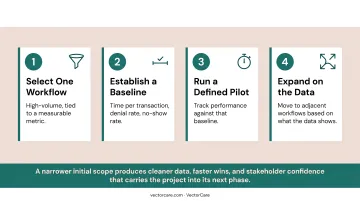
A narrower initial scope produces cleaner data, faster wins, and stakeholder confidence that carries the project into its next phase.
Step 4: Train Staff and Manage Change
Technology rarely fails because of the technology. Adoption fails because frontline staff weren't involved in the process and don't understand how automation changes their role.
Effective change management means:
- Involving clinical and operational staff early in workflow design
- Communicating clearly that automation reduces administrative burden — it doesn't eliminate the people doing the work
- Creating structured feedback loops post-launch so staff can flag friction points
- Designating internal champions who can support peers through the transition
Measuring the ROI of Healthcare Workflow Automation
ROI in healthcare automation is a set of metrics that compound across departments — and the compounding is where most organizations leave value on the table.
Key Performance Indicators to Track
| Metric | What It Measures |
|---|---|
| Time savings per workflow (hrs/week) | Direct labor reduction |
| Cost per transaction | Manual vs. automated process comparison |
| Claims denial rate | Billing automation effectiveness |
| No-show rate | Scheduling automation impact |
| Patient length of stay | Downstream logistics efficiency |
| On-time transport performance | Patient logistics quality |
| Staff hours redirected to patient care | Clinical capacity recovered |
How ROI Compounds Across Departments
The mistake most organizations make is evaluating automation one workflow at a time. The real value is systemic:
- Patient logistics automation that reduces length of stay frees bed capacity for new admissions
- Billing automation that reduces denials accelerates revenue without adding collection staff
- Scheduling automation that reduces no-shows improves utilization across service lines
McKinsey estimates that roughly 30 known administrative simplification interventions could deliver up to $265 billion in annual U.S. healthcare savings. That ceiling reflects what happens when automation compounds — not what any single workflow produces in isolation.
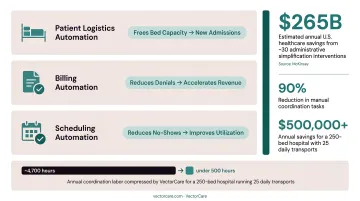
For patient logistics specifically, VectorCare's documented outcomes provide a concrete benchmark: a 90% reduction in scheduling time (from 31 minutes to under 3 minutes) and $500,000+ in annual savings for a 250-bed hospital with 25 daily transports.
For a 250-bed hospital running 25 daily transports, the platform compresses roughly 4,700 hours of annual coordination labor to under 500 hours. No amount of additional hiring could close that gap.
Frequently Asked Questions
What is healthcare workflow automation?
Healthcare workflow automation uses technology — including AI, RPA, and integrated digital platforms — to replace manual, repetitive processes across administrative and clinical operations, from scheduling and billing to care coordination and patient transport logistics.
Which healthcare workflows should be automated first?
Prioritize workflows that are high-volume, rule-based, and tied directly to revenue or patient outcomes — such as insurance verification, appointment scheduling, and transport coordination. Start with one well-defined use case, establish a baseline metric, then expand based on performance data.
How does healthcare workflow automation improve patient outcomes?
Automation reduces delays in care access, ensures timely follow-ups and medication adherence, and frees care teams to focus on clinical decision-making rather than administrative coordination — contributing to shorter lengths of stay and lower readmission rates.
Is healthcare workflow automation HIPAA compliant?
Compliance depends on platform selection and implementation. Any tool handling Protected Health Information (PHI) must include Business Associate Agreements, encryption, audit logging, and role-based access controls. Verify BAA availability before deploying any automation that touches patient data.
What is patient logistics automation and why does it matter?
Patient logistics automation coordinates transport, transfers, NEMT, home health, and DME across care transitions without manual phone calls or data re-entry. It directly affects length of stay, bed availability, and discharge efficiency — areas where coordination failures cost hospitals measurable time and money.
What ROI can healthcare organizations realistically expect from workflow automation?
ROI depends on workflow complexity and scale, but common gains include reduced time per transaction, fewer claim denials, and shorter lengths of stay. Measuring impact across departments — rather than one workflow at a time — produces a more complete and defensible business case.