Introduction
Healthcare organizations are drowning in paperwork — and it's costing them. Manual payment workflows drive billing errors, delay reimbursements, and consume administrative budgets that could fund patient care instead.
The problem runs deeper than billing software. Healthcare payments span an entire ecosystem — transport, home health, DME, and ancillary services coordinated across dozens of payers. When that coordination still happens by phone and fax, the resulting documentation gaps are invisible until a claim gets denied.
According to CAQH's 2024 Index, electronic healthcare payment workflows already avoid $222 billion in annual administrative costs — yet another $20 billion remains on the table through fully electronic workflows. Closing that gap starts with understanding what a fully electronic payment platform actually looks like in practice.
This guide covers what a healthcare payment platform is, what it must include, the measurable benefits it delivers, how AI is raising the bar, and what to look for when evaluating a solution.
Key Takeaways
- A healthcare payment platform covers the full lifecycle: service coordination, claims generation, payment posting, and reconciliation
- Manual workflows cost the industry billions annually — the average denial rate hit 12% in 2023, up from 9% in 2016
- The payoff is measurable: fewer denied claims, shorter AR days, and real labor savings
- AI-driven tools like VectorCare's A.D.I. generate structured, auditable records that improve downstream payment accuracy
- Evaluate platforms on EHR integration, multi-payer support, compliance certifications, and real-time reporting
What Is a Healthcare Payment Platform?
A healthcare payment platform is a technology system that digitizes and streamlines financial and administrative workflows across the full payment lifecycle — from service request and authorization through billing, claims submission, and reconciliation.
Unlike basic billing software, a true platform connects payers, providers, and service partners in a unified, rules-driven environment where data moves without being re-entered at each handoff.
Two Layers of Payment Processing
Most platforms address two distinct layers:
- Transactional processing — claims generation, payment posting, electronic remittance advice (ERA) processing, and electronic funds transfer (EFT)
- Operational coordination — service coordination, dispatch, documentation capture, and authorization management
Both layers must work together. Many organizations modernize the billing side but leave coordination running on phone calls and spreadsheets. That's where data gaps originate — incomplete service records, missing timestamps, undocumented authorizations — and those gaps become billing errors downstream.
How It Relates to Revenue Cycle Management
Payment processing handles the execution layer: turning service events into accurate claims and converting claims into collected revenue. Revenue cycle management (RCM) is broader, covering the full workflow from patient registration through final payment. Modern platforms increasingly bridge both domains, embedding billing logic into operational workflows rather than treating them as separate processes.
VectorCare's platform shows this in practice: when a transport is dispatched through A.D.I. and completed via the Hub module, trip completion triggers invoice generation in Pay, with no manual handoff required.
The Hidden Cost of Manual Payment Workflows in Healthcare
The Volume Problem
Healthcare organizations process thousands of transactions daily. Manual handling of even a fraction creates compounding delays. CAQH reports that moving eligibility verification and claim-status inquiries to fully electronic workflows alone could save more than $15 billion annually — representing the scale of what's still being done inefficiently.
The per-transaction cost differential is stark:
| Transaction | Manual Cost | Electronic Cost |
|---|---|---|
| Medical claim submission | $6.74 | $3.20 |
| Claim payment (EFT) | $4.70 | $2.71 |
| Remittance advice (ERA) | $5.36 | $2.94 |
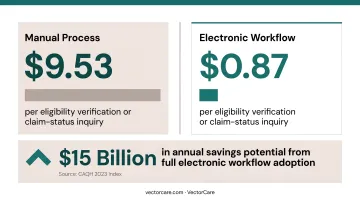
Source: CAQH 2023 Index
The Coordination-to-Billing Gap
When patient services — particularly transport and ancillary care — are coordinated via phone calls, faxes, and spreadsheets, the documentation trail is incomplete. This produces:
- Undercoding due to missing service details
- Delayed claim submission from incomplete records
- Billing disputes because payers and providers have different service records
- Missed charges that never surface until revenue is already lost
This problem is acute in patient logistics, where ambulance, NEMT, home health, and DME providers may all contribute to a single care episode. When any one of those service records is off — wrong transport type, missing timestamp, incomplete patient data — the downstream bill reflects that gap.
Denials: The Downstream Consequence
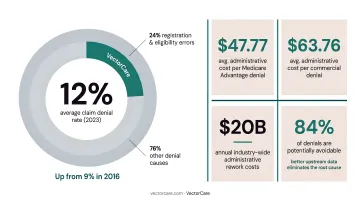
Inaccurate upstream records don't just create billing friction — they drive denials. According to Optum's 2024 Revenue Cycle Denials Index, the average claim denial rate reached 12% in 2023, up from 9% in 2016. 24% of those denials were attributed to registration and eligibility errors — problems that begin at the front end of the workflow, not in the billing department.
The financial impact of rework is significant:
- $47.77 average administrative cost per Medicare Advantage denial (Premier Inc. 2023 survey of 516 hospitals)
- $63.76 per commercial denial
- Nearly $20 billion in annual administrative rework costs industry-wide
84% of denials are potentially avoidable — which means better upstream data quality doesn't just reduce rework, it eliminates most of the reason rework exists.
Core Components of a Healthcare Payment Platform
Service Coordination and Documentation
Payment accuracy starts with clean service data. A platform must capture who provided what service, when, to which patient, under which authorization — so the billing record reflects what actually happened at the point of care.
When service requests are generated and broadcast through structured workflows rather than by phone, every transaction is timestamped and documented. This creates an auditable record that directly supports billing accuracy and payer compliance.
VectorCare's Hub module captures this data end-to-end: from initial transport request through provider assignment, GPS-tracked delivery, and proof-of-service documentation. The SMART on FHIR integration with Epic pulls patient demographics, encounter data, and ICD-10 codes directly from the EHR. Notably, the Medical Transfer Protocol (MTP) app is one of the few call-processing systems that attaches ICD-10 billing codes at the dispatch level, connecting clinical documentation to revenue cycle workflows from the first moment of a transfer.
Claims Generation and Payer Integration
A strong platform converts structured service records into payer-ready claims, applying payer-specific rules to reduce rejections before submission.
The features that determine whether claims get paid on first submission:
- EHR integration via FHIR — populates billing records with accurate patient demographics from the EHR, eliminating manual re-entry errors
- Multi-payer support — Medicare, Medicaid, commercial insurance, and managed care organizations each have different billing requirements
- Front-end eligibility validation — given that 24% of denials stem from registration and eligibility errors, validation before submission is non-negotiable
- Payer-specific claim edits — rules that catch errors before they reach the payer
Payment Posting and Reconciliation
Structured payment posting processes electronic remittance advice (ERA), matches payments to claims, and flags exceptions for human review rather than requiring manual reconciliation of every transaction.
VectorCare Pay handles payment reconciliation against contracted rate cards, with invoice generation triggered by trip completion. The system supports ACH and credit card collection through Stripe (PCI DSS Level 1 certified), with email, SMS, and in-app reminders driving faster collection cycles.
This accelerates month-end close and improves cash flow predictability — a measurable advantage for organizations running on thin operating margins.
Compliance and Audit Readiness
Every transaction in a healthcare payment platform must comply with two non-negotiable frameworks: HIPAA electronic transaction standards (ASC X12 Version 5010, governed by 45 CFR Part 162) and PCI DSS for any payment card data.
Structured audit trails give compliance teams a timestamped record of every action in the payment workflow, reducing compliance risk and cutting the time required to respond to payer audits. VectorCare maintains SOC 2 Type I certification alongside HIPAA compliance, with a full audit trail covering every invoice, payment, and adjustment.
Key Benefits: What a Payment Platform Delivers
Measurable Efficiency Gains
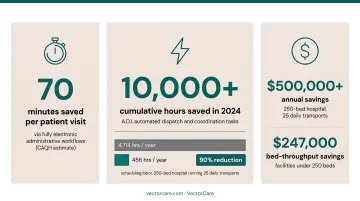
CAQH estimates that fully electronic administrative workflows save 70 minutes per patient visit on average. For high-volume healthcare organizations, that compounds fast.
VectorCare's own data illustrates the operational impact:
- A.D.I. saved customers over 10,000 hours cumulatively in 2024 by automating manual dispatch and coordination tasks
- A 250-bed hospital running 25 daily transports reduced scheduling labor from 4,714 hours per year to 456 hours — a 90% reduction
- Over $500,000 in annual savings for a 250-bed hospital running 25 daily transports (smaller facilities under 250 beds see approximately $247,000 in bed-throughput savings)
Faster Reimbursement and Reduced AR
When claims are submitted accurately because service data is captured in real time, days in accounts receivable (AR) decrease. HFMA benchmarks place ideal AR days at 30 to 40, with AR over 90 days below 10%.
Shorter AR cycles improve working capital and reduce the need to finance operational costs while waiting for reimbursements. That matters when healthcare margins average just 1–3%.
Fewer Denials, Less Rework
Electronic data validation catches eligibility and documentation errors before submission. Each denial prevented saves:
- The administrative cost of rework ($47–$64 per claim)
- 30–90 days of payment delay
- The risk of write-offs when denials aren't successfully appealed
HFMA documented one AI-driven example where denial rates dropped 18% and first-pass yield improved from 85% to 92%. Given that 22% of avoidable denials are non-recoverable, catching errors before submission is far less costly than mounting appeals after the fact.
Stronger Payer-Provider Relationships
Fewer denials also mean fewer disputes — and when payment data is transparent and accessible in real time, the ones that do arise get resolved faster. Structured digital documentation gives both sides a shared record, reducing the back-and-forth that delays payment and strains relationships.
That's where tools like VectorCare Insights add practical value: custom dashboards track cost and performance data by vendor, region, and service level, giving both providers and payer partners a shared analytical foundation for contract negotiations and dispute resolution.
How AI Is Raising the Bar for Healthcare Payments
Traditional rules-based platforms follow fixed logic. AI learns patterns, predicts exceptions, and handles decisions in real time — a meaningful difference in complex healthcare payment environments.
McKinsey projects that AI-enabled revenue cycle management could reduce provider cost-to-collect by 30% to 60%, while Deloitte reports that more than 80% of health systems are prioritizing agentic AI across operations including RCM. These are directional projections, not guaranteed outcomes — but where health systems are putting their money is clear.
Intelligent Dispatch as a Payment Enabler
AI-driven dispatch automation doesn't just save coordination time. It creates the structured, auditable service records that downstream payment accuracy depends on.
VectorCare's A.D.I. (Automated Dispatching Intelligence) processes 3.23 requests per minute across its accredited provider network. In 2024, this generated over 2.3 million broadcasts with a contract value exceeding $570 million. Every one of those transactions is timestamped, documented, and traceable — not reconstructed manually after the fact.
When AI handles service dispatch — matching the right provider to the right request based on availability, capability, and contract terms — it also enforces contract-compliant billing from the outset. The billing record reflects what actually happened because the dispatch system documented it in real time.
AI Agents for End-to-End Workflow Management
AI agents can manage complex, multi-step workflows, from scheduling and authorization through billing and reconciliation, with minimal human intervention. This is particularly valuable for care episodes involving multiple providers billed under a single patient encounter.
VectorCare's roadmap includes several agents currently in development alongside capabilities already live today:
- Predictive demand forecasting to anticipate service needs before requests arrive
- Structured prior-authorization handling to reduce manual follow-up with payers
- Conversational AI for care team requests and status updates
The live A.D.I. already handles multi-vendor dispatch, invoice generation, and exception detection on stalled trips.
One real constraint: AI-driven platforms must maintain full audit trails and HIPAA-compliant data handling. Every AI-generated decision must be documented, reviewable, and defensible in payer audits. VectorCare's HIPAA compliant, SOC 2 Type I certified architecture ensures that AI-driven payment workflows don't create compliance blind spots.
How to Evaluate and Implement a Healthcare Payment Platform
Key Evaluation Criteria
When assessing platforms, prioritize:
- EHR integration — FHIR-based connections to Epic, Cerner, and other major systems; bi-directional data exchange without middleware
- Multi-payer support — Medicare, Medicaid, commercial, MCO, and split-payment scenarios
- Service type coverage — transport, home health, DME, and ancillary services on one platform
- Compliance certifications — HIPAA, SOC 2 Type I, and PCI DSS for payment processing
- Real-time reporting — dashboards that surface AR performance, denial rates, and vendor scorecards
- Vendor track record — documented outcomes with healthcare organizations of similar size and complexity
Implementation Approach
Once you've selected a platform, a phased rollout reduces disruption and protects existing revenue cycles:
- Start with high-volume, high-error workflows — typically claims submission and payment posting, where errors are most costly
- Integrate with existing EHR systems — for Epic users, VectorCare's SMART on FHIR integration takes 8–12 weeks from decision to go-live with minimal IT lift
- Expand to upstream coordination workflows — dispatch, authorization, and documentation workflows that feed billing accuracy
- Train and support staff — how staff adapt to new workflows determines whether adoption sticks; comprehensive training from day one prevents regression to manual processes
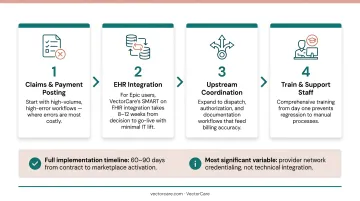
VectorCare's full implementation timeline runs 60–90 days from contract to marketplace activation. The most significant variable is provider network credentialing rather than the technical integration itself.
Measuring Success
Measurement starts before go-live. Without a baseline, you're guessing at ROI — with one, you're reporting it. Key metrics to track:
- Days in AR: target 30–40 days
- First-pass claim acceptance rate: HFMA documented one AI-driven example improving from 85% to 92%
- Denial rate: industry average sits at 12%; benchmark your current rate before implementation
- Staff hours on manual billing and coordination: VectorCare customers average a 90% reduction
- Cost per transaction: $6.74 manually vs. $3.20 electronically for claim submission
Track these monthly for the first two quarters. The trend line — not just the snapshot — is what justifies the investment and surfaces where further efficiency gains remain.
Frequently Asked Questions
What is a healthcare payment platform?
A healthcare payment platform is a technology system that digitizes and manages financial and administrative workflows across the payment lifecycle: from service documentation through claims submission and reconciliation. It connects payers, providers, and service partners in a shared digital environment, replacing manual processes with structured, rule-based workflows.
How does a healthcare payment platform reduce administrative costs?
Structured digital workflows eliminate manual data entry, phone-based coordination, and paper-based reconciliation. This frees staff time and reduces errors that generate costly rework — translating into measurable labor savings and faster revenue collection. CAQH estimates fully electronic workflows save 70 minutes per patient visit.
What is the difference between healthcare payment management and revenue cycle management?
Payment management handles the execution of financial transactions accurately and efficiently. RCM covers the broader end-to-end process from patient registration to final payment. Modern platforms increasingly integrate both, embedding billing logic into operational workflows rather than treating them as separate systems.
How does EHR integration improve healthcare payment accuracy?
EHR integration via SMART on FHIR populates billing records with accurate patient demographics, encounter data, and clinical codes from the EHR — eliminating manual re-entry errors that are a leading cause of claim denials. VectorCare's MTP app attaches ICD-10 codes at the dispatch level, connecting clinical documentation to billing from the start.
What are the biggest challenges in implementing a healthcare payment platform?
The most common obstacles are:
- Legacy system integration with existing EHRs and billing tools
- Multi-payer complexity across Medicaid, Medicare, and commercial contracts
- Staff change management during workflow transitions
- Data quality gaps in existing patient and billing records
A phased rollout with defined baseline metrics and hands-on vendor support resolves most of these before go-live.
How long does it take to implement a healthcare payment platform?
VectorCare's full implementation runs 60–90 days from contract to activation, with Epic integration achievable in 8–12 weeks. Core workflows can go live in as few as four to eight weeks. Additional payment platform capabilities are added in subsequent phases.