Most guides treat healthcare logistics as a supply chain topic. But there are actually two operating systems running simultaneously: one that moves products, and one that moves patients. Both are mission-critical. Both are frequently broken. And fixing one without the other leaves significant performance — and patient outcomes — on the table.
This guide covers both domains: medical supply chain logistics and patient logistics. You'll find definitions, a breakdown of the four logistics types, the core challenges, the technology reshaping operations, and practical guidance for healthcare operations leaders looking to improve performance across the continuum.
Key Takeaways
- Healthcare logistics has two lanes: product flow (supply chain) and patient flow (transport, transfers, care transitions)
- Supply expenses average 15% of total hospital costs — logistics optimization is a margin issue, not a back-office one
- Discharge delays, care transition failures, and fragmented coordination directly drive excess length of stay and readmissions
- AI-driven dispatching, real-time tracking, and EHR integration are replacing manual workflows — cutting coordination delays and administrative overhead
- Unified platforms outperform point solutions by eliminating handoff gaps and giving operations teams visibility across every care transition
What Is Healthcare Logistics Management?
Healthcare logistics management is the systematic coordination of planning, movement, storage, and delivery of medical products, supplies, and patients across the care continuum. The goal: the right resource reaches the right place at the right time in the right condition.
That definition spans two distinct domains.
Medical Supply Chain Logistics
This covers the movement of pharmaceuticals, devices, and supplies from manufacturers through distributors to healthcare facilities. AHRMM defines it as management of health care supplies across manufacturing, distribution, delivery, utilization, and replacement. The focus is product integrity, inventory accuracy, cost control, and regulatory compliance.
Patient Logistics
Patient logistics is the less-covered half of healthcare logistics — and often the more operationally complex. It covers:
- Non-emergency medical transportation (NEMT)
- Inter-facility transfers and air medical transport
- Discharge coordination and post-acute placement
- Home health scheduling and DME delivery
- Care transitions between settings
CMS defines NEMT as a benefit helping people get to and from medical appointments. In practice, the operational scope extends well beyond a ride: it includes every handoff, placement decision, and care transition a patient moves through across settings.
Key Stakeholders
Both domains require coordination across a broad set of organizations — each with distinct roles, systems, and accountability:
- Manufacturers, distributors, and 3PLs
- Hospitals, health systems, and transfer centers
- Ground, air, and NEMT transport providers
- Home health agencies and DME suppliers
- Payers and Medicare Advantage plans
- PACE organizations and skilled nursing facilities
- Patients themselves
VectorCare, for example, serves over 2,500 healthcare facilities by coordinating patient logistics across most of these stakeholder categories — routing requests between hospitals, payers, transport providers, and home health agencies through a shared workflow rather than separate phone calls and fax queues.
The 4 Types of Healthcare Logistics Management
Understanding each type helps operations leaders identify where their organization is losing time, money, or quality.
Inbound Logistics
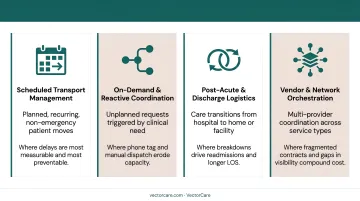
Inbound logistics covers procurement and movement of medical supplies, pharmaceuticals, and equipment from suppliers into facilities: receiving, inspection, and storage. When inbound processes break down, facilities face stockouts, expired products, and continuity-of-care gaps.
Inventory management systems and supplier reliability aren't just purchasing decisions here — they're operational imperatives.
Outbound Logistics
Outbound logistics is the delivery of products or services from a healthcare facility outward. This includes:
- Shipping specimens to reference labs
- Discharging patients with DME orders fulfilled
- Dispatching mobile care resources or home health teams
Delays here don't stay contained. A late DME delivery holds up a discharge. A delayed specimen delays a diagnosis. Outbound bottlenecks cascade quickly into clinical and financial consequences.
Reverse Logistics
Reverse logistics handles the return or disposal of expired medications, recalled devices, reusable equipment, and regulated medical waste. It's often treated as a compliance checkbox rather than an operational discipline — which is a mistake. Poor reverse logistics creates both regulatory exposure and unnecessary cost. FDA and DEA compliance requirements for pharmaceutical returns alone require documented chain-of-custody at every step.
Patient and Care Coordination Logistics
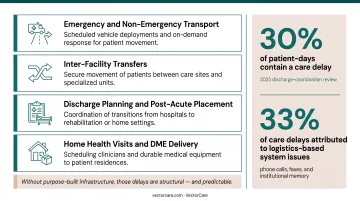
This is the most underappreciated of the four types. Patient logistics is the real-time coordination of:
- Emergency and non-emergency transport
- Inter-facility transfers
- Discharge planning and post-acute placement
- Home health visits and DME delivery
VectorCare founder David Emanuel built the company on a specific observation: patient logistics is an infrastructure problem, not a scheduling problem. Most health systems still manage it through phone calls, faxes, and institutional memory — producing fragmented, reactive coordination that extends length of stay, drives readmissions, and exhausts clinical staff.
A 2025 discharge-coordination review found that 30% of patient-days contain a care delay, with logistics-based system issues accounting for 33% of those occurrences. Without purpose-built infrastructure, those delays are structural — and predictable.
Key Challenges in Healthcare Logistics Management
Healthcare logistics operates under conditions that make every other industry's supply chain look straightforward: time-sensitivity, regulatory complexity, multi-stakeholder coordination, and a direct connection between logistical performance and patient safety.
Managing Temperature-Sensitive Supply Chains
Cold chain failures carry direct patient risk and significant financial cost. According to ASHP's cold chain management guide, inadequate cold storage results in at least $10 million in annual vaccine loss in the U.S. IQVIA estimates 16% annual vaccine wastage from temperature excursions.
Regulatory requirements compound the complexity. No single framework governs every jurisdiction — standards including FDA CFR Title 21, ICH Q1A(R2), GDP, GSP, and GMP may all apply simultaneously. Facilities must maintain:
- Documented validation at every chain segment
- Exception workflows for temperature excursions
- Mean kinetic temperature records throughout transit
- Jurisdiction-specific compliance documentation
Fragmented Systems and Lack of End-to-End Visibility
Most healthcare organizations operate with disconnected tools for inventory, transport scheduling, EHR data, and billing. Without a unified view, operations are reactive — problems surface after they've already caused delays.
Supply chain data from Guidehouse/Navigant puts the cost of that fragmentation in concrete terms: U.S. hospitals spend approximately $25.7 billion more per year on supply chain than necessary — roughly $12.1 million per hospital annually. Much of that excess stems from visibility gaps that prevent proactive management.
Manual Coordination and Communication Delays in Patient Logistics
Before VectorCare, a hospital transfer coordinator described the process bluntly: call five vendors, hold for 2–3 minutes each, write down patient vitals manually, and wait. The Joint Commission reported that **69% of clinical learning environments lacked a standardized handoff process** — a finding that reflects systemic infrastructure failure, not individual error on the part of care teams.
Discharge-to-departure time dropping from over two hours to under 30 minutes is achievable when transport coordination moves off phones and onto automated platforms. That difference has real bed-capacity implications.
Cost Pressures and Labor Shortages
Supply expenses average 15% of total hospital costs and can reach 30–40% in surgery-intensive facilities with high case-mix index. McKinsey estimates that external spend on supplies, pharmacy, and purchased services represents 30–40% of a typical health system's cost base, with 5–15% savings potential from optimization.
Labor shortages compound the pressure further. AHRMM noted in 2023 that supply chain teams are adopting AI and automation because of staff shortages, making automation a necessity rather than an optional upgrade.
How Technology Is Transforming Healthcare Logistics Management
Healthcare logistics used to run on phone calls, fax machines, and manual tracking. The technology available today makes that model obsolete — and the gap in outcomes between organizations that have modernized and those that haven't is growing fast.
Real-Time Tracking and IoT Monitoring
IoT sensors, GPS telematics, and real-time location systems (RTLS) give healthcare organizations continuous visibility into both shipment conditions and asset locations. Applications include:
- Cold chain monitoring — temperature alerts for biologics and vaccines in transit
- Vehicle tracking — real-time status for patient transport fleets
- Asset location — finding mobile equipment (infusion pumps, wheelchairs) without manual search
The healthcare RTLS market is projected to grow from $2.33 billion in 2024 to $5.72 billion by 2029 — a 19.6% CAGR — reflecting how rapidly this capability is being adopted.
AI and Automated Dispatching Intelligence
Manual dispatching is being replaced by AI-driven platforms that match transport requests to available providers, handle scheduling negotiations, and route resources without human intervention per transaction.
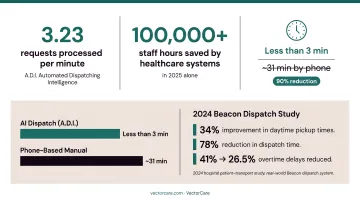
VectorCare's A.D.I. (Automated Dispatching Intelligence) illustrates what this looks like at scale: the platform processes 3.23 requests per minute. In 2025 alone, A.D.I. saved healthcare systems over 100,000 staff hours.
Scheduling takes less than 3 minutes vs ~31 minutes by phone (90% reduction) when logistics are embedded in clinical workflows.
A 2024 hospital patient-transport study documented a real-world Beacon dispatch system improving daytime pickup times by 34%, reducing dispatch time by 78%, and cutting overtime delays from 41% to 26.5%.
EHR Integration and Data Interoperability
Logistics platforms that integrate directly with EHRs via SMART on FHIR eliminate a critical source of delay: manual data re-entry. When a coordinator submits a transfer request from within Epic, patient demographics, vitals, and clinical information are already pre-populated. Providers can be contacted simultaneously rather than sequentially.
VectorCare's Epic integration demonstrates that scheduling takes less than 3 minutes, vs ~31 minutes by phone (90% reduction), to identify the best available transport option. The company's partnership with Priority Dispatch Corp launched a Medical Transfer Protocol SMART on FHIR App directly on the Epic Showroom, embedding this capability natively into clinical workflows.
Predictive Analytics for Supply Chain Optimization
Inventory optimization through predictive analytics and machine learning delivers measurable ROI. A 2021 point-of-use inventory study found that optimized systems can reduce inventories by 70-80% and material-handler FTEs by 30-45%. Just-in-time approaches have generated $3-11 million in annual savings per hospital — though COVID-19 exposed the fragility of over-lean models for critical supplies.
The lesson: predictive analytics should optimize for resilience, not just lowest unit cost.
Best Practices for Optimizing Healthcare Logistics Management
Audit Before Investing in Technology
Technology amplifies existing processes — good or bad. Before selecting any platform, map current workflows and establish baselines:
- Average transport request-to-dispatch time
- Stock-out frequency and emergency procurement events
- Length of stay attributed to discharge delays
- Time spent on manual coordination tasks per shift
Process clarity has to come before investment. Organizations that skip this step don't fix broken workflows — they just run them faster.
Standardize Communication Protocols Across Care Transitions
A significant share of patient logistics delays comes from inconsistent handoff protocols between units, facilities, and transport providers. Establish standardized workflows for:
- Discharge planning initiation
- Inter-facility transfer requests
- Post-acute placement coordination
- DME fulfillment and home health scheduling
Digital platforms enforce these workflows consistently, removing dependence on whoever happens to be on shift. That consistency also exposes where manual system-switching creates its own delays — which brings interoperability to the front of any technology decision.
Prioritize Interoperability as a Buying Criterion
When evaluating any logistics platform, EHR integration should be a non-negotiable requirement, not a bonus feature. The right question isn't "does it integrate?" but rather: how deeply, via what standard, and how many manual steps does it actually eliminate?
Platforms with SMART on FHIR Epic integration allow logistics workflows to live inside clinical workflows. Coordinators don't switch systems; the request flows from the clinical decision directly into dispatch. That's the standard to evaluate against.
Use KPIs to Drive Continuous Improvement
Establish and track logistics performance metrics consistently:
- On-time transport rate
- Discharge-to-departure time
- Inventory accuracy rate
- Cost-per-transport by modality and vendor
- Length of stay reduction attributable to discharge logistics
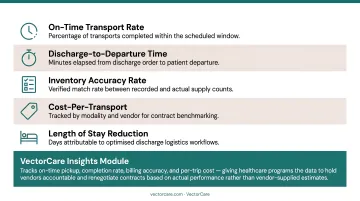
VectorCare's Insights module tracks on-time pickup, completion rate, billing accuracy, and per-trip cost, giving healthcare programs the data to hold vendors accountable and renegotiate contracts based on actual performance rather than vendor-supplied estimates.
The Future of Healthcare Logistics Management
Healthcare logistics is at an inflection point. AI, interoperability mandates, value-based care models, and demographic pressure are forcing organizations to treat logistics as strategic infrastructure — and the market is moving fast to reflect it.
AI agents and full automation represent the next step beyond automated dispatching. Rather than reviewing AI recommendations, humans will oversee while AI agents independently create transport orders, negotiate schedules, monitor in-transit status, and escalate exceptions. The healthcare supply chain management software market reflects this shift: projected to grow from $3.71 billion in 2024 to $5.06 billion by 2030.
Value-based care is turning patient logistics into a financial exposure. CMS's Hospital Readmissions Reduction Program caps payment reductions at 3%, a direct penalty for avoidable readmissions. Poor discharge coordination, transportation barriers, and failed care transitions all feed that risk.
Transportation barriers are among the leading non-clinical reasons patients miss post-discharge follow-up appointments. Patients who miss that first follow-up face significantly higher 30-day readmission rates.
The longer arc is logistics-as-infrastructure. VectorCare's SoFaaS (SMART on FHIR as a Service) illustrates where this is heading: a platform layer that lets any healthcare vendor build EHR-embedded applications, so logistics coordination happens automatically as care decisions are made. Patient logistics stops being a separate department and becomes part of care delivery itself.
Frequently Asked Questions
What does healthcare logistics management do?
Healthcare logistics management coordinates the planning, movement, and delivery of medical supplies, equipment, and patients across the healthcare system. The goal is making sure the right resource — a medication, a transport, a DME delivery — reaches the right place at the right time to keep care moving without interruption.
What are the 4 types of logistics management?
Healthcare logistics covers four core types:
- Inbound logistics — receiving drugs, devices, and supplies into facilities
- Outbound logistics — delivering products outward, including patient discharge with DME
- Reverse logistics — managing returns, recalls, and regulated waste disposal
- Patient/care coordination logistics — transport, inter-facility transfers, and post-acute coordination
What is the difference between healthcare supply chain logistics and patient logistics?
Supply chain logistics focuses on moving physical products — drugs, devices, and supplies — from manufacturers to facilities. Patient logistics focuses on coordinating patient movement and care transitions, including transport, inter-facility transfers, home health scheduling, and DME delivery. Both are essential; most organizations invest heavily in one and underinvest in the other.
What are the biggest challenges in healthcare logistics management?
The most common challenges include:
- Fragmented systems with no end-to-end visibility
- Manual coordination that creates bottlenecks at discharge
- Cold chain compliance for temperature-sensitive products
- Inconsistent handoff protocols during care transitions
- Dual pressure from rising costs and workforce shortages
How does technology improve healthcare logistics management?
Technology addresses the core inefficiencies that slow logistics down:
- Real-time tracking and IoT monitoring for visibility across the supply chain
- AI-driven dispatching that replaces manual phone coordination
- EHR integration that eliminates duplicate data entry
- Predictive analytics that prevent stockouts and optimize inventory
Unified platforms replace siloed tools and give operations leaders one view across all workflows.
How can hospitals reduce costs through better logistics management?
Several operational levers consistently move the needle on cost:
- Automating manual coordination workflows to cut staff hours on non-clinical tasks
- Optimizing inventory to prevent both overstocking and emergency procurement
- Shortening patient length of stay through faster discharge logistics
- Consolidating vendors onto integrated platforms with visibility into cost-per-transport, on-time rates, and vendor performance