Introduction
Patient logistics has long been treated as a scheduling problem. Book the transport, fax the DME order, call the home health agency. Repeat. In modern healthcare systems, that framing is costly. Delays in moving patients, coordinating post-discharge services, and managing transport networks have direct consequences for bed capacity, patient outcomes, and hospital finances.
Phone calls and faxes still dominate care transitions. According to AHRQ, 70% of hospital-to-home transitions include at least one safety issue such as incomplete information or medication errors. Meanwhile, approximately 30% of all patient-days involve a care delay, with a third of those delays traced directly to internal system failures like transport coordination and discharge scheduling.
This guide covers what healthcare logistics actually means, why it's harder to fix than most organizations expect, what software must do to address it, and how AI is reshaping what's possible — so you can evaluate solutions with clear criteria in hand.
Key Takeaways:
- Patient logistics is infrastructure, not scheduling — fragmented coordination directly extends length of stay and increases costs
- Effective platforms require EHR integration, automated dispatch, real-time visibility, and compliance tools
- AI-driven dispatching can reduce coordination time by over 75%, with measurable impact on throughput and labor costs
- SMART on FHIR compliance is now a baseline procurement requirement, not a differentiator
- Unified platforms covering transport, home health, DME, and post-acute care outperform single-function point solutions
What Is Healthcare Logistics?
Healthcare logistics covers the planning, coordination, and execution of moving people, information, and services across the care continuum. That includes pharmaceutical distribution, medical supply chains, patient transport, and post-acute care coordination.
Supply Chain vs. Patient Logistics
These two disciplines are frequently conflated, but they require different infrastructure:
- Supply chain logistics moves drugs, devices, and medical supplies through procurement and distribution networks — well-served by existing enterprise logistics platforms
- Patient logistics coordinates the movement of patients themselves, along with every service supporting their care at each transition point: transport, home health visits, DME delivery, and follow-up care scheduling
Patient logistics carries clinical, compliance, and safety dimensions that standard supply chain tools aren't built to handle.
A missed shipment is a procurement problem. A missed discharge transport extends a patient's hospital stay, delays a bed for the next admission, and in some cases directly affects clinical outcomes.
VectorCare CEO David Emanuel put it directly: patient logistics is no longer a back-office function — it's foundational infrastructure.
The Scale of the Problem
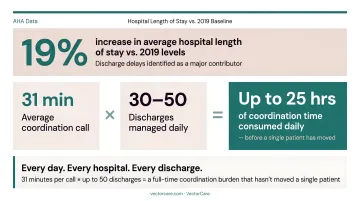
The AHA reported that average hospital length of stay increased 19% compared to 2019 levels, with discharge delays identified as a major contributor. When a single transport coordination call takes an average of 31 minutes, and a hospital manages 30–50 discharges daily, that's up to 25 hours of coordination time consumed every day — before a single patient has moved.
Why Healthcare Logistics Is Uniquely Complex
Healthcare logistics is hard for a specific reason: the ecosystem is fragmented, the stakes are clinical rather than commercial, and the systems managing these workflows were never built to work together.
Multi-Stakeholder Coordination
A typical patient discharge involves hospitals, ambulance providers, NEMT operators, home health agencies, DME suppliers, payers, and receiving facilities — each operating on different systems, different timelines, and different communication channels. Without a unified platform, coordination defaults to phone calls and faxes, which collapse under volume.
Regulatory and Compliance Pressure
Healthcare logistics must navigate:
- HIPAA requirements for protected health information at every handoff
- Insurance authorization requirements varying by payor and plan
- Medical necessity documentation standards
- Payor-specific form requirements that change by contract
The 2025 AMA Prior Authorization Survey found physicians spend an average of 13 hours per week on prior authorization, with 95% reporting care delays as a direct result. Only 24% have access to electronic prior authorization within their EHR — meaning most of this work is still done manually, adding hours of administrative friction before a patient ever moves.
Time-Sensitivity That Exceeds Commercial Logistics
A delayed transport in healthcare isn't an inconvenience — it extends a bed stay, causes a missed specialist appointment, or, in critical interfacility transfers, affects patient safety directly. The tolerance for failure is near zero, yet the systems managing these workflows were built for far more forgiving environments.
Data Fragmentation and Legacy Systems
Most healthcare organizations manage patient logistics through a patchwork of EHRs, CAD systems, spreadsheets, and phone-based coordination. Patient data sits in silos. It's rarely shared in real time across care transitions. Before implementing VectorCare, the Orange County Healthcare Agency's behavioral health teams manually phoned down a list of contracted ambulance providers for each mental health crisis call — while simultaneously managing a patient in distress. With VectorCare's platform, scheduling takes less than 3 minutes vs. ~31 minutes by phone (90% reduction).
Core Features of Healthcare Logistics Software
Not all logistics platforms are built for healthcare. These are the capabilities that distinguish purpose-built solutions from general scheduling tools.
Scheduling and Dispatch Management
Effective scheduling must cover the full spectrum of patient movement: ground transport, air medical, NEMT, home health visits, and DME delivery. Manual scheduling — even with good software — creates bottlenecks at scale. The platform should support automated dispatch that matches requests to the best available provider based on real-time criteria, rather than coordinator availability.
EHR Integration and Data Interoperability
Software that requires manual data entry from the EHR introduces errors and adds time. That's the opposite of what logistics coordination is supposed to do. By 2022, more than two-thirds of US hospitals had adopted FHIR-based APIs to enable patient access — making SMART on FHIR compliance a baseline expectation, not a premium feature.
VectorCare's own SMART on FHIR Epic integration pulls patient demographics, clinical context, pickup location, and destination automatically at the moment a transport request is initiated. Scheduling takes less than 3 minutes vs ~31 minutes by phone (90% reduction).
Separately, the Medical Transfer Protocol SMART on FHIR app, built by Priority Dispatch Corp., is listed on the Epic Showroom. Epic-using health systems can access it through an officially recognized channel.
Real-Time Communication and Status Visibility
Dispatchers aren't the only ones who need live status updates. Hospital staff need to know when transport is en route. Receiving facilities need accurate ETAs. Transport crews need complete patient data before they arrive.
Platforms that replace phone tag with in-platform messaging, automated status notifications, and transparent activity logs eliminate a major source of coordination failure.
Automated Dispatching Intelligence
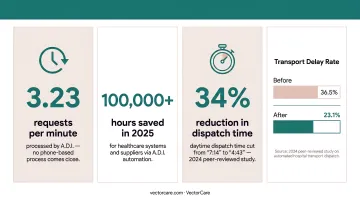
Rule-based and AI-driven dispatch automation replaces the manual process of finding available providers, contacting them in sequence, and confirming coverage. VectorCare's A.D.I. (Automated Dispatching Intelligence) processes 3.23 requests per minute. No phone-based process comes close to that throughput. In 2025, A.D.I. saved healthcare systems and suppliers more than 100,000 hours.
A 2024 peer-reviewed study on automated hospital transport dispatch found that automation reduced average daytime dispatch time from 7:14 to 4:43 — a 34% reduction — while transport delay rates dropped from 36.5% to 23.1%.
Analytics, Compliance, and Documentation
Two additional capabilities belong in every evaluation:
- Analytics: On-time performance, scheduling time, transport utilization, and cost per transport. One VectorCare customer identified that 12% of dialysis transport pickups were missing SLA — traced to a notification gap between Epic and dispatch. A single rules-based automation fix raised on-time performance from 88% to 94% within one week.
- Compliance and documentation: The platform should auto-generate required documentation, maintain audit-ready logs, and configure to payor-specific requirements without requiring manual administrative work to stay compliant.
How AI and Automation Are Transforming Healthcare Logistics
From Reactive to Predictive Coordination
Traditional logistics management responds to requests as they arrive. AI-enabled platforms can identify patients likely to need post-acute services before discharge — shifting planning from reactive to proactive.
Two health systems show what that shift looks like in practice:
- Parkview Health implemented an AI-driven predictive model for post-acute care identification, reducing average LOS by 0.54 days per patient and generating $7.5 million in total cost savings over one year
- UnityPoint Health deployed a real-time LOS predictive model that saved 5,000 hours of nursing labor by proactively flagging patients at risk of extended stays
McKinsey's Q4 2025 survey found that 50% of US healthcare organizations had implemented generative AI, with 82% expecting positive ROI. Administrative efficiency was a top deployment priority.
Workflow Automation Beyond Dispatching
Dispatching is just the starting point. AI now handles coordination tasks that once required constant manual intervention:
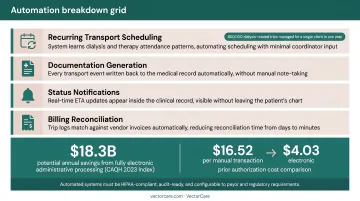
- Recurring transport scheduling: For dialysis or therapy patients, the system learns attendance patterns and automates scheduling with minimal coordinator input (VectorCare's platform managed 800,000 dialysis-related trips for a single client in one year)
- Documentation generation: Every transport event is written back to the medical record automatically, without manual note-taking
- Status notifications: Real-time ETA updates appear inside the clinical record, visible without leaving the patient's chart
- Billing reconciliation: Trip logs match against vendor invoices automatically, reducing reconciliation time from days to minutes
The CAQH 2023 Index calculated that transitioning remaining manual administrative transactions to fully electronic processing could save $18.3 billion annually across the healthcare industry. Prior authorization alone costs $16.52 per manual transaction versus $4.03 electronic.
Those savings only materialize when automation is built to healthcare's compliance standards. Automated systems must be HIPAA-compliant, audit-ready, and configurable to payor and regulatory requirements. VectorCare's platform tracks what rules changed and when, creating an auditable history of operational logic that documents compliance without adding manual burden.
Key Benefits of Implementing Healthcare Logistics Software
Operational Efficiency and Cost Reduction
The labor math is significant. When a single transport coordination call takes 31 minutes and a hospital manages dozens of discharges daily, that's hours of staff time spent on logistics that software can handle in seconds. VectorCare's platform has demonstrated over $500,000 in annual savings for a 250-bed hospital with 25 daily transports through centralized logistics — with one large California payer saving $22.2 million in annual scheduling time savings through automated coordination.
Across VectorCare's network, A.D.I. generated 2.3 million broadcasts in 2024 with contract value exceeding $570 million — demonstrating the scale at which automated coordination can operate without proportional staffing growth.
Improved Patient Throughput and Reduced Length of Stay
Faster discharge logistics directly reduce bed occupancy. When transport, DME, and home health services are coordinated in a unified system, patients don't wait for discharge while coordinators make phone calls. One structured case management implementation documented in BMJ Open Quality reduced average LOS from 11.5 days to 4.4 days, increased patients discharged before noon from 20% to 64%, and generated approximately $32.8 million in net cost savings — a 26.1x ROI on a $1.3 million investment.
Better Care Continuity Across Settings
When logistics are unified, handoffs are cleaner. Patient information travels with the patient automatically, accurately, and in a HIPAA-secure format. Receiving facilities know who's coming and when. Transport crews have the clinical context they need before they arrive.
The stakes for getting post-discharge logistics right are financial, not just operational:
- Nearly 1 in 5 Medicare beneficiaries experience unplanned readmission within 30 days
- More than 75% of the resulting $15 billion annual cost is identified as potentially preventable
- Transportation barriers rank among the leading non-clinical drivers of missed follow-up appointments
- For FY2026, 240 hospitals face HRRP penalties of 1% or more, up from 208 in FY2025
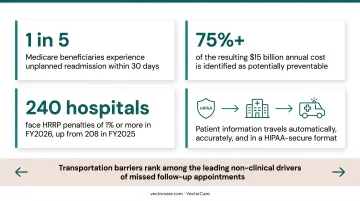
Coordinated patient logistics closes the gap between discharge and follow-through — turning post-discharge planning from a compliance risk into a manageable, measurable process.
How to Choose the Right Healthcare Logistics Software
Map Your Logistics Scope First
Before evaluating platforms, document every logistics workflow your organization manages:
Before evaluating platforms, document every logistics workflow your organization manages:
- Patient transport and interfacility transfers
- Non-emergency medical transportation (NEMT)
- Home health scheduling and DME delivery
- Air medical coordination
Prioritize platforms built to handle your specific mix. Point solutions for individual workflow types create new silos — the same fragmentation you're trying to eliminate.
VectorCare serves hospitals, payers, NEMT providers, home health agencies, DME suppliers, PACE organizations, and ambulance providers — all from a single platform. For organizations managing multiple logistics types simultaneously, a unified architecture eliminates the integration overhead and coordination gaps that come with stitching together point solutions.
Evaluate Integration Depth
Ask vendors specifically:
- Does the integration use FHIR standards or custom-built connectors?
- Is the platform listed on the Epic Showroom or equivalent?
- What patient data fields populate automatically, and what still requires manual entry?
- How are integrations maintained when EHR versions update?
Custom connectors require ongoing maintenance and break during upgrades. FHIR-native integrations are more durable and align with ONC Cures Act requirements that certified health IT must implement standardized FHIR-based APIs.
Assess Network Size, Scalability, and Vendor Track Record
Evaluate:
- The size and geographic coverage of the provider network accessible through the platform
- Whether the platform can scale as your service area and logistics volume grow without proportional staffing increases
- The vendor's experience with organizations of similar size, complexity, and logistics mix
These criteria matter because growth exposes gaps that pilots don't. VectorCare serves over 2,500 healthcare facilities nationwide and has operated profitably for three consecutive years — a track record that reflects sustained production performance, not just early-stage momentum.
Frequently Asked Questions
What is healthcare logistics?
Healthcare logistics is the coordination of people, products, and services across the care continuum, encompassing both supply chain management of medical products and the coordination of patient transport, home health, and post-acute care services. Patient logistics has emerged as a distinct discipline requiring dedicated infrastructure separate from general supply chain tools.
What are the key features to look for in healthcare logistics software?
Prioritize automated scheduling and dispatch, FHIR-based EHR integration, real-time communication and status visibility, compliance documentation automation, and operational analytics. These five capabilities separate purpose-built platforms from general scheduling tools adapted for healthcare use.
How does healthcare logistics software improve patient outcomes?
Faster, more reliable transport coordination reduces gaps between care settings: patients reach follow-up appointments, receive home health services on time, and aren't left waiting at discharge. Smoother handoffs lower readmission risk and help close the care gaps that drive preventable complications.
How does healthcare logistics software integrate with EHR systems?
Modern platforms use SMART on FHIR to embed directly into EHR environments like Epic, automatically pulling patient demographics, clinical context, and logistics details, eliminating manual re-entry. VectorCare offers its own SMART on FHIR integration with Epic. Separately, the Medical Transfer Protocol app by Priority Dispatch Corp. is listed on the Epic Showroom as an officially recognized procurement channel.
What types of organizations benefit most from healthcare logistics software?
Most organizations coordinating patient movement or post-acute services benefit, especially those managing multiple logistics types across a complex provider network:
- Hospitals and health systems
- Ambulance, EMS, and NEMT providers
- Home health agencies and DME providers
- Payers and PACE organizations
- Skilled nursing facilities and public health departments
What is the difference between healthcare supply chain logistics and patient logistics?
Supply chain logistics moves pharmaceuticals, devices, and medical supplies through distribution networks. Patient logistics coordinates the movement of patients themselves and the services (transport, home health, DME) that support their care transitions. The latter requires clinical context, compliance guardrails, and real-time coordination across care settings that supply chain platforms aren't designed to provide.