Introduction
The NEMT industry serves roughly 3.3 million Medicaid beneficiaries annually, generating over 55 million ride days — and the software coordinating those trips now determines whether that capacity is used efficiently. As operations grow more complex, so does the pricing landscape for the technology running them.
NEMT software pricing ranges from under $50/month for a solo operator to custom six-figure enterprise contracts for health systems coordinating hundreds of vehicles across multiple facilities. That gap reflects fundamentally different operational demands, not vendor pricing games.
Most buyers approach pricing the wrong way. They compare monthly subscription fees without accounting for setup costs, integration fees, clearinghouse charges, and annual escalation clauses that can double year-one costs.
This guide covers the full picture:
- What each pricing tier actually includes
- How the main pricing models work
- Which factors drive costs up or down
- How to build a budget around ROI, not just the lowest available rate
Key Takeaways
- Entry-level plans start around $50–$75/month; mid-tier runs $125–$250+/month; enterprise is custom-quoted
- Fleet size, automation depth, integrations, and compliance requirements are the biggest cost drivers
- Per-vehicle pricing suits small fleets; tiered subscriptions fit growing operators; enterprise contracts work best for hospitals and health systems
- Setup fees, clearinghouse charges, and annual rate increases add meaningfully to total cost of ownership beyond the monthly subscription
- Platforms that automate dispatch and reduce manual coordination typically deliver savings that far outpace their subscription cost
How Much Does NEMT Software Cost?
NEMT software doesn't carry a fixed price. Two providers running similar operations can pay very different amounts depending on fleet size, required features, and the vendor's pricing model.
Underestimating costs creates real problems: switching vendors mid-contract is expensive, choosing the wrong tier leaves feature gaps at critical moments, and ignoring total cost of ownership inflates year-one spend well beyond the advertised rate.
Understanding those risks starts with knowing what each tier actually covers — and where the gaps are.
Entry-Level / Basic Plans
Typical range: $50–$75/month (flat or per-vehicle)
Verified examples:
- RouteGenie: starts at ~$50/month
- NEMT Cloud Dispatching Solo: $49.99/month for 1 vehicle
- Bambi: $69/month/vehicle
- NEMT Platform Freedom: $74.99/month (includes 250 trips/month, then $0.30/additional trip)
What's typically included: Core scheduling, basic dispatch, GPS tracking, a driver mobile app, and basic billing tools in some plans.
What's typically excluded: Route optimization, broker API integrations, EDI 837 billing, advanced analytics, and multi-state EVV compliance.
Best for: Solo operators or single-van providers where affordability outweighs feature depth.
Mid-Range / Standard Plans
Typical range: $125–$250/month (flat or hybrid per-vehicle)
Verified examples:
- NEMT Cloud Dispatching Small Fleet: $149.99/month (up to 5 vehicles)
- NEMT Cloud Dispatching Growth: $149.99/month + $39.99/vehicle for 6–49 vehicles
- NEMT Platform Corporate: $249.99/month (450 trips included, then $0.27/additional trip)
What mid-tier adds: Route optimization, broker billing support, CMS-1500/EDI 837 filing, dedicated account management, and unlimited training in some plans.
Where add-on fees appear: Remote dispatch support (NEMT Platform charges ~$4.50/hour), credit card processing (typically 3–4%), and overflow trip charges.
Best for: Growing fleets of 6–30 vehicles that need automation and broker connectivity without enterprise complexity.
Enterprise / Advanced Plans
Typical range: Custom-quoted, negotiated per-vehicle rates at scale
Enterprise contracts are scoped to the organization, not published on a pricing page. What buyers can expect at this level:
- Custom EHR integrations (including SMART on FHIR for Epic)
- Multi-modal coordination across transport, DME, and home health
- Dedicated SLAs and account management
- Compliance infrastructure built for multi-state operations
- ML-powered analytics and automated dispatching intelligence
Platforms like VectorCare, which serves 2,500+ healthcare facilities, operate at this tier. Pricing at this level reflects the full operational complexity of coordinating patient logistics across multiple care settings. This is infrastructure pricing, not scheduling tool pricing.
Best for: Hospitals, health systems, payers, and multi-site organizations where patient logistics is infrastructure, not a scheduling tool.
Tier Comparison at a Glance
| Tier | Monthly Cost | Fleet Size | Key Add-Ons Unlocked |
|---|---|---|---|
| Entry-Level | $50–$75 | 1–5 vehicles | Core dispatch, GPS, driver app |
| Mid-Range | $125–$250 | 6–30 vehicles | Route optimization, broker billing, EDI 837 |
| Enterprise | Custom | 30+ vehicles | EHR integrations, multi-modal, ML analytics |
NEMT Software Pricing Models Explained
The pricing model shapes how costs scale as operations grow — sometimes more consequentially than the sticker price itself. There are four primary structures in the market.
Per-Vehicle Pricing
A fixed monthly fee per active vehicle, regardless of trip volume. Bambi's published $69/month/vehicle is a clean example.
Costs scale linearly as the fleet grows — which means no surprise trip overages, but every new vehicle adds to the monthly bill. It's predictable and easy to budget, which makes it a natural fit for operators with stable fleets and consistent trip volume.
Per-Trip Pricing
Charged per completed trip, either instead of or on top of a base fee. NEMT Platform's $0.27–$0.30 overflow trip pricing illustrates how this typically works in hybrid models.
Lower-volume or seasonal operations benefit because costs stay proportional to actual activity. At higher trip volumes, though, per-trip pricing becomes a growth tax. Operators running 500+ trips/month often find flat or per-vehicle pricing more economical.
Flat-Rate / Tiered Subscription Pricing
A base fee covers a defined set of vehicles, trips, and features. Higher tiers unlock increased caps or premium capabilities, including:
- Route optimization
- Broker billing integrations
- Advanced reporting and analytics
Feature gating is common: operators often find that the feature they actually need sits one tier above their current plan. Before signing, confirm exactly where dispatch limits, reporting access, and API integrations fall across tiers — that's where surprises typically hide.
Enterprise / Custom Pricing
Quote-based and negotiated based on:
- Number of facilities or vehicles
- Required integrations (EHR, broker APIs, billing clearinghouses)
- Support SLAs
- Deployment complexity
This model is standard for hospitals, health systems, and payers coordinating patient logistics across multiple care settings. There's no published rate; the scope determines the price.
Key Factors That Affect NEMT Software Pricing
Pricing is shaped by operational, technical, and contractual variables — not fleet size alone. Understanding these helps avoid overpaying for unused features or underspending on critical ones.
Fleet Size and Deployment Scope
On per-vehicle plans, fleet size directly scales costs. On enterprise contracts, scope matters more: a single NEMT provider with 20 vehicles pays differently than a health system coordinating transportation across dozens of facilities in multiple states.
Feature Set and Automation Depth
The jump from core features to advanced automation is where pricing diverges most sharply:
| Feature Category | Examples | Pricing Impact |
|---|---|---|
| Core | Scheduling, GPS, basic dispatch | Entry-level tiers |
| Standard | Route optimization, broker APIs, basic billing | Mid-tier |
| Advanced | AI-driven automated dispatch, real-time visibility | Premium or enterprise |
| Enterprise | EHR integration (SMART on FHIR), multi-modal coordination | Custom-quoted |
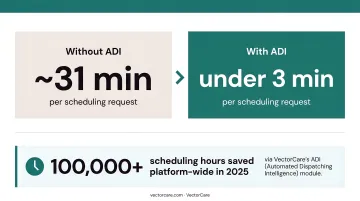
VectorCare's ADI (Automated Dispatching Intelligence) module cuts scheduling time from roughly 31 minutes to under 3 minutes per request, with platform-wide savings exceeding 100,000 hours in 2025.
Integration Requirements
EHR integrations, broker API connections, and billing clearinghouse links add cost — but they also reduce manual re-entry errors and claim inaccuracies that typically cost more to fix after the fact. Platforms that handle these natively tend to lower total cost of ownership over a 12–24 month window.
Compliance and Security Infrastructure
HIPAA-secure architecture, audit-ready documentation, and EVV compliance (which the 21st Century Cures Act mandates for Medicaid personal care and home health services) carry higher base costs in platforms that build them in from the start. Bolt-on compliance is less expensive upfront and more expensive in regulatory risk.
Support Level and Customization
What's included in the base price varies widely between vendors. Key questions to ask before signing:
- Does the base tier include dedicated account management or email-only support?
- Are custom workflows and state-specific compliance builds priced separately?
- Is tailored reporting an add-on or standard?
- What's the escalation path if a compliance issue surfaces post-deployment?
Complex operations almost always need more than the default support tier — clarifying this upfront prevents surprises at renewal.
What's Actually Included (and Not) in NEMT Software Pricing
The monthly subscription is just the start. Total cost of ownership extends across the full implementation lifecycle.
One-Time Setup and Onboarding Costs
Some vendors waive these entirely — Bambi and NEMT Platform both advertise $0 onboarding. Others charge for broker integration configuration, data migration, and initial training, sometimes without disclosing it until contract signing.
What to ask vendors upfront:
- Is there a setup or onboarding fee?
- Are broker API configurations included or billed separately?
- What does training cost, and is it one-time or ongoing?
Ongoing Operational Costs
Beyond the base subscription, buyers should budget for:
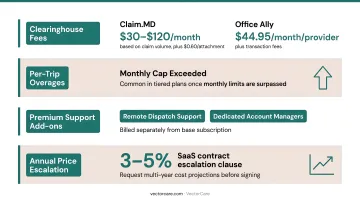
- Clearinghouse fees: Claim.MD runs $30–$120/month depending on claim volume, plus $0.60/attachment; Office Ally charges $44.95/month/provider plus transaction fees
- Per-trip overages once monthly caps are exceeded — common in tiered plans
- Premium support add-ons such as remote dispatch support or dedicated account managers
- Annual price escalation — SaaS contracts commonly include 3–5% escalation clauses, so request multi-year cost projections before signing
Upgrade and Feature Add-On Costs
Features commonly priced separately include:
- White-label passenger apps
- Advanced analytics dashboards
- Additional user licenses
- Custom integrations
Request an all-in quote that reflects your actual use case — not just the base tier. A base-tier price of $150/month can easily reach $400/month once the required features are added.
Low-Cost vs. Enterprise NEMT Software: Key Differences
Both categories handle dispatch. Where they diverge is in operational outcomes — and the scale of problems each can actually solve.
| Capability | Low-Cost Platforms | Enterprise Platforms |
|---|---|---|
| Dispatch automation | Manual or semi-automated assignment | AI-driven automated dispatching |
| Integration depth | Standalone tools, limited API access | EHR connectivity (e.g., SMART on FHIR), broker APIs, billing clearinghouses |
| Compliance coverage | Basic EVV, limited multi-state support | Full HIPAA-secure multi-state compliance infrastructure |
| Scalability | Single fleet, single location | Multi-facility, multi-modal coordination across transport, DME, home health |
| Analytics | Basic reporting | ML-powered insights and fraud detection |
Lower-cost tools reduce upfront spend but typically require parallel billing systems, manual re-entry, and additional staff to fill coordination gaps. Enterprise platforms carry higher initial cost but deliver measurable savings through automation and error reduction.
A vendor case study from VectorCare shows a large California payer saving $22.2 million in annual scheduling time savings after implementing the platform. Roundtrip similarly documented $1 million in cost savings for St. Luke's University Health Network. These are vendor case studies, not independent benchmarks, but they illustrate the scale of savings automation can produce in practice.
The right comparison is total cost of ownership: a low-cost tool plus staff time and manual workarounds, weighed against an enterprise platform's subscription plus the measurable savings from automation.
How to Estimate the Right NEMT Software Budget
The right budget maps to operational complexity, payer mix, compliance requirements, and growth trajectory — not the lowest available number.
Questions to Answer Before Requesting a Quote
- How many vehicles, facilities, or service lines need coordination?
- What integrations are required — EHR, broker APIs, billing clearinghouses?
- What level of automation is needed to reduce manual workload?
- What are your compliance requirements across states and payer types?
- What does your current cost of manual coordination actually look like — in staff hours, claim errors, and denied reimbursements?
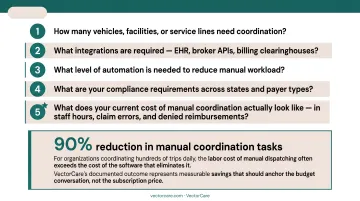
That last question matters most. For organizations coordinating hundreds of trips daily, the labor cost of manual dispatching often exceeds the cost of the software that eliminates it.
VectorCare's documented outcome — a 90% reduction in scheduling time (from 31 minutes to under 3 minutes) — represents measurable savings that should anchor the budget conversation, not the subscription price.
Framing the ROI Conversation
For smaller NEMT operators, the ROI question is simpler: does this tool save enough time per trip to justify the monthly cost?
For hospitals and health systems, the calculation is broader. It involves:
- Length-of-stay impact from faster discharge coordination
- Staff hours reclaimed from phone-based transport requests
- Claim accuracy improvements that reduce denials
VectorCare reports over $500,000 in annual savings for a 250-bed hospital with 25 daily transports, tied to outcomes across transport, discharge coordination, and ancillary services.
Get a formal ROI estimate before signing. Most enterprise-grade platforms, including VectorCare, provide ROI assessments as part of the sales process. That number gives you a concrete basis for comparison — not just monthly rates, but total value delivered.
Frequently Asked Questions
How much does NEMT software cost?
Entry-level per-vehicle plans start around $50–$75/month. Mid-tier subscriptions run $125–$250/month depending on fleet size and features. Enterprise contracts for hospitals and health systems are custom-quoted. Total cost always depends on fleet size, feature requirements, integrations, and pricing model.
What is the difference between per-vehicle and per-trip NEMT software pricing?
Per-vehicle pricing charges a flat monthly fee per active vehicle regardless of trip volume, making costs predictable as your fleet grows. Per-trip pricing charges based on completed trips, which works well for low-volume or seasonal operators but becomes expensive at higher volumes where per-vehicle pricing is typically more economical.
What hidden costs should NEMT providers watch out for?
The most common add-ons beyond the base subscription: setup and onboarding fees, broker integration configuration charges, clearinghouse fees per claim, remote support or account management upgrades, and annual escalation clauses in multi-year contracts. Always request an all-in first-year cost estimate before signing.
What NEMT software features justify a higher price tier?
AI-driven automated dispatch, EHR integration via SMART on FHIR, multi-state compliance infrastructure, real-time patient tracking, billing automation, and enterprise-grade data security consistently command higher pricing. These features deliver measurable returns through reduced manual work, fewer claim errors, and faster coordination.
Is enterprise NEMT software worth the cost for hospitals and larger health systems?
For organizations coordinating patient logistics across multiple facilities, payer types, and care settings, the ROI typically exceeds the software cost through automation savings, shorter patient length of stay, and staff time reclaimed from manual coordination — especially when integrated with existing EHR infrastructure.
How long does NEMT software implementation take, and are there setup costs?
Basic SaaS platforms deploy in 24–48 hours with no setup fee. Enterprise deployments with EHR integrations and multi-facility scoping typically take 4–6 weeks, with setup costs ranging from $0 to several thousand dollars depending on complexity.