Introduction
Most hospitals still coordinate patient transport the same way they did 20 years ago — phone calls to vendors, handwritten logs, spreadsheet tracking, and a coordinator juggling a dozen requests at once. It works until it doesn't, and at scale, it doesn't.
According to AHRQ, which draws on early-2000s emergency-care data, 9 out of 10 hospitals had boarded admitted ED patients while waiting for inpatient beds, with roughly 500,000 ambulances diverted annually as a downstream consequence. Patient logistics is a direct contributor to both problems.
A healthcare workforce logistics VMS replaces that fragmented architecture with a centralized, automated platform — one that manages dispatch, vendor networks, and real-time tracking across every transport type. The facilities that have made this shift are seeing measurable results: shorter patient stays, fewer diverted ambulances, and millions of dollars in recovered operational costs.
Key Takeaways
- A healthcare logistics VMS automates dispatch, eliminates manual coordination, and provides real-time visibility across every patient transport type.
- Facilities see measurable reductions in dispatch time, per-transport costs, and bed turnaround time.
- EHR integration via SMART on FHIR removes manual data re-entry and creates clean audit trails automatically.
- Without a VMS, missed transports, delayed discharges, and unchecked vendor spend accumulate quietly — and the total cost is rarely visible until it's significant.
- The ROI grows as more transport types are consolidated onto a single platform.
What Is a Healthcare Workforce Logistics VMS?
A healthcare workforce logistics VMS (Vendor Management System) is a technology platform that centralizes the coordination, dispatching, and management of patient transport and logistics services across a credentialed network of providers. That includes ground ambulance, NEMT, air medical, home health, and DME — all managed through a single system rather than separate vendor relationships.
It serves organizations that coordinate patient movement across care settings, including:
- Hospitals and health systems
- Transfer centers and payers
- SNFs and PACE organizations
- Home health agencies and DME providers
The more useful frame is infrastructure, not software. A logistics VMS doesn't just organize requests — it standardizes the entire workflow from order placement to completion, creating accountability, visibility, and measurable performance data that manual coordination can never produce consistently.
VectorCare's platform, for example, serves over 2,500 healthcare facilities and processed 2.3 million broadcasts in 2024 with contract value exceeding $570 million — numbers that reflect what happens when coordination shifts from phone calls and spreadsheets to a purpose-built logistics layer.
Key Advantages of a Healthcare Workforce Logistics VMS
The advantages below are grounded in outcomes healthcare organizations actually track: cost, time, quality, and risk reduction. They apply across facility types but become especially significant as coordination complexity grows.
Advantage 1: Automated Dispatch Eliminates Manual Coordination
In most facilities, transport coordination still runs on phone calls, texts, and follow-up calls to confirm the previous call worked. Each manual handoff introduces delay, and delays compound across hundreds of daily requests.
A VMS replaces this with automated broadcast-and-accept dispatch. When a transport request is placed, the system simultaneously broadcasts to the appropriate provider network, applies pre-set rules (distance, specialty, vehicle type), and confirms the assignment without requiring a coordinator to pick up the phone.
VectorCare's A.D.I. (Automated Dispatching Intelligence) processes 3.23 requests per minute. By 2025, A.D.I. had saved customers more than 100,000 hours, previously absorbed by manual coordination tasks.
The operational impact is direct: removing manual dispatch eliminates the communication delays that consistently push transport timelines out.
A 2024 hospital study on real-time dispatch found that automated methods reduced overtime delay rates from 41.0% to 26.5% and cut daytime pickup times from 7:14 to 4:43 — a 34% improvement in pickup performance.
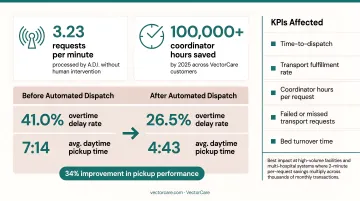
KPIs affected:
- Time-to-dispatch
- Transport fulfillment rate
- Coordinator hours per request
- Failed or missed transport requests
- Bed turnover time
When it matters most: High-volume facilities and multi-hospital health systems where even a 2-minute per-request saving multiplies across thousands of monthly transactions.
Advantage 2: Measurable Cost Reduction and Smarter Resource Allocation
Without a VMS, most facilities default to familiar vendors at fixed rates with no competitive pressure. There's no mechanism to compare pricing across providers, benchmark performance, or understand where transport spend is actually going.
A VMS changes that structure. By broadcasting to a credentialed provider network, facilities receive competitive responses rather than a single rate. Analytics surface cost variance by vendor, transport type, and region, shifting procurement from instinct to evidence.
VectorCare has documented over $500,000 in annual savings for a 250-bed hospital with 25 daily transports, with one large California payer saving $22.2 million in annual scheduling time savings after restructuring their patient logistics through the platform. Those savings flow from lower per-transport rates through competitive broadcasting, and reduced administrative overhead as coordinator hours shift away from manual dispatching.
AHRQ data, drawn from early-2000s studies, shows a single hour of ED boarding reduction was associated with over $9,000 in additional revenue at one academic medical center, and each hour on ambulance diversion was linked to $1,086 in foregone hospital revenue. Transport delays that extend patient length of stay carry those costs at scale.
KPIs affected:
- Cost per transport
- Total annual transport spend
- Vendor rate variance
- Average patient length of stay
- Bed utilization rate
- Administrative hours per transport request
When it matters most: Organizations managing multiple transport vendors across diverse transport types with no standardized pricing or performance benchmarking in place.
Advantage 3: Real-Time Visibility and EHR Integration Across the Care Continuum
Coordinators without live transport data spend a significant portion of their day making check-in calls: asking vendors where the vehicle is, whether the patient has been picked up, and when arrival is expected. That reactive loop consumes hours that should go toward actual coordination.
A VMS provides end-to-end status tracking for every request, from order through dispatch, in-transit updates, and completion confirmation. Care teams know where patients are without making a single phone call.
EHR integration takes this further. VectorCare's SMART on FHIR compatibility with Epic automatically extracts patient demographics, pickup location, destination, and clinical context at the point of order, eliminating manual data re-entry between systems.
Every event is written back to the medical record automatically. A scheduling process that previously took ~31 minutes by phone drops to less than 3 minutes — a 90% reduction.
ONC data shows that by 2022, 4 in 5 non-federal acute care hospitals were using APIs to enable patient data sharing, and more than two-thirds had adopted FHIR-based APIs — meaning EHR-integrated logistics is operationally feasible for most facilities today.
Manual data entry between EHR and logistics systems is a documented source of clinical errors. Eliminating it improves compliance documentation completeness, creates clean audit trails, and reduces liability exposure from transcription errors.
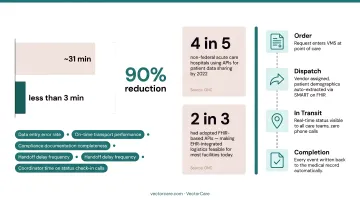
For receiving facilities, real-time visibility means they're prepared when patients arrive — reducing handoff delays and improving coordination between sending and receiving care teams.
KPIs affected:
- Data entry error rate
- On-time transport performance
- Compliance documentation completeness
- Handoff delay frequency
- Coordinator time on status check-in calls
When it matters most: Health systems operating across multiple sites, transfer centers managing inter-facility movement, and payers coordinating post-acute logistics where care continuity directly affects outcomes and readmission risk.
What Happens When a Healthcare Logistics VMS Is Missing or Ignored
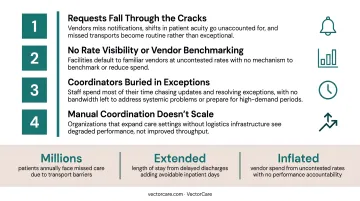
Manual coordination doesn't fail dramatically — it fails quietly, and the costs accumulate in ways that rarely get attributed to their root cause.
- Requests fall through the cracks: vendors miss notifications, shifts in patient acuity go unaccounted for, and missed transports become routine rather than exceptional
- Without centralized rate management and vendor performance data, facilities default to familiar vendors at uncontested rates with no mechanism to benchmark or reduce spend
- Coordinators spend most of their time chasing updates and resolving exceptions, with no bandwidth left to address systemic problems or prepare for high-demand periods
- As patient volume grows, manual coordination doesn't scale — organizations that expand care settings without logistics infrastructure see degraded performance, not improved throughput
The cost shows up in measurable ways: transport barriers cause missed care for millions of patients annually, delayed discharges extend length of stay, and uncontested vendor relationships inflate spend with each passing year.
How to Get the Most Value from a Healthcare Workforce Logistics VMS
A VMS delivers compounding returns when configured correctly, monitored against defined KPIs, and used as a continuous improvement tool — not just a coordination layer.
Three practices that maximize value:
Standardize and automate from day one. Configure dispatch rules, vendor tiers, and escalation timelines upfront so the system works automatically rather than requiring manual overrides. Look for a HIPAA-secure platform with native EHR integration to avoid creating a parallel data workflow alongside your existing systems.
Review performance data regularly. Use VMS analytics to track vendor fill rates, transport times, cost per request, and on-time performance on a recurring basis — not just during contract renewals. This turns the platform from a scheduling tool into a proactive monitoring tool that surfaces cost and performance trends before they escalate.
Expand use case coverage over time. Facilities that start with ground transport coordination and later incorporate NEMT, home health, and additional transport types onto the same platform see the greatest efficiency gains. Unified logistics decisions outperform siloed ones at every level of scale.
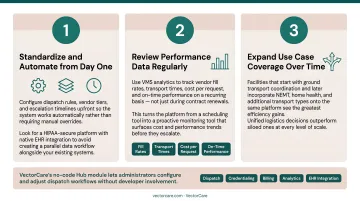
That kind of incremental expansion works best when the platform is built to accommodate it. VectorCare's no-code Hub module lets administrators configure and adjust dispatch workflows without developer involvement. Its modular structure covers dispatch, credentialing, billing, analytics, and EHR integration — so organizations can add capabilities over time without replacing the platform at each stage.
Conclusion
A healthcare workforce logistics VMS delivers value through operational change: faster dispatch, lower transport costs, cleaner documentation, and better-coordinated care handoffs. Those gains compound when the platform is applied consistently across every transport type and care setting.
Patient logistics is infrastructure — and organizations that manage it accordingly see measurable results. The difference shows up in throughput, cost control, and care quality: VectorCare customers have documented over $500,000 in annual savings for a 250-bed hospital with 25 daily transports. That kind of performance gap doesn't close with better scheduling. It closes with the right platform, applied consistently.
Frequently Asked Questions
What is healthcare workforce logistics?
Healthcare workforce logistics refers to the coordination, management, and optimization of patient movement and support services across the care continuum — including transport, home health, DME, and NEMT. The goal is ensuring patients receive the right service at the right time without administrative delays or coordination gaps between care settings.
What is VMS in healthcare?
A VMS (Vendor Management System) in healthcare is a centralized platform that manages relationships, requests, and performance tracking across a network of service providers. In patient logistics, this means coordinating transport vendors, automating dispatch, and providing real-time visibility into every patient movement from order to completion.
What is the difference between MSP and VMS in staffing?
A VMS is the technology platform used to manage vendor relationships and workflows. An MSP (Managed Service Provider) is an organization that operates alongside a VMS to manage supplier relationships on behalf of a client. The VMS is the tool; the MSP is an optional service layer built around it.
How does a patient logistics VMS reduce hospital length of stay?
A logistics VMS automates dispatch and eliminates communication delays, cutting the time between a discharge order and actual patient departure. Faster movement frees beds sooner, improving throughput and reducing length of stay — which directly affects hospital capacity and cost.
Can a healthcare logistics VMS integrate with existing EHR systems like Epic?
Yes. VectorCare integrates directly with Epic via SMART on FHIR, automatically pulling patient data into transport requests without manual re-entry. Every transport event writes back to the clinical record automatically, reducing errors and eliminating the need to work across multiple systems.