Introduction
Most healthcare organizations today run on dozens of disconnected platforms — EHRs, billing systems, lab tools, transport coordinators, payer portals — and that fragmentation has real consequences. According to The Business Research Company, the healthcare IT integration market is valued at $5.28 billion in 2025 and projected to reach $10.91 billion by 2030, growing at a 15.7% CAGR. That growth reflects the urgent pressure healthcare organizations face to close the gaps between their systems.
Integration now extends well beyond connecting clinical records. Patient logistics — transport coordination, home health handoffs, DME ordering, post-acute transitions — remains heavily manual at most organizations. When those workflows depend on phone calls and faxes, delays compound at every step.
Organizations that treat integration as purely a clinical IT project miss the operational layer where much of the inefficiency lives. That gap is where costs accumulate and patient care suffers.
This article covers both dimensions — the clinical IT side and the operational logistics layer — including which platforms lead each category and how to evaluate them against your organization's actual needs.
TL;DR
- Healthcare integration connects clinical, administrative, and operational systems for seamless data and workflow exchange across care settings.
- Modern integration standards like HL7 FHIR and SMART on FHIR enable real-time, EHR-embedded data exchange without custom builds.
- The most impactful practices go beyond EHR connectivity to include patient logistics automation, AI-driven dispatching, and HIPAA-compliant security at every layer.
- Evaluating solutions means weighing standards compliance, real-time capability, scalability, and operational scope — not vendor name recognition alone.
- VectorCare stands apart by extending integration beyond clinical data exchange into full patient logistics — transport, home health, DME, and discharge coordination in one platform.
What Is Healthcare Integration?
Healthcare integration is the technical and operational layer that connects clinical systems — EHRs, labs, billing, imaging — with administrative and logistics platforms: transport coordination, DME, home health, and payer portals. The goal is consistent, bidirectional data and workflow exchange across those systems.
This is distinct from interoperability. Interoperability describes the broader ability of systems and organizations to share and meaningfully use information. Integration is the specific technical work that makes interoperability possible.
Where Things Stand Today
EHR adoption is no longer the challenge. ONC reports that 96% of U.S. non-federal acute care hospitals had adopted certified EHR technology as of 2021. The gap is in what happens after adoption.
ONC's 2023 interoperability data shows that only 70% of non-federal acute care hospitals engaged in all four interoperability domains — send, receive, find, and integrate. Just 43% did so routinely. That means nearly a third of hospitals with certified EHRs still aren't consistently exchanging data across all four functions.
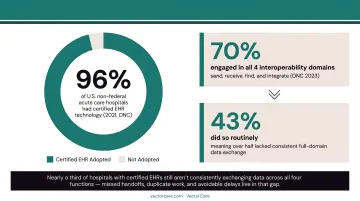
That gap — between having a certified EHR and actually using it to coordinate care — is where missed handoffs, duplicate work, and avoidable delays live. It's also what the regulatory and care model pressures below are designed to close.
Why Integration Is No Longer Optional
Three forces are pushing organizations toward deeper, real-time integration:
- The 21st Century Cures Act prohibits information blocking and mandates open API support from certified EHR developers
- Value-based care contracts tie shared savings and quality metrics to coordinated data across the care continuum
- The Joint Commission classifies inadequate handoff communication as a formal Sentinel Event risk — making integration a patient safety issue, not just an IT one
Top Healthcare Integration Practices
Effective healthcare integration isn't purely a technology decision. It requires the right operational practices connecting people, processes, and platforms across the care continuum.
Practice 1: Adopt Standards-Based Integration (HL7, FHIR, SMART on FHIR)
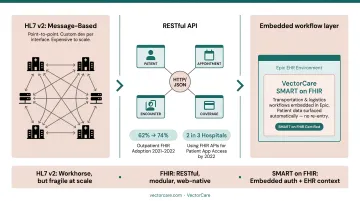
Legacy HL7 v2 remains the workhorse of clinical data exchange — it handles the majority of messages flowing between hospital systems today. But v2 is a message-based standard built for point-to-point connections. Every new interface requires custom development, and managing dozens of them becomes expensive and fragile.
FHIR takes a different approach. It uses RESTful web standards — HTTP, JSON, XML — and organizes data into modular "Resources" that can be queried individually. This makes integration closer to building with a modern web API than managing custom message pipelines.
The adoption shift is already underway. ONC data shows that more than two-thirds of hospitals used FHIR-based APIs to enable patient app access by 2022. In outpatient settings, adoption climbed from 62% in 2021 to 74% in 2022. Any new integration initiative should be FHIR-first.
SMART on FHIR adds an authentication and authorization layer on top, enabling third-party applications to embed directly within EHR workflows — pulling patient context without requiring users to switch systems. VectorCare's SMART on FHIR Epic integration is a direct example: transportation and logistics workflows launch from within the Epic clinical environment, with patient data automatically surfaced rather than re-entered manually.
Practice 2: Integrate Patient Logistics as Operational Infrastructure
Most integration discussions focus on clinical data — labs, imaging, medication reconciliation. The operational layer gets far less attention, and that's where discharge delays accumulate.
A Johns Hopkins-linked study of 1,152 patient-days found that 30% of days involved a care delay, with 28% of delays attributed to discharge barriers. A separate study found that a multidisciplinary discharge coordination intervention reduced length of stay from 15.45 days to 9.04 days — a 41.5% reduction. Manual transport dispatch compounds the problem: a 2024 transport study found traditional manual dispatch methods had overtime delays as high as 41%.
Effective patient logistics integration replaces phone-and-fax workflows with:
- A unified platform connecting hospitals, payers, transport providers, and home health agencies
- Automated dispatching that broadcasts requests to provider networks simultaneously
- Real-time tracking visible to care teams without manual status checks
- Bi-directional EHR documentation so transport events appear in the medical record automatically
VectorCare was built specifically for this layer — unifying NEMT, ambulance, DME, and home health coordination in a single platform with SMART on FHIR Epic integration and AI-driven dispatching (A.D.I.) that replaces manual phone coordination.
Practice 3: Build Security and HIPAA Compliance Into Every Integration Layer
The integration layer itself must meet the same security standards as the systems it connects. This is a common oversight: organizations focus on securing their EHR but treat the middleware connecting it to third-party systems as an afterthought.
HHS OCR's 2024 breach report puts the stakes clearly: business associates were involved in 16% of large-breach reports but accounted for 85% of affected individuals — over 206 million people. Every vendor with access to ePHI is a potential exposure point.
Minimum requirements for any integration vendor:
- Encryption in transit (TLS) and at rest (AES-256)
- Role-based access controls and audit logging
- A signed Business Associate Agreement (BAA) (HHS confirms this is required even for cloud vendors that only store encrypted ePHI)
- SOC 2 Type I certification, which covers security, availability, processing integrity, confidentiality, and privacy
Cloud-based integrations enable real-time collaboration but introduce new exposure surface. Contractual promises aren't sufficient — look for verifiable certifications and demonstrated compliance track records.
Practice 4: Leverage AI and Automation to Eliminate Manual Coordination
AI-powered integration goes beyond passive data exchange. It actively routes requests, flags bottlenecks before they stall care, and cuts the administrative burden that follows coordination staff home.
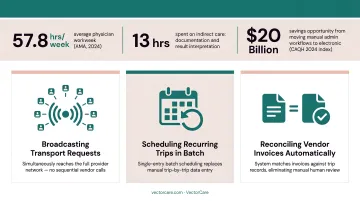
AMA data from 2024 shows physicians averaged a 57.8-hour workweek, with 13 hours spent on indirect care including documentation and result interpretation. Coordinators carry a similar load. CAQH's 2024 Index identifies a $18.3 billion (CAQH 2023 Index) savings opportunity from moving manual administrative workflows to electronic ones — phone calls, manual data entry, and paper-based processes that existing technology can replace today.
Organizations seeing the strongest returns from integration are using automation to replace specific, repeatable tasks:
- Broadcasting transport requests to provider networks simultaneously instead of calling vendors one by one
- Scheduling recurring trips in batch rather than entering each one manually
- Reconciling vendor invoices automatically against trip records instead of manual human review
Top Healthcare Integration Solutions
The right solution depends on whether your primary integration need is clinical data exchange, operational logistics, financial workflows, or all three. Each platform below leads in a specific domain.
Epic Systems
Epic is the dominant EHR vendor for large U.S. health systems and academic medical centers. Its Showroom marketplace — now consolidated into the Epic Showroom — connects certified third-party applications directly into clinical workflows.
What differentiates Epic is Care Everywhere, its cross-organizational data sharing network, which Epic reports exchanges 28 million charts daily, half with non-Epic platforms. Its SMART on FHIR Showroom allows certified third-party apps to embed within the Epic environment, reducing clinician context-switching and enabling real-time data access without custom point-to-point builds.
| Attribute | Detail |
|---|---|
| Key Feature | Care Everywhere cross-organizational data sharing and SMART on FHIR App Showroom for EHR-embedded third-party apps |
| Best For | Large health systems and academic medical centers requiring deep EHR integration and embedded third-party apps |
| Standards Supported | HL7 FHIR, SMART on FHIR, CDA |
InterSystems HealthShare
InterSystems specializes in data platform technologies for mission-critical healthcare integration, with HealthShare serving as a unified engine for health information exchange, clinical workflow orchestration, and real-time analytics.
Its strength is hybrid environment management — deep expertise in both legacy HL7 interface engines and modern FHIR server implementations makes it particularly suited for organizations running old and new systems simultaneously.
| Attribute | Detail |
|---|---|
| Key Feature | Unified patient record aggregation, HL7 interface engine, and FHIR server for hybrid environments |
| Best For | Health systems and HIEs managing legacy and modern system integration simultaneously |
| Standards Supported | HL7 v2, HL7 v3, FHIR, CDA |
Redox
Redox is a cloud-native API infrastructure company that abstracts the complexity of HL7 and FHIR standards for digital health applications, allowing them to connect to multiple EHR systems through a single standardized integration layer. Redox reports integration with 4,500 healthcare organizations.
For digital health companies, Redox dramatically reduces time-to-market by eliminating the need to build and maintain custom point-to-point connections with each health system they serve.
| Attribute | Detail |
|---|---|
| Key Feature | Cloud-native API abstraction layer connecting digital health apps to hundreds of EHR systems |
| Best For | Digital health startups and healthcare technology vendors needing rapid EHR connectivity at scale |
| Standards Supported | HL7, FHIR, CCD, custom API formats |
Change Healthcare (Optum)
Change Healthcare, now part of Optum, operates one of the largest healthcare data networks in the U.S. — connecting payers, providers, and pharmacies across revenue cycle management, clinical decision support, and payment processing. The company reported processing 12 billion healthcare transactions and $2.0 trillion in claims annually.
Its focus is financial and administrative integration: claims processing, prior authorizations, and payer-provider data exchange at enterprise scale. Note that Change Healthcare experienced a significant ransomware cyberattack in 2024, which HHS has documented as a large-scale PHI breach — a relevant consideration for any security risk assessment.
| Attribute | Detail |
|---|---|
| Key Feature | Largest U.S. healthcare data network spanning payer-provider claims, RCM, and payment accuracy |
| Best For | Health systems and payers requiring large-scale financial and administrative data integration |
| Standards Supported | X12 EDI, HL7, FHIR, proprietary payer APIs |
VectorCare
VectorCare is a patient logistics platform serving over 2,500 healthcare facilities nationwide. It unifies transport, home health, DME, and non-emergency patient services into one HIPAA-secure ecosystem built specifically for hospitals, payers, transfer centers, and care coordination teams.
Unlike the other platforms on this list, VectorCare targets the operational layer — the phone calls, faxes, and manual handoffs that govern how patients actually move through the healthcare system. Where Epic, InterSystems, and Redox focus on clinical data connectivity, VectorCare handles the coordination infrastructure underneath it.
Its core capabilities include:
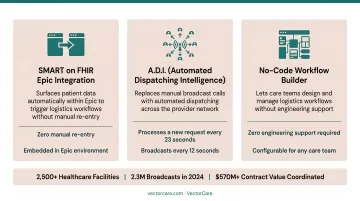
- SMART on FHIR Epic integration — surfaces patient data automatically within the Epic environment to trigger logistics workflows without manual re-entry
- A.D.I. (Automated Dispatching Intelligence) — replaces manual broadcast calls with automated dispatching across the provider network
- No-code workflow builder — lets care teams design and manage logistics workflows without engineering support
| Attribute | Detail |
|---|---|
| Key Feature | SMART on FHIR Epic integration, A.D.I. automated dispatching, and real-time logistics network covering 2,500+ facilities |
| Best For | Hospitals, payers, transfer centers, NEMT providers, home health agencies, and SNFs requiring end-to-end patient logistics automation |
| Standards Supported | SMART on FHIR, FHIR, HIPAA-secure cloud infrastructure |
How We Chose the Best Healthcare Integration Solutions
The evaluation focused on three dimensions:
- Standards compliance and EHR compatibility — Does the platform support FHIR and SMART on FHIR? Can it connect to the EHR systems your organization already runs?
- Operational impact and scalability — Does it offer real-time data exchange rather than batch processing? Can it scale as your organization grows?
- Security posture and regulatory compliance — Does it hold verifiable certifications (SOC 2, HIPAA BAA), not just contractual representations?
A common mistake in vendor selection is prioritizing brand recognition over fit-for-purpose capability. A platform built for clinical data exchange won't resolve transport coordination delays, and no amount of EHR connectivity fixes a broken post-acute handoff.
The most overlooked criterion is operational scope. Clinical data integration and patient logistics integration serve different workflows — and organizations that treat them as the same problem typically end up with clinical IT solutions that leave coordination delays, transport scheduling, and post-acute handoffs unresolved.
The two layers address distinct failure points:
- Clinical integration — EHR connectivity, data standards, lab results, and care record exchange
- Logistics integration — transport dispatch, vendor coordination, discharge planning, and real-time tracking
Selecting for one without the other leaves gaps that show up as delays at the bedside, not in the software dashboard.
Conclusion
Organizations that execute healthcare integration well reduce costs, shorten patient stays, eliminate communication delays, and free clinicians from coordination work that shouldn't require clinical training. That's not aspirational — it's the operational baseline for systems running connected logistics infrastructure today.
Before selecting a partner, assess your integration gaps across both clinical and operational dimensions. Prioritize platforms that offer measurable workflow automation. As value-based care models expand, the gap between organizations with automated, EHR-connected logistics and those still relying on phone-based coordination will only widen.
For healthcare organizations looking to eliminate phone tag, reduce manual coordination tasks, and connect patient logistics workflows with their EHR systems, VectorCare's HIPAA-secure platform connects transport, home health, and ancillary services directly to your EHR — explore how it works or reach out to schedule a conversation.
Frequently Asked Questions
What is healthcare integration?
Healthcare integration is the technical and operational layer that connects clinical systems — EHRs, labs, billing — with administrative and logistics platforms to enable data and workflow exchange across care settings. It is the specific technical work that makes coordinated, cross-system care delivery possible.
What is the difference between healthcare integration and interoperability?
Integration is the act of technically connecting specific systems so they can exchange data. Interoperability is the broader ability of systems, organizations, and providers to share and meaningfully use information across boundaries. Integration is one of the building blocks that makes interoperability achievable.
What is FHIR and why does it matter for healthcare integration?
FHIR (Fast Healthcare Interoperability Resources) is the modern RESTful API standard for exchanging healthcare data and the dominant integration standard for new healthcare software. SMART on FHIR builds on it by allowing third-party applications to embed directly within EHR workflows, pulling patient context without requiring system switching.
What are the biggest challenges in implementing healthcare integration?
The three most common barriers are: legacy systems that cannot connect to modern platforms without middleware; HIPAA compliance requirements that apply to the integration layer itself, not just the connected systems; and the complexity of achieving real-time data exchange across multi-vendor environments at scale.
How does patient logistics integration differ from clinical data integration?
Clinical data integration connects EHRs, labs, imaging, and billing systems to support informed care decisions. Patient logistics integration connects transport, NEMT, home health, DME, and payer platforms to coordinate how patients actually move through the healthcare system. Both are necessary, yet most organizations underinvest in the logistics layer despite its direct impact on discharge delays, readmissions, and care continuity.