Introduction
Healthcare organizations have poured significant investment into automating physical supply chains — pharmaceutical distribution, surgical inventory, medical device procurement. Yet one of the most operationally complex supply chains they manage daily gets almost no automation attention: the network of transport providers, home health agencies, DME suppliers, and skilled nursing facilities that must coordinate seamlessly for patients to move through care.
This is patient logistics. And it still runs largely on phone calls.
The consequences are measurable. Nearly 20% of patients experience adverse events within three weeks of discharge, and roughly two-thirds of those events were preventable or ameliorable — most tracing back to coordination failures during care transitions.
The scale of the problem compounds that risk. About 41% of Medicare inpatient discharges are followed by post-acute care services, meaning the coordination burden touches nearly half of every hospital's patient volume.
This article examines how AI and automation are transforming healthcare supply chain management, with particular focus on the patient logistics layer that physical supply chain investments have long overlooked.
Key Takeaways
- Patient logistics — transport, home health, DME coordination — is a critical supply chain segment that most facilities still manage manually
- Manual coordination creates communication delays, extends hospital stays, and diverts clinical staff from direct patient care
- AI dispatching tools can eliminate up to 90% of manual coordination tasks, saving over $500,000 annually for a 250-bed hospital with 25 daily transports
- SMART on FHIR EHR integration eliminates duplicate data entry and speeds up every transport request
- Measurable ROI includes reduced length of stay and fewer readmissions
The Patient Logistics Gap: Healthcare's Most Overlooked Supply Chain
Most healthcare supply chain automation conversations center on procurement, inventory management, and pharmaceutical distribution. Physical goods supply chains now benefit from ERP systems, RFID tracking, and AI-driven demand forecasting. Transport requests still get handled by phone.
This gap exists because patient logistics has historically been treated as a scheduling problem — a series of individual phone calls to arrange rides — rather than as infrastructure. VectorCare founder David Emanuel built the company on exactly this insight: that misclassifying patient logistics as scheduling rather than infrastructure creates systemic inefficiency that no amount of scheduling optimization can fix.
Consider a typical scenario: a care coordinator needs to arrange transport for a patient discharge. She calls Provider A — busy. Provider B has no availability. Provider C might work but needs to call back. Meanwhile, a bed sits occupied, clinical staff wait for confirmation, and the patient's discharge window slips.
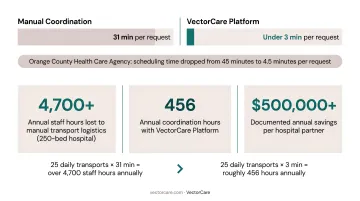
Multiply that across 25 daily transports in a 250-bed hospital, and the administrative burden becomes substantial. Each transport request handled manually consumes an average of 31 minutes of staff time. That's over 4,700 hours annually — time pulled directly away from patient care.
The contrast with physical supply chain management is stark. When a hospital's surgical supply dips below par level, an automated system triggers replenishment. When a patient needs transport, someone picks up a phone. That gap compounds with every transition a patient makes through the care continuum.
Why Supply Chain Complexity Grows With Every Care Transition
Each care transition adds coordination layers:
- SNF placements require simultaneous bed availability checks, insurance verification, clinical documentation, and transport matching
- Home health discharges add agency referrals, DME ordering, and medication reconciliation on top of scheduling
- Interfacility transfers demand acuity-based transport matching and time-sensitive clinical handoffs to a receiving facility that must be confirmed ready
- Air escalations layer in multi-modal coordination, clinical crew requirements, and flight authorization — all under time pressure
MedPAC data shows that 47% of post-surgical discharges use post-acute care services, with SNFs and home health each accounting for roughly 18-19% of acute hospital discharges. Every one of those transitions requires coordinating multiple vendors, timing windows, insurance authorization, and real-time availability — all currently managed through fragmented manual processes.
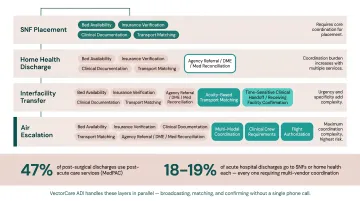
For hospitals serving geographically dispersed populations, air transport coordination, multi-modal logistics, and cross-network provider matching compound the problem further. Platforms like VectorCare's ADI handle these coordination layers in parallel — broadcasting requests, matching providers, and confirming availability without a single phone call.
Key Technologies Powering Healthcare Supply Chain Automation
Patient logistics automation requires a different technology stack than physical supply chain management. The tools that work for pharmaceutical distribution don't map cleanly onto care coordination workflows. Four technology categories matter most here.
AI-Powered Dispatching and Intelligent Automation
AI dispatching tools analyze multiple parameters at once — patient acuity, transport type, timing requirements, geographic proximity, provider availability, and pricing — then automatically identify, contact, and confirm the best-matched provider. No phone calls. No sequential vendor outreach.
What gets evaluated on every dispatch request:
- Patient acuity and transport type requirements
- Geographic proximity and provider availability
- Timing constraints and pricing parameters
- Credentialing status within the provider network
VectorCare's A.D.I. (Automated Dispatching Intelligence) illustrates what this looks like at scale. The system processes 3.23 requests per minute, broadcasting to a credentialed provider network. In 2025, A.D.I. saved more than 100,000 hours for healthcare systems and suppliers — a tenfold increase from the 10,000+ hours saved in 2024.
This parallels automated inventory replenishment in physical supply chains: rather than a human checking stock levels and calling a supplier, the system handles matching and fulfillment based on predefined parameters. EHR integration takes that same logic and applies it to patient data.
EHR Integration and Interoperability
EHR integration eliminates the most error-prone step in transport coordination: manual data re-entry. Without it, every request requires re-entering patient demographics, insurance information, diagnosis, and care requirements — introducing transcription risk at exactly the moment clinical accuracy matters most.
SMART on FHIR is the industry standard enabling EHR-embedded application integration. VectorCare's SMART on FHIR integration with Epic automatically extracts patient demographics, encounter details, insurance coverage, conditions, and vital signs at the moment a transport request is initiated — eliminating manual transcription.
ONC data shows that more than two-thirds of hospitals already used HL7 FHIR APIs to enable patient data sharing in 2022, meaning the technical foundation for EHR-integrated logistics automation is already in place across most health systems.
Clinical staff initiate transport requests without leaving Epic. Ride status, estimated arrival times, and driver assignments are visible within the same interface. Arrival confirmations are automatically pushed back into the patient chart.
Real-Time Visibility and Network Connectivity
Real-time transport visibility functions like RFID tracking for physical goods — except it tracks patients and providers rather than inventory. Hospital logistics coordinators can see transport status, provider location, and estimated arrival without making a single status call.
A 2024 peer-reviewed study of hospital transport dispatch found that real-time Beacon dispatch reduced overtime delays from 41.0% to 26.5% and improved daytime dispatch efficiency by 34%. Average pickup time fell from 7 minutes 14 seconds to 4 minutes 43 seconds. That kind of shift — from reactive status calls to proactive real-time visibility — changes how coordinators spend their time across an entire shift.
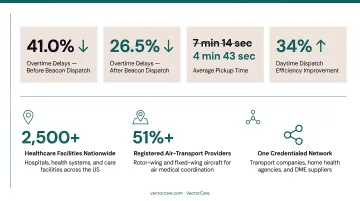
Network breadth determines how reliably automation can match and dispatch. VectorCare's platform connects:
- 2,500+ healthcare facilities nationwide
- 51%+ of registered air-transport providers for air medical coordination
- Transport companies, home health agencies, and DME suppliers under one credentialed network
The larger the connected network, the faster a confirmed match — and the less fallback to manual outreach.
What AI and Automation Actually Deliver: Measurable Results
The ROI case for patient logistics automation is concrete and calculable. Healthcare organizations implementing these platforms consistently report outcomes across three dimensions.
Operational Efficiency and Cost Reduction
The time math is straightforward. A 250-bed hospital handling 25 daily transports, each requiring 31 minutes of manual coordination, spends over 4,700 staff hours annually on transport logistics alone. VectorCare's platform reduces that per-request time to under 3 minutes, cutting annual coordination hours to roughly 456.
The financial translation: applying average RN and case manager hourly rates to recovered hours, combined with bed-cost savings from faster discharge execution, produces documented savings exceeding $500,000 annually.
Results from Orange County Health Care Agency, which implemented VectorCare in 2022, illustrate what this looks like at scale:
- Scheduling time dropped from 45 minutes to 4.5 minutes per request
These gains translate directly to the clinical side of the equation.
Patient Throughput and Clinical Outcomes
Transport coordination speed and clinical outcomes are directly connected. When discharge transport is delayed, a bed stays occupied. That occupied bed prevents an incoming patient from accessing needed care. Length of stay extends. Hospital-acquired condition risk increases.
Automating transport coordination compresses the discharge timeline. Research shows that dedicated discharge coordination interventions can reduce length of stay by 0.5 to 1 day — and transport-related delays are among the nonmedical factors most commonly extending stays beyond clinical necessity.
The effects extend beyond the hospital stay:
- Patients discharged efficiently reach appropriate post-acute care sooner
- Earlier post-acute placement correlates with better recovery trajectories
- Reduced readmissions connect directly to value-based care performance metrics
AHRQ data shows that standardized care transition interventions like RED reduced preventable readmissions and ED visits by 30% — establishing the framework within which patient logistics automation operates as a supporting mechanism.
Scalability Without Proportional Headcount Growth
Manual coordination scales linearly: more patients means more transports, more coordinators. Automated platforms break that relationship.
VectorCare's Hub lets health systems design workflows once and deploy them across all facilities. Urban hospitals, suburban clinics, and rural care centers operate through the same interface with consistent coordination and system-wide analytics. Expanding to new facilities or service lines doesn't require rebuilding coordination infrastructure at each site.
The platform scales with volume without requiring proportional administrative staffing growth. As network density increases, matching and dispatching become faster and more reliable. That's the inverse of what happens with manual processes, where complexity compounds alongside volume.
Overcoming the Barriers to Healthcare Automation Adoption
Real obstacles exist. Acknowledging them is more useful than glossing over them.
The three most common barriers health systems face:
- Change management — organizational culture and lack of internal ownership
- Data security — hesitation around cloud-based platforms handling PHI
- Integration complexity — concerns about EHR compatibility and IT lift
Change management tops the list. Deloitte found that organizational culture blocked digital transformation at 60% of health systems, with lack of ownership and communication cited by 48%. Staff who have coordinated transport via phone for years need clear evidence that the new workflow is faster, not just different.
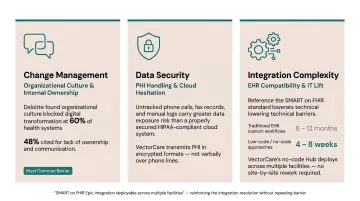
Data security concerns create hesitation around cloud-based coordination platforms — yet untracked phone calls, fax records, and manual logs carry greater data exposure risk than a properly secured HIPAA-compliant cloud system. VectorCare's platform is built with HIPAA-secure architecture, transmitting protected health information in encrypted formats rather than verbally over phone lines.
Integration complexity is real, but the SMART on FHIR standard has lowered the technical barrier considerably. Where traditional EHR custom workflows historically took 6 to 12 months, low-code/no-code approaches now compress that timeline to 4 to 8 weeks.
VectorCare's no-code Hub workflow builder lets health systems configure and deploy coordination workflows without heavy IT involvement. The SMART on FHIR Epic integration is also deployable across multiple facilities — no costly site-by-site rework required.
The Future of Patient Logistics and Supply Chain AI
The current state of patient logistics automation — reactive dispatching, where a request triggers an automated response — is the starting point, not the destination.
The trajectory points toward proactive logistics orchestration: AI agents that anticipate patient needs before discharge orders are written, systems that pre-position transport resources based on predictive discharge timing, and autonomous coordination that handles scheduling, provider negotiation, and confirmation without human initiation.
Deloitte reports that more than 80% of health systems are already prioritizing agentic AI for clinical operations, care delivery, and revenue cycle management. Patient logistics is the natural next application domain — the workflows are well-defined, the data is structured, and the ROI from automation is measurable and direct.
The expanding scope includes:
- Home health scheduling embedded directly in discharge workflows
- DME delivery coordination triggered automatically at point of discharge order
- In-transit patient monitoring integration, connecting transport and clinical teams during transfer
- International health system deployment — VectorCare's 2025 UK launch aims to address NHS delayed discharge challenges, where the Nuffield Trust reports long-stay delayed discharges increased 8% between January 2022 and January 2026
Patient logistics is moving from a back-office scheduling function to foundational infrastructure — the same way ERP systems manage surgical supply inventory without anyone thinking twice. The goal is logistics coordination that operates reliably in the background, invisible until something breaks.
For health systems already running automated dispatch and proactive discharge coordination, that shift isn't on the horizon. It's operational.
Frequently Asked Questions
What is healthcare supply chain automation?
Healthcare supply chain automation uses technology to coordinate and automate the procurement, coordination, and delivery of services and supplies needed for patient care. Automation now extends well beyond physical goods to include patient transport coordination, home health scheduling, and DME delivery logistics.
How does AI improve patient logistics in healthcare?
AI analyzes patient acuity, timing requirements, geographic proximity, and provider availability in real time to match and dispatch the best transport or service provider automatically. This replaces sequential phone calls with faster dispatch, fewer delays, and significantly reduced staff time per request.
What are the biggest challenges in healthcare supply chain management?
The primary barriers are fragmented vendor networks, lack of real-time visibility, manual and paper-based processes, and siloed systems without EHR integration. Multi-modal care transitions under time pressure — coordinating ground transport, air, home health, and DME simultaneously — compound these challenges further.
How does automation reduce costs in healthcare supply chain operations?
Automation eliminates labor costs associated with manual coordination, reduces costly delays that extend patient length of stay, and optimizes provider selection to lower per-transport cost. Documented savings reach over $500,000 annually for a 250-bed hospital with 25 daily transports.
What is the role of EHR integration in healthcare supply chain automation?
EHR integration via standards like SMART on FHIR allows logistics platforms to automatically pull patient demographics, insurance, and clinical data at the moment a transport request is initiated — eliminating manual re-entry, reducing errors, and creating one seamless workflow for clinical and logistics staff.
How can hospitals measure the ROI of patient logistics automation?
Track these metrics against pre-implementation baselines:
- Manual coordination hours per transport request
- Communication-related delays
- On-time transport performance
- Average length of stay
- Total annual cost savings