Introduction
Standard HIPAA scheduling guidance typically focuses on clinical appointment booking — one patient, one provider, one record. Patient transport scheduling is fundamentally different. A single discharge request can simultaneously expose patient name, diagnosis, insurance details, mobility status, and facility information to a hospital coordinator, a dispatch platform, and multiple competing transport providers in real time.
That exposure isn't incidental — it's structural. Every transport request is a compliance event distributed across multiple parties simultaneously.
According to IBM's 2025 data breach analysis, the average healthcare data breach now costs $7.42 million — the highest average across all industries. For operations teams coordinating patient logistics, that figure represents the consequence of treating scheduling as a workflow problem rather than an infrastructure problem.
Key Takeaways:
- A single transport request can contain 8–10 distinct PHI fields, each a compliance obligation
- HIPAA's Technical Safeguard Rule applies to every system that stores, transmits, or processes ePHI — including dispatch platforms
- Business Associate Agreements are legally required, not optional, for any vendor touching PHI
- SMART on FHIR integration removes manual data re-entry between EHR and dispatch systems
- Purpose-built platforms maintain compliance controls at dispatch speed — generic tools often don't
Why Patient Transport Scheduling Carries Unique HIPAA Risk
Clinical appointment software manages PHI between two parties: a patient and a provider. Patient logistics scheduling is different. PHI flows simultaneously between the originating hospital, the scheduling platform, multiple transport providers, payers, and the receiving facility.
Every party in that chain that stores, transmits, or accesses PHI falls under HIPAA and the HITECH Act.
A dispatch platform that receives a transport request, broadcasts it to providers, and logs status updates is processing ePHI at each step. It is, by definition, a business associate under HIPAA — with obligations that include signed BAAs, breach notification within 60 days, and demonstrable audit controls.
The Financial and Operational Stakes
The enforcement record makes the financial risk concrete. HHS OCR has settled or imposed civil money penalties in 152 cases totaling over $144 million, averaging roughly $953,000 per case. Individual settlements for audit control failures and encryption lapses have reached into the millions.
Beyond financial penalties, non-compliance in patient logistics creates operational consequences that are often more immediate:
- Delayed transports when insecure systems are taken offline following a breach investigation
- Broken care transitions when receiving facilities can no longer trust data transmitted through a compromised platform
- Loss of hospital partnerships when a transport provider's non-compliant software puts a covered entity at legal risk
For hospitals that rely on transport partners to manage post-discharge volume, that last consequence can be existential.
What PHI Is Exposed in a Transport Request
A standard patient transport request is not a simple form. It is a dense collection of individually identifiable health information transmitted, often simultaneously, to multiple parties.
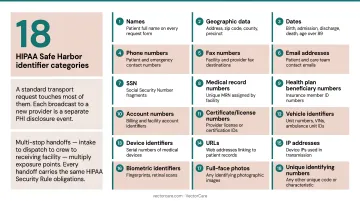
Under HIPAA's Safe Harbor de-identification standard, 18 identifier categories qualify as PHI. A typical transport request touches most of them:
| Data Element | PHI Category |
|---|---|
| Patient name | Names |
| Date of birth | Dates tied to an individual |
| Origin and destination facility | Geographic subdivisions below state level |
| Pickup and drop-off address | Geographic identifiers |
| Phone/fax/email for coordination | Phone, fax, email identifiers |
| Medical record or health plan number | MRN, health plan beneficiary number |
| Diagnosis or clinical condition | Individually identifiable health information |
| Transport acuity / mobility status | Health information tied to care provision |
| Insurance information | Health plan / account identifiers |
| Ordering physician details | Provider identifiers |
Broadcasting this request to multiple transport providers simultaneously (standard practice in competitive dispatch environments) makes each transmission a separate PHI disclosure event, subject to the same protections as the original.
Multi-stop coordination — intake to dispatch to crew to receiving facility — multiplies those exposure points further. Every handoff requires the same level of technical safeguarding under HIPAA's Security Rule.
Core Technical Safeguards for HIPAA-Compliant Scheduling Systems
HIPAA's Technical Safeguard Rule (45 CFR §164.312) defines specific controls that any system maintaining ePHI must implement. In a patient logistics context, three deserve particular attention.
Data Encryption: At Rest and In Transit
HIPAA designates encryption as an "addressable" specification: organizations must either implement it or document a compliant alternative. For any system transmitting ePHI across networks or storing patient data in cloud environments, encryption is the only defensible choice.
The stakes are concrete. Failure to encrypt mobile devices alone cost the University of Rochester Medical Center $3 million in a HIPAA settlement.
Industry standards for transport scheduling platforms:
- AES-256 for data stored in scheduling databases, backups, and mobile device caches
- TLS 1.3 for data moving between systems, API connections to EHRs, and broadcast transmissions to transport providers
Encryption must extend to every system component — not just the core database. API connections, mobile devices used by field crews, third-party notification tools, and backup storage all require the same protection.
Role-Based Access Controls
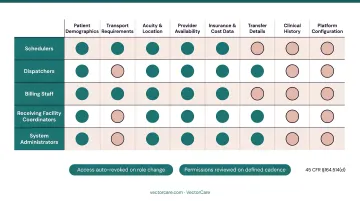
HIPAA's minimum necessary standard (45 CFR §164.514(d)) requires that PHI access be limited to what's needed for a specific function. In a patient logistics platform, that means:
- Schedulers see patient demographics and transport requirements
- Dispatchers see acuity, location, and provider availability
- Billing staff access insurance and cost data only
- Receiving facility coordinators see transfer details but not full clinical history
- System administrators manage platform configuration without routine PHI access
Proper RBAC implementation goes beyond initial setup. Access must be automatically revoked when a user's role changes, and permissions should be reviewed on a defined cadence to prevent access creep in high-turnover clinical environments.
Audit Logging and Session Management
HIPAA requires systems to record who accessed PHI, when, from where, and what action was taken. In dispatch environments, this means every broadcast, every transport request view, and every status update generates a log entry — timestamped, attributed to a specific user and role, and stored in a tamper-evident format.
A $5.5 million HIPAA settlement with Memorial Healthcare System specifically cited deficient audit controls as the central violation. That case made one thing clear: logging is not optional infrastructure. It is the mechanism by which compliance can be demonstrated when OCR comes asking.
Session management is just as critical in dispatch environments where shared workstations are common. Automatic logout after inactivity, combined with re-authentication requirements, prevents PHI exposure when a device is left unattended mid-shift.
Business Associate Agreements in Multi-Party Transport Scheduling
Any vendor, platform, or subcontractor that creates, receives, maintains, or transmits PHI on behalf of a covered entity is a business associate under HIPAA — and a signed BAA is legally required before that relationship begins, not after.
Patient logistics creates a more complex BAA landscape than most healthcare settings. When a hospital uses a dispatch platform to broadcast a transport request to dozens of providers, the platform itself is a business associate. If those providers use their own sub-systems to receive and manage the request, those systems may require BAAs as well.
What a BAA Must Cover for Patient Logistics
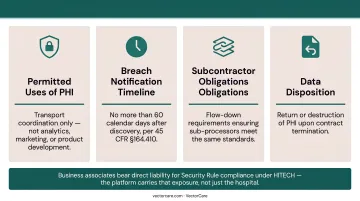
A BAA in this context should explicitly address:
- Permitted uses of PHI — transport coordination only, not analytics, marketing, or product development
- Breach notification timeline — no more than 60 calendar days after discovery, per 45 CFR §164.410
- Subcontractor obligations — flow-down requirements (contractual obligations passed to subcontractors) ensuring sub-processors meet the same standards
- Data disposition — return or destruction of PHI upon contract termination
Business associates bear direct liability for Security Rule compliance under HITECH — the platform carries that exposure, not just the hospital that signed the contract. A vendor that cannot produce a signed BAA, or cannot map its full subcontractor chain, is a compliance liability no matter how capable its workflow features are.
Secure EHR Integration in Patient Logistics Workflows
When a coordinator manually transcribes patient information from an EHR into a separate dispatch system, two things happen: the chance of error increases, and an uncontrolled PHI exposure point is created. The transcription process itself (pulling data from one screen and typing it into another) is an audit gap that no logging system can fully capture.
Direct EHR integration eliminates that gap. The established framework for compliant EHR-to-application data exchange is HL7 FHIR R4 (v4.0.1), implemented through SMART App Launch using OAuth 2.0 scopes. This approach allows a scheduling platform to request only the specific data fields required for a transport request — patient demographics, mobility status, insurance, origin facility — without pulling a full medical record.
That field-level specificity is how the minimum necessary standard works at the integration layer. The authorization token scoped to a specific user and role determines what data can be accessed, not what the underlying EHR contains.
VectorCare's SMART on FHIR integration with Epic operationalizes this approach. Rather than requiring coordinators to manually document patient information, the platform automatically extracts transport-relevant data from the EHR at the point of request. This eliminates both transcription errors and the PHI exposure that comes with them.
Every data pull from an EHR into a scheduling system is a PHI access event. Compliant integration must log each pull with:
- Timestamp of the access event
- Requesting user's identity and role
- Specific data fields accessed
Those logs become the audit evidence that supports HIPAA compliance documentation.
What to Look for in a HIPAA-Compliant Patient Logistics Platform
Most scheduling tools adapted for healthcare cover the basics. A platform built specifically for patient logistics needs to cover all of them — at dispatch speed, across multiple parties, without gaps in the coordination chain.
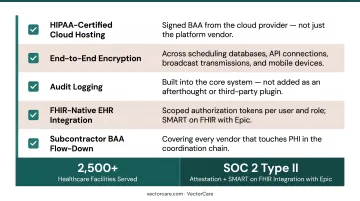
The infrastructure-level requirements that matter:
- HIPAA-compliant cloud hosting with a signed BAA from the cloud provider — not just the platform vendor
- End-to-end encryption across scheduling databases, API connections, broadcast transmissions, and mobile devices
- Audit logging built into the core system, not added as an afterthought or third-party plugin
- FHIR-native EHR integration with scoped authorization tokens per user and role
- Subcontractor BAA flow-down covering every vendor that touches PHI in the coordination chain
Performance at scale matters just as much as the checklist above. A platform handling requests every few seconds and broadcasting to multiple providers at once must maintain all of these controls without slowing the workflow. When compliance creates friction, coordinators route around it — and that's precisely when PHI exposure occurs.
VectorCare is built with this infrastructure-first approach. The platform serves 2,500+ healthcare facilities with real-time broadcast capabilities, SOC 2 Type I attestation, and SMART on FHIR integration with Epic — purpose-built for the compliance demands of multi-party patient logistics, not retrofitted from general appointment scheduling software.
Frequently Asked Questions
Is encryption required under HIPAA?
HIPAA's Security Rule classifies encryption as "addressable," meaning organizations must assess whether it's reasonable and appropriate and document that assessment. For any system transmitting ePHI over networks or storing patient data in cloud environments, the answer is virtually always yes. Failure to encrypt has resulted in multi-million dollar OCR settlements.
How is encryption used in healthcare?
Healthcare organizations use encryption to protect patient data stored in databases and cloud systems (at rest) and to secure data moving between systems, devices, and parties over networks (in transit). Common standards include AES-256 for storage and TLS for data transmission across APIs, broadcast communications, and mobile connections.
What is the best scheduling software for healthcare?
The right platform depends on use case. Clinical appointment scheduling and patient transport coordination have different compliance architectures. Transport scheduling requires multi-party PHI protections, real-time broadcast controls, EHR integration, and audit logging at dispatch speed. Standard appointment scheduling tools are not built to meet these requirements.
What is a Business Associate Agreement and why is it required for scheduling software?
A BAA is a legally required contract between a covered healthcare entity and any vendor that handles PHI on its behalf. For scheduling platforms, it defines the vendor's obligations to protect patient data, report breaches within 60 days, restrict PHI to permitted uses, and manage subcontractors in the coordination chain.
What PHI is typically included in a patient transport scheduling request?
A standard transport request typically includes patient name, date of birth, diagnosis, acuity level, insurance information, ordering physician, and origin and destination facilities. Each field carries HIPAA obligations for every party that accesses it: platform, dispatcher, and transport provider.
What makes a patient logistics platform different from a clinical scheduling tool for HIPAA purposes?
Patient logistics platforms transmit PHI to multiple external parties simultaneously (transport providers, payers, receiving facilities) while clinical scheduling tools typically manage PHI within a single organization. That multi-party disclosure structure requires broadcast-level encryption, BAA chains covering all recipients, and audit logging that captures every transmission as a distinct compliance event.