Introduction
Managing patient flow across a single clinic is a scheduling problem. Managing it across dozens or hundreds of facilities is an infrastructure problem — one most health system leaders don't fully grasp until a breakdown forces the issue.
Multi-location healthcare organizations face a fundamentally different operational challenge: coordinating patient movement, transport logistics, and cross-facility care handoffs simultaneously across geographically dispersed sites.
When a patient needs an interfacility transfer, NEMT pickup, home health visit, or DME delivery, failure to coordinate that movement in real time causes measurable harm — extended length of stay, missed appointments, and care team communication that falls apart mid-handoff.
Legacy scheduling tools weren't built for this. They handle calendars, not care logistics networks. According to the AHA, hospital length of stay in 2022 ran nearly 19% higher than pre-pandemic levels, with discharge-to-post-acute delays cited as a primary driver.
This guide evaluates multi-location healthcare scheduling software built for real operational complexity: key features to prioritize, selection criteria that matter at scale, and the platforms worth serious consideration.
Key Takeaways
- Multi-location healthcare scheduling is an infrastructure problem, not a calendar problem
- Top platforms combine real-time EHR integration, automated dispatch, and HIPAA-compliant data handling
- VectorCare leads in patient logistics with AI-powered dispatching and SMART on FHIR Epic integration across 2,500+ facilities
- Prioritize integration depth, automation capability, and documented outcomes — not feature lists
What Is Multi-Location Healthcare Scheduling Software?
Most scheduling tools are built for a single front desk. They manage appointment slots, provider availability, and patient reminders within one location. That works for standalone clinics. It doesn't work for health systems coordinating care across a dozen facilities.
Multi-location healthcare scheduling software coordinates patient care logistics — transport, staffing, appointments, and service delivery across geographically distributed facilities from a single command view. The distinction between an appointment-scheduling tool and a patient logistics platform is significant: one manages a calendar, the other manages care movement across an entire network.
A patient logistics platform handles:
- Interfacility transfers and transport dispatch
- NEMT routing across multiple service zones
- Home health visit coordination
- DME delivery logistics
- Air medical routing
- Real-time cross-facility visibility
That scope explains why investment in these platforms is accelerating. Mordor Intelligence estimates the medical scheduling software market at $496 million in 2026, projected to reach $871 million by 2031 — a CAGR of nearly 12%. Cloud-based deployment accounts for 69% of that segment, a direct result of health systems moving toward centralized, network-wide coordination.
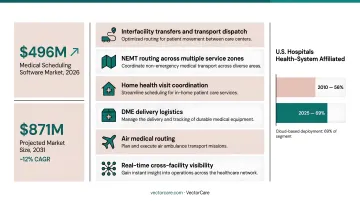
With 69% of U.S. hospitals now health-system affiliated — up from 56% in 2010 — the demand for software that manages logistics across multiple facilities isn't a niche need. It's the operational baseline.
Best Multi-Location Healthcare Scheduling Software Solutions
These platforms were selected based on their ability to serve multi-facility healthcare organizations. Evaluation criteria span EHR integration depth, automation capability, compliance readiness, real-world performance, and scalability across locations.
VectorCare
VectorCare is a patient logistics platform purpose-built for healthcare organizations managing patient movement across multiple facilities. Founded over 14 years ago, VectorCare was built on a core premise: patient logistics is an infrastructure problem, not a scheduling problem. Today it serves 2,500+ healthcare facilities nationwide.
The platform spans NEMT, air medical, home health, and DME coordination from a single interface. Its A.D.I. (Automated Dispatching Intelligence) automates dispatch tasks and eliminates the manual coordination that slows most multi-facility workflows.
The SMART on FHIR integration embeds directly inside Epic, auto-extracting patient data to trigger transport requests and care coordination workflows without leaving the EHR.
Key documented outcomes include:
- 90% reduction in manual coordination tasks
- $500,000+ in annual savings for a 250-bed hospital with 25 daily transports
- Scheduling time reduced from roughly 31 minutes to under 3 minutes per request
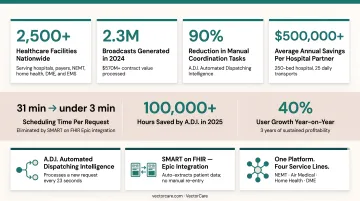
In 2024, VectorCare generated 2.3 million broadcasts with contract value exceeding $570 million.
| Category | Details |
|---|---|
| Key Features | A.D.I. automated dispatching, SMART on FHIR Epic integration, real-time cross-facility visibility, air and ground transport coordination, home health and DME orchestration, no-code workflow builder, in-transit patient monitoring integration |
| Compliance & Security | HIPAA-secure cloud-based platform; BAA availability — verify directly with VectorCare |
| Best For | Hospitals, health systems, transfer centers, payers, SNFs, NEMT providers, home health agencies, and county health departments managing patient logistics across multiple facilities |
TripMaster
TripMaster is a cloud-based NEMT and paratransit scheduling platform designed for transportation providers operating across multiple dispatch zones. Its focus is on route optimization, trip management, and billing efficiency for Medicaid and non-emergency transport fleets.
The platform is built around operational dispatch — making it a strong fit for NEMT providers who need structured fleet coordination rather than clinical care integration.
Key differentiators include:
- Intelligent route optimization across multiple zones
- Real-time GPS vehicle tracking and driver management
- Automated scheduling and trip dispatching
- Electronic billing and payroll tracking
- Custom reporting and analytics dashboards
- ParaScope driver mobile app
| Category | Details |
|---|---|
| Key Features | Route optimization, trip scheduling and dispatch, GPS tracking, driver and vehicle management, electronic billing, reporting dashboards |
| Compliance & Security | Physical, technical, and managerial safeguards confirmed; HIPAA certification and BAA — verify directly with TripMaster |
| Best For | NEMT providers, Medicaid transportation brokers, and paratransit operators managing multi-location dispatch and fleet coordination |
Tobi Cloud
Tobi Cloud is an end-to-end NEMT operations management platform delivered via a centralized cloud-based system. It emphasizes simplicity, mobile-first design for drivers, and automated trip assignment across service areas — a practical fit for smaller to mid-sized NEMT operations.
Core capabilities include:
- Autonomous dispatching with import from major NEMT brokerages
- iOS and Android mobile driver app with push notifications and GPS navigation
- Live GPS tracking with geofencing and real-time ETA visibility
- Electronic documentation with GPS timestamps
- Multi-fleet management and billing platform integration
| Category | Details |
|---|---|
| Key Features | Automated trip dispatch, mobile driver interface, real-time trip status and ETA, claims and invoice tracking, multi-fleet management |
| Compliance & Security | Data encrypted via TLS 1.2; hosted in SOC2-compliant data center; HIPAA posture — verify BAA availability directly with Tobi |
| Best For | NEMT providers and community transportation organizations scaling across multiple service areas or dispatch locations |
Qgenda
Qgenda is a healthcare workforce management platform designed for hospitals and health systems managing physician, nurse, and clinical staff schedules across multiple departments and facilities. Its focus is workforce scheduling — not patient transport logistics.
That distinction matters for buyers: Qgenda is the right choice when the core challenge is clinical staffing coverage, not patient movement coordination.
The platform includes:
- Automated rules-based scheduling engine for providers across departments
- Centralized on-call schedule management as a single source of truth
- 85+ out-of-the-box integrations with Epic, Oracle Health, Workday, and major HRIS and payroll systems
- Credential-aware scheduling logic
- System-wide analytics via Qgenda Insights
Nebraska Methodist Health System selected Qgenda to manage scheduling and time-and-attendance for 650 physicians and 8,000+ nurses — a concrete example of its enterprise-scale capacity.
| Category | Details |
|---|---|
| Key Features | Automated provider scheduling, on-call management, multi-department and multi-facility views, EHR and payroll integrations, workforce analytics |
| Compliance & Security | HIPAA compliance confirmed; BAA required; SOC 2 Type 1 achieved in 2018 — confirm current Type II status directly with Qgenda |
| Best For | Hospitals and health systems optimizing clinical workforce scheduling — physicians, nurses, and allied health staff — across multiple facilities |
Skedulo
Skedulo is a mobile workforce management platform used by healthcare organizations to coordinate field-based care workers — home health aides, mobile nurses, and community health workers — across multiple service territories.
Where patient logistics platforms coordinate transport and care transitions, Skedulo focuses on the worker side: scheduling field staff, tracking them in real time, and managing job assignments across service territories.
The platform handles:
- Intelligent scheduling with availability and skills-based matching
- Real-time worker status, routing, and job tracking
- Mobile worker dispatch with on-the-job guidance
- Salesforce-native integration
- Analytics for productivity and operational metrics across locations
- Data encrypted in transit (TLS 1.2) and at rest (AES 256)
| Category | Details |
|---|---|
| Key Features | Intelligent shift scheduling, mobile worker tracking, skills and availability matching, CRM integration, cross-location analytics |
| Compliance & Security | HIPAA/HITECH business associate status confirmed; encryption standards confirmed; SOC 2 — verify current certification status directly |
| Best For | Home health agencies and mobile care organizations coordinating field-based care workers across multiple service territories |
How We Chose the Best Solutions
The Most Common Mistake
Organizations frequently select tools designed for single-site appointment scheduling and attempt to scale them across multiple facilities. The result is predictable: the tools lack routing logic, EHR depth, and automation capability needed to manage cross-facility patient flow. Manual workarounds multiply. Staff time disappears into phone coordination. Patients wait longer.
Core Evaluation Criteria
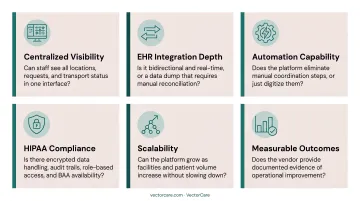
Every platform on this list was assessed against the following factors:
- Centralized visibility: Can staff see all locations, requests, and transport status in one interface?
- EHR integration depth: Is it bidirectional and real-time, or a data dump that requires manual reconciliation?
- Automation capability: Does the platform eliminate manual coordination steps, or just digitize them?
- HIPAA compliance: Is there encrypted data handling, audit trails, role-based access, and BAA availability?
- Scalability: Can the platform grow as facilities and patient volume increase without slowing down?
- Measurable outcomes: Does the vendor provide documented evidence of operational improvement?
What Separates High Performers
Three factors consistently distinguish platforms that work from those that require constant workarounds:
- Shallow integrations that require manual data entry between systems create the same bottlenecks as having no integration at all
- Dispatching logic needs to genuinely remove human steps — not just provide a digital form to fill out
- IBM's 2025 Cost of a Data Breach Report puts the average healthcare breach cost at $7.42 million — the highest of any industry. Getting compliance wrong isn't an operational inconvenience; it's a financial and reputational crisis
Conclusion
Multi-location healthcare scheduling is an infrastructure problem — one that determines how efficiently patients move through the care continuum, how reliably facilities communicate, and whether care delivery standards hold across every site in the network.
Choosing the wrong platform — one built for a single location's appointment calendar — creates delays that extend length of stay, burden staff with manual coordination, and expose organizations to compliance risk.
Evaluate platforms on four criteria before committing:
- Integration depth — bidirectional EHR connectivity, not one-way data exports
- Automation maturity — dispatching and scheduling logic that acts, not just alerts
- Scalability — architecture designed for network growth, not retrofitted for it
- Documented outcomes — verified results at facilities comparable to yours in size and complexity
These factors separate tools that reduce coordination bottlenecks from tools that add a digital layer to the same broken process.
For health systems, transfer centers, payers, and providers managing patient logistics across multiple locations, VectorCare was built from the ground up for exactly this challenge. The platform currently serves 2,500+ healthcare facilities and has reduced manual coordination tasks by 90%. To explore its capabilities or speak with the team, reach out at info@vectorcare.com.
Frequently Asked Questions
What are the best systems for managing multi-location staffing?
The right system depends on what you're managing. For clinical workforce scheduling — physicians, nurses, on-call coverage — platforms like Qgenda are purpose-built. For coordinating patient movement and transport across facilities, a patient logistics platform like VectorCare is the appropriate tool. Most health systems need both.
What is the most popular scheduling method in healthcare?
Centralized scheduling is the dominant model for multi-location health systems, where a single platform manages logistics across all sites. The shift toward automated and AI-driven scheduling is accelerating: HIMSS and Medscape's 2024 AI Adoption report found that 86% of respondents already use AI in medical-business operations.
What features should multi-location healthcare scheduling software have?
Look for these capabilities at minimum:
- Centralized visibility across all sites
- Real-time bidirectional EHR integration
- Automated dispatch or routing logic
- HIPAA-compliant data handling and audit trails
- Role-based access controls
- Architecture that scales with facility and patient volume growth
How does EHR integration work with multi-location patient logistics platforms?
The strongest platforms use standards like SMART on FHIR to embed directly inside EHR systems such as Epic. Patient data is automatically extracted to trigger transport or coordination workflows, with no manual re-entry required. VectorCare's SMART on FHIR app, available through Epic Showroom, compresses coordination that once took roughly 31 minutes to under 3 minutes.
Is multi-location healthcare scheduling software HIPAA compliant?
Enterprise-grade platforms are built with HIPAA compliance as a foundation — encrypted data storage, audit trails, role-based access controls, and Business Associate Agreements. Always verify BAA availability and current security certifications directly with any vendor before contracting.
How does automated dispatching improve on-time performance across facilities?
Automated dispatching eliminates the manual phone-and-fax coordination loop. It matches transport resources to patient needs in real time and applies consistent routing logic across all facilities, regardless of which staff member initiates the request.