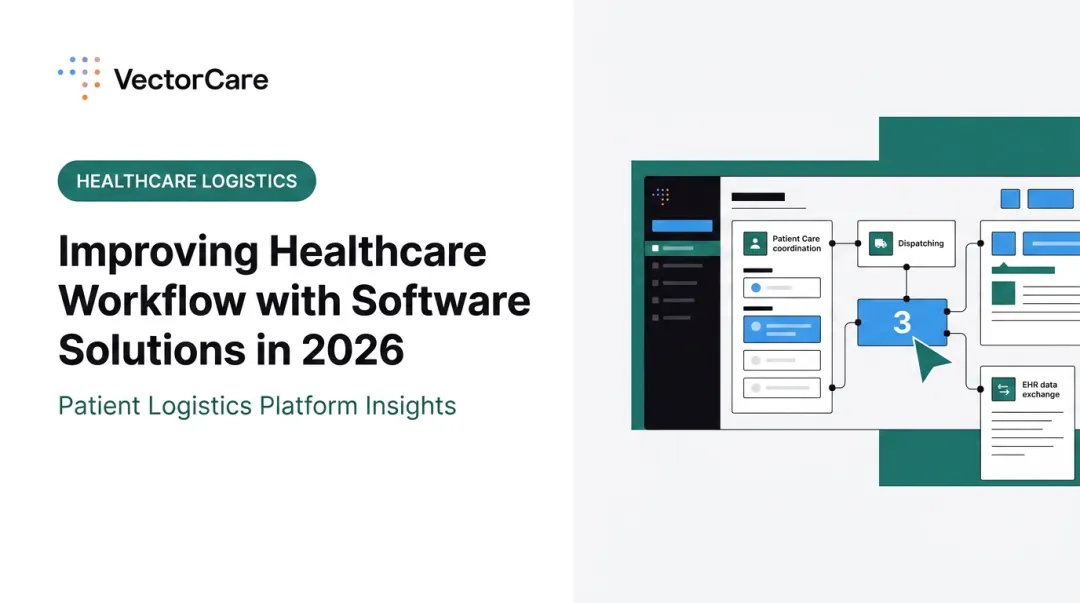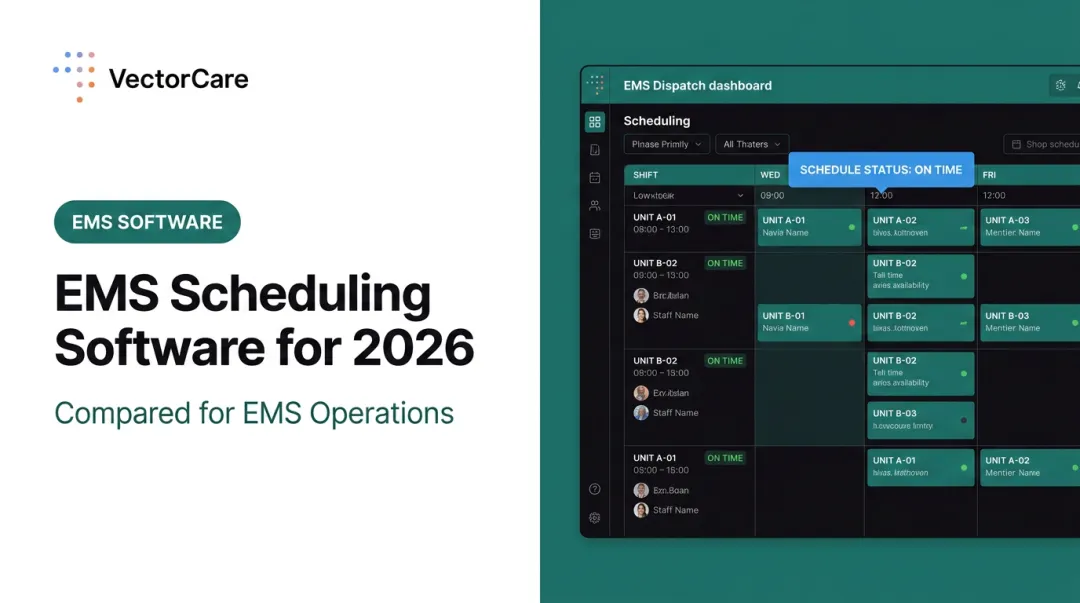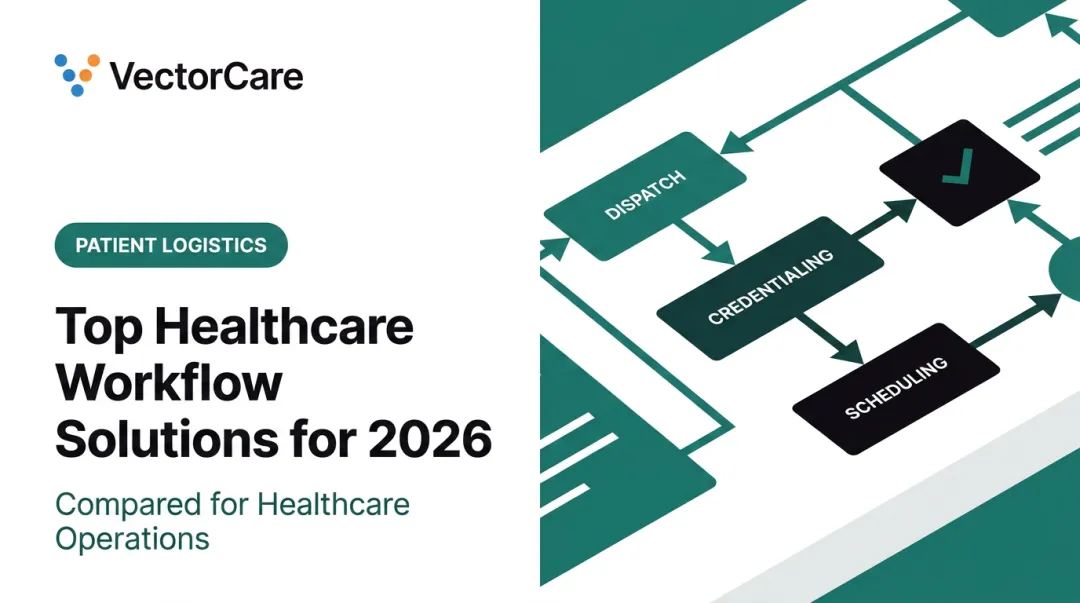
Paper logs, radio calls, and disconnected spreadsheets created manageable friction when call volumes were low and transport networks were simple. They create dangerous gaps today. A missed data handoff between dispatch and ePCR, a billing system that can't read clinical documentation, or a transport network with no shared visibility layer — each of these failures carries real cost, clinical and financial.
The EMS software landscape has split accordingly. Field-focused agencies need purpose-built tools for dispatch, documentation, and billing. Organizations managing high-volume, multi-vendor patient transport at the hospital level need something different: enterprise-grade logistics infrastructure. Choosing the wrong category is the most common — and most expensive — mistake in EMS technology procurement.
Key Takeaways
- EMS software ranges from point solutions (CAD, ePCR, billing) to enterprise patient logistics platforms spanning transport, home health, and DME.
- 63.5% of Medicare ambulance improper payments stem from documentation failures — making ePCR-to-billing integration a revenue-critical requirement.
- Field-focused agencies typically rely on platforms like TraumaSoft, ESO, ImageTrend, or ZOLL for EMS operations.
- Enterprise hospital logistics — coordinating transport, home health, and DME across facilities — requires a platform like VectorCare.
- EHR interoperability (HL7/FHIR) and HIPAA compliance are non-negotiable baseline requirements for any hospital-adjacent deployment.
- Match your software choice to both current operational scope and projected growth across care settings over the next three to five years.
Overview of Ambulance and EMS Software
Ambulance and EMS software covers digital platforms that manage the full operational lifecycle of emergency and non-emergency medical transport — from call intake and unit dispatch through clinical documentation, billing, and compliance reporting.
The Major Software Categories
| Category | Primary Function |
|---|---|
| Computer-Aided Dispatch (CAD) | Automates call taking, unit assignment, and dispatch record keeping |
| Electronic Patient Care Reporting (ePCR) | Captures clinical history, exam findings, and treatments electronically |
| Billing & Revenue Cycle | Manages claims submission, denial management, and reimbursement |
| Scheduling & Crew Management | Handles shift scheduling, HR records, and workforce logistics |
| Fleet & Asset Tracking | GPS-based vehicle location, status monitoring, and deployment |
| Enterprise Patient Logistics | Coordinates multi-vendor transport, home health, and DME across large systems |
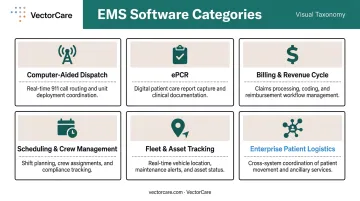
Each category solves a different operational problem. A small agency running 30 calls per day has different needs than a health system managing interfacility transfers, NEMT, and home health coordination across hundreds of daily discharges.
Integration is now the defining factor in purchasing decisions. Disconnected point solutions — a CAD system that doesn't talk to ePCR, an ePCR that doesn't feed billing — create documentation gaps and manual re-entry that drive claim denials and coordination delays.
Top Ambulance and EMS Software Options
These platforms were selected based on operational depth, integration capability, compliance posture, and real-world adoption across EMS agencies and healthcare facilities. Each serves a distinct use case.
VectorCare
VectorCare is a comprehensive patient logistics platform that goes beyond traditional EMS dispatch, unifying ambulance transport, home health, and DME coordination into one AI-powered system trusted by over 2,500 healthcare facilities nationwide.
What separates VectorCare from field-level EMS tools is its architectural premise. Founder David Emanuel built the platform around a core insight: patient logistics is fundamentally an infrastructure problem, not a scheduling challenge that phone-based workflows can fix. Traditional coordination relies on phone calls and fax machines, where delays are structural by design.
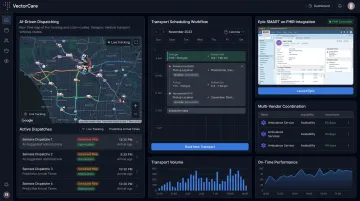
Its A.D.I. (Automated Dispatching Intelligence) automates manual coordination tasks, while SMART on FHIR integration with Epic EHR automatically extracts patient data and embeds logistics directly into clinical workflows. In practice, this has reduced transport scheduling from approximately 31 minutes using phone-based workflows to under 3 minutes for a confirmed transport decision.
| Feature | Details |
|---|---|
| Key Features | AI-driven dispatching (A.D.I.), SMART on FHIR Epic integration, real-time transport tracking, multi-vendor management, home health and DME coordination, no-code workflow customization, secure care team messaging, vendor credentialing |
| Best For | Hospitals, health systems, ambulance providers, NEMT providers, payers, and public health agencies managing high-volume multi-vendor patient transport and non-emergency logistics |
| Pricing | Custom pricing; contact VectorCare directly for a tailored quote |
TraumaSoft
TraumaSoft is an all-in-one EMS operations platform built specifically for ambulance agencies, consolidating CAD, ePCR, billing, scheduling, and fleet and HR management into a single unified system. Founded in 2006 and trusted by nearly 200 customers, it targets private EMS providers that need a single platform from call receipt to billing closeout.
The key differentiator is tight native module integration: data entered in dispatch flows automatically into ePCR and billing, reducing duplicate entry and the claim denials that result from manual handoffs. TraumaSoft's ePCR also includes AI-powered QA/QI to catch documentation issues before they become billing problems.
| Feature | Details |
|---|---|
| Key Features | Computer-Aided Dispatch (CAD), Electronic Patient Care Reporting (ePCR) with AI QA/QI, billing and revenue cycle management, crew scheduling, fleet management, real-time routing |
| Best For | EMS agencies and ambulance providers needing a single platform to manage operations from call intake to billing closeout |
| Pricing | Not publicly listed; contact TraumaSoft for a custom quote |
ESO
ESO is a data-driven emergency response platform used by EMS agencies, fire departments, hospitals, and government agencies. Its primary differentiator is real-time bidirectional EMS-to-hospital data sharing, which enables receiving teams to begin preparing for a patient before the ambulance arrives.
A notable deployment: CommonSpirit Health and ESO launched the first EMS-hospital data exchange in Utah in July 2025, giving nearly 4,000 first responders along the Wasatch Front access to real-time patient outcome data. ESO's Innovation Award recipients include the Tulsa Fire Department and the Hawaii State Department of Health.
| Feature | Details |
|---|---|
| Key Features | Next-generation ePCR, real-time bidirectional EMS-to-hospital data sharing, fire reporting, compliance and quality improvement reporting, state and public health reporting |
| Best For | Emergency response agencies, fire departments, hospitals, and public health bodies that need cross-sector data sharing and pre-arrival clinical coordination |
| Pricing | Not publicly listed; contact ESO for a tailored quote |
ImageTrend EMS
ImageTrend is a cloud-based EMS platform focused on prehospital and mobile integrated health (MIH) agencies. Its configurable ePCR supports agency-specific workflows, drag-and-drop editing, and NEMSIS v3.5 compliance, with built-in data validation to reduce submission errors.
ImageTrend's strength is connectivity: bidirectional data flow between prehospital systems, hospital EHR environments, and state registries. Its Health Information Hub supports ePCR integration into hospital EMR/EHR systems and returns outcome data to EMS agencies. Its Community Health module separately supports MIH and community paramedicine programs.
| Feature | Details |
|---|---|
| Key Features | Configurable ePCR, NEMSIS v3.5 state registry connectivity, bidirectional hospital data sharing, mobile integrated health support, patient registry reporting |
| Best For | Prehospital and MIH-focused agencies that prioritize clinical documentation accuracy and state data submission compliance |
| Pricing | Not publicly listed; contact ImageTrend for pricing details |
ZOLL Data Systems
ZOLL Data Systems is a CAD and EMS operations platform built around map-centric fleet monitoring and real-time unit positioning. Its dispatch engine ranks resources by proximity, live traffic, and road closures. Its companion product, ZOLL Respond, supports two-way communication between dispatchers, field crews, and supervisors, including video chat, broadcast alerts, and mobile trip acceptance.
Outcome example: Virtua Health Patient Logistics — managing 91,000 annual responses across 1,000 square miles — reduced expenses by $4 million and achieved Level Zero transfer-request-to-arrival times within 30 minutes after integrating ZOLL solutions.
| Feature | Details |
|---|---|
| Key Features | Computer-Aided Dispatch (CAD), two-way dispatcher-crew communications, unit positioning optimization, real-time fleet monitoring, routing and analytics |
| Best For | EMS agencies and dispatch centers focused on optimizing unit deployment and reducing response time through data-driven vehicle positioning |
| Pricing | Not publicly listed; contact ZOLL Data Systems for a custom quote |
Key Features to Look for in Ambulance and EMS Software
Real-Time Dispatch and GPS Tracking
Any viable EMS platform needs live unit status visibility paired with intelligent dispatch recommendations. Automated Vehicle Location (AVL) systems — which use GPS to report vehicle location, speed, and status — give dispatchers the data to assign the closest appropriate unit rather than guessing from a radio call. Research on dynamic ambulance reallocation found system-status-management plans reduced median response times compared with static deployment policies, supporting the operational value of real-time positioning data.
The combination of AVL and smart dispatch also prevents mismatches — sending a BLS unit to an ALS call, for example — which waste response miles and delay appropriate care.
ePCR and Billing Integration
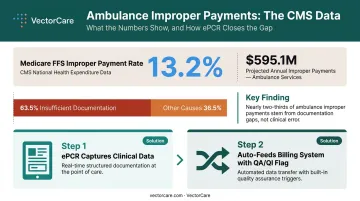
Disconnected clinical documentation and billing systems are the primary driver of claim denials in EMS. CMS data for the 2024 reporting period shows a 13.2% Medicare FFS ambulance improper payment rate — representing $595.1 million in projected improper payments — with 63.5% attributed to insufficient documentation.
When patient data captured in the field must be manually re-entered into billing systems, transcription errors and incomplete records result. Look for platforms where ePCR data flows directly into billing records without re-entry, and where QA/QI tools flag documentation gaps before claims are submitted.
EHR Interoperability and HIPAA Compliance
For hospital-adjacent organizations, connecting with electronic health record systems via HL7 FHIR standards is becoming a baseline requirement. Epic holds 43.7% of the U.S. acute-care EHR market and 56.9% of hospital beds — meaning Epic integration directly affects how broadly a platform can serve the hospital sector.
HIPAA compliance requirements apply to any software handling protected health information. Per HHS guidance, software vendors handling PHI function as business associates and must have documented contracts in place. Before contracting with any vendor, request evidence of HIPAA compliance certification and ask specifically about data encryption standards and access controls.
Scalability and Configuration Flexibility
Evaluate whether a platform can grow with your organization without requiring a full system replacement down the road. No-code workflow configuration is a practical differentiator here — teams that can adjust workflows without developer dependency sidestep costly build cycles when operational needs shift.
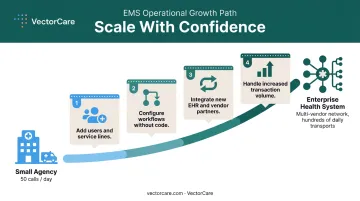
Key scalability indicators to assess:
- Supports adding users and service lines without rearchitecting the system
- Allows workflow changes through configuration, not custom code
- Integrates with new vendor and EHR partners as your network expands
- Handles higher transaction volumes without performance degradation
An agency processing 50 calls per day today may be coordinating multi-vendor transport networks across a regional footprint within a few years. The right platform makes that transition an upgrade, not a replacement.
How We Chose the Best Ambulance and EMS Software
The platforms listed were assessed on five criteria:
- Operational depth — range of functions covered, from dispatch through billing
- Real-world adoption — verifiable healthcare organization deployments
- Integration capability — connectivity with existing clinical and billing systems
- Compliance posture — HIPAA certification and data governance practices
- Enterprise vs. field fit — ability to serve both agency-level EMS and hospital-level logistics operations
These criteria exist for a reason. The most common selection mistake is choosing software based on a compelling demo rather than fit with existing workflows — and CMS data shows why that matters. Documentation failures drove the majority of ambulance improper payments, not coding errors. Platforms with strong ePCR-to-billing integration and built-in QA/QI tools close that gap; platforms that route data through manual handoffs between systems leave it open.
Before contracting with any vendor, demand live integration testing with your own ePCR, billing, or EHR systems. Demo environments don't replicate the friction of production data, and discovering integration gaps after go-live is a pattern that repeats across EMS technology implementations — and one of the most avoidable.
Conclusion
The right EMS or ambulance software depends on where your organization actually operates: field-level tools, enterprise coordination infrastructure, or both.
Two distinct needs define most purchasing decisions:
- Field-focused agencies running fewer than 100 calls per day with straightforward billing workflows are well-served by purpose-built EMS platforms like TraumaSoft, ESO, ImageTrend, or ZOLL.
- Enterprise health systems managing high-volume interfacility transfers, multi-vendor NEMT, home health, and DME coordination need infrastructure built for that operational complexity — not a scaled-up point solution.
The decision matters beyond current operations. An organization managing 50 transports per day today could be coordinating hundreds of vendors and care transitions within five years. Building on a platform that can't scale to that scope means an expensive migration at exactly the moment when operational continuity matters most.
Health systems and ambulance providers that have outgrown point solutions can explore VectorCare's enterprise patient logistics platform — designed for automated, auditable, EHR-integrated coordination at scale. Request a demo or contact VectorCare directly to see how it performs against your specific operational requirements.
Frequently Asked Questions
What does ambulance (EMS) software do?
EMS software manages the full operational lifecycle of medical transport. It covers call intake, unit dispatch, GPS tracking, ePCR documentation, billing, and compliance reporting — connecting every stage of a transport event to reduce errors and speed up coordination.
Can ambulance software track ambulances?
Yes. Most modern platforms include Automated Vehicle Location (AVL) using real-time GPS to show live unit location and status. Dispatchers can assign the closest available unit, monitor routing, and reduce unnecessary mileage — eliminating reliance on radio-only coordination.
What is the difference between EMS dispatch software and a patient logistics platform?
EMS dispatch software focuses on field operations: call taking, unit assignment, and ePCR documentation. Patient logistics platforms like VectorCare manage the broader coordination of non-emergency transport, home health, DME, and multi-vendor scheduling across large healthcare systems. EHR integration is a core feature of these platforms, not an optional add-on.
Does ambulance software need to be HIPAA compliant?
Yes. Any software handling protected health information, such as patient care reports, demographics, and transport records, must be HIPAA compliant. Vendors handling PHI are business associates under HHS rules — request compliance certifications, encryption documentation, and a signed Business Associate Agreement before contracting.
How does ambulance software integrate with hospital EHR systems?
Modern platforms use interoperability standards like HL7 and FHIR to connect with hospital EHR systems such as Epic. VectorCare's SMART on FHIR integration, for example, pulls patient data automatically and embeds transport coordination into Epic workflows — cutting manual entry and documentation errors.
How long does it typically take to implement ambulance or EMS software?
Cloud-based SaaS platforms can go live in weeks; enterprise systems with complex EHR integrations may take several months. Plan for data migration, staff training, and a parallel-run period before full deployment.