Introduction
US healthcare systems are under compounding operational pressure. Patient volumes keep climbing, 77% of medical group members cite regulatory and administrative burdens as significant physician burnout factors in 2026, and communication breakdowns appear in 40% of malpractice cases from 2015–2024. Against that backdrop, workflow infrastructure has shifted from a nice-to-have to an operational necessity.
"Healthcare workflow solutions" covers a wide operational surface: clinical documentation, scheduling automation, patient transport coordination, and post-acute care transitions. This guide evaluates five platforms shaping care delivery in 2026 — what each does, where it performs best, and which fits your organization's needs.
Key Takeaways
- Top 2026 workflow solutions target four layers: patient logistics, ambient documentation, clinical decision support, and patient communication.
- The strongest platforms combine HIPAA compliance, FHIR-based EHR integration, and published, measurable outcomes.
- Patient logistics and post-acute coordination remain the most underinvested workflow categories across health systems.
- The five platforms reviewed: VectorCare, Curogram, EvidenceCare, Epic Systems, and Nuance DAX.
What Are Healthcare Workflow Solutions?
Healthcare workflow solutions are digital platforms that manage the structured sequence of tasks care teams perform to deliver patient care — across administrative, clinical, and operational functions. They replace fragmented manual processes with automated, standardized workflows that reduce errors and free staff to focus on patients.
The Four Primary Workflow Categories
| Category | What It Covers |
|---|---|
| Patient-facing & administrative | Scheduling, registration, billing, appointment reminders |
| Clinical & diagnostic | Order entry, documentation, results routing, decision support |
| Operational & logistics | Patient transport, care coordination, discharge planning |
| Back-office | Compliance, credentialing, supply management |
The strongest platforms in 2026 address one or more of these categories with precision, not all four superficially.
Why the Market Is Growing Fast
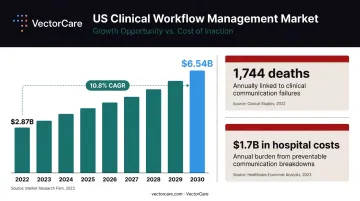
The US clinical workflow solutions market was valued at $2.87 billion in 2022 and is projected to reach $6.54 billion by 2030 at a 10.8% CAGR. That growth is driven by a measurable cost problem: fragmented care coordination carries real financial consequences. Communication failures alone contributed to nearly 1,744 deaths and $1.7 billion in hospital costs across a five-year malpractice claims window.
The platforms below were selected because they eliminate coordination bottlenecks at the source, not just add a digital layer on top of existing manual steps.
Top Healthcare Workflow Solutions for 2026
Each platform below was shortlisted for automation depth, EHR interoperability, measurable clinical or operational impact, and proven adoption across US healthcare facilities.
VectorCare
VectorCare is a HIPAA compliant, cloud-based patient logistics platform built since 2011 to unify transport, home health, DME, and all non-emergency patient services into one automated ecosystem. It serves 2,500+ healthcare facilities nationwide.
The platform's core differentiator is its Automated Dispatching Intelligence (A.D.I.) — which automates the full dispatch lifecycle, from request intake through provider negotiation and confirmation, eliminating manual coordination entirely. Before VectorCare, facilities like the Orange County Health Care Agency spent an average of 45 minutes per transport request coordinating manually. After deploying VectorCare Hub, that dropped to 4.5 minutes — a 10x reduction in coordination time per request.
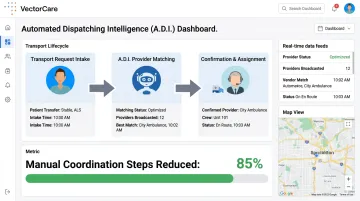
The platform's **SMART on FHIR Epic integration** automatically extracts patient data directly from the EHR when a transport request is initiated, removing the need for coordinators to manually transcribe vitals, demographics, and clinical context before contacting transport providers.
| VectorCare | |
|---|---|
| Key Feature | A.D.I. automates dispatching end-to-end — negotiating times, prices, and managing requests with no manual intervention |
| Integration | SMART on FHIR Epic EHR integration; broad network of transport providers on platform |
| Proven Outcomes | 10x reduction in coordination time (45 min → 4.5 min); vendor-published 90% reduction in scheduling time (from 31 minutes to under 3 minutes); A.D.I. saved customers over 100,000 hours in 2025 |
Curogram
Curogram is a patient engagement and communication workflow platform designed for medical practices. It offers HIPAA-compliant two-way texting, automated appointment reminders, online patient forms, insurance verification automation, and integrations with 150+ EMR/EHR systems — including athenahealth, Epic, eClinicalWorks, and NextGen.
Its strength is patient-facing workflow automation. According to vendor-published data, Curogram's automated reminder workflows reduce no-show rates by up to 75%, with clients averaging no-show rates 53% lower than industry benchmarks. One published case study showed a primary care practice cut no-shows from 22% to under 9% within three months.
Staff savings are equally notable: the platform claims an average of 10 hours of phone time saved per week per practice, with one clinic reducing phone calls by 70% and saving 15 staff hours weekly.
| Curogram | |
|---|---|
| Key Feature | Automated appointment reminders via SMS, email, and voice with two-way patient response that updates the schedule in real time |
| Integration | 150+ EMR/EHR pre-built connectors; VOIP integration; HIPAA-compliant and SOC2 certified patient portal |
| Proven Outcomes (vendor-published) | Up to 75% no-show reduction; clients average 53% lower no-show rates than industry; 10 hrs/week phone time saved |
EvidenceCare
EvidenceCare is a clinical decision support (CDS) platform built for hospital clinicians. Its suite includes AdmissionCare (point-of-care bed status decisions), CareGauge (real-time care utilization and cost transparency), and CarePathways (evidence-based care logic embedded in the physician's workflow). Health system partners include Ballad Health, MedStar Health, and Moffitt Cancer Center.
EvidenceCare embeds guidance directly into existing clinical workflows. Clinicians receive decision support inside their existing EHR environment, with no additional tab or separate login required. The platform integrates with Epic, Oracle Cerner, and MEDITECH via SMART on FHIR, and holds both HITRUST Risk-based, 2-year certification and SOC 2 Type I compliance.
On outcomes, EvidenceCare reports (vendor-published) that CareGauge delivers an average of $325 in savings per discharge and a 4-hour reduction in length of stay. One Texas health system achieved a half-day LOS decrease and $5 million in cost savings within the first ten months.
For systems with 100,000 annual admissions, AdmissionCare projects an average of $6 million in additional reimbursement. EvidenceCare has made the Inc. 5000 for four consecutive years, ranking No. 1,897 overall in 2025.
| EvidenceCare | |
|---|---|
| Key Feature | EHR-embedded clinical decision support with evidence-based care pathways — non-invasive to existing clinician workflows |
| Integration | Epic, Oracle Cerner, MEDITECH via SMART on FHIR; HITRUST certified; SOC 2 Type I compliant |
| Proven Outcomes (vendor-published) | $325 saved per discharge; 4-hour LOS reduction; $5M savings in 10 months (Texas health system) |
Epic Systems
Epic holds 42.3% of hospitals and 54.9% of beds in the US non-federal acute care hospital EHR market, according to KLAS's year-end 2024 rankings — the only vendor with a net market-share increase in 2023. In 2026, its workflow value extends well beyond records management.
Epic's unified data model means clinical, administrative, and operational workflows share a single patient record, reducing the duplication that plagues organizations running disconnected point solutions. Its Showroom and Epic Showroom ecosystem hosts 2,751 live apps using open.epic web services, with over 750 no-cost APIs enabling third-party workflow tools to embed SMART on FHIR applications directly into the Epic environment.
VectorCare's patient logistics tools and Priority Dispatch Corp's Medical Transfer Protocol are both available through this channel, extending Epic's native capabilities into transport and dispatch coordination.
The scale of Epic's API infrastructure is significant: its USCDI v3 APIs have been called over 8 billion times since their 2024 release, with 8.91 billion annual patient record exchanges — 54% with non-Epic organizations.
| Epic Systems | |
|---|---|
| Key Feature | End-to-end EHR workflows (CPOE, eMAR, scheduling, referrals, patient portal, revenue cycle) under a unified patient data model |
| Integration | SMART on FHIR open API ecosystem; 2,751+ live third-party apps; interoperable with major lab, imaging, and ancillary systems |
| Scale | 42.3% of hospitals / 54.9% of beds (KLAS, year-end 2024); 190M+ MyChart patients; 2,000+ hospitals and 50,000+ clinics live |
Nuance DAX (Microsoft)
Nuance DAX (Dragon Ambient eXperience), now part of Microsoft, addresses one of the most persistent clinician complaints: documentation burden. The platform listens to natural physician-patient conversations and automatically generates structured clinical notes, with no active input required from the physician during the visit.
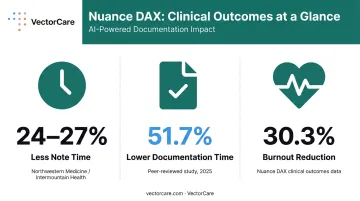
This ambient model is the key distinction from traditional dictation. The AI captures, structures, and drafts the note for physician review and sign-off. Microsoft reported that Northwestern Medicine DAX Copilot users spent 24% less time on notes and saw a 17% decrease in after-hours "pajama time." Intermountain Health saw a 27% reduction in note time per appointment. A peer-reviewed 2025 study reported even stronger outcomes: 51.7% lower documentation time, 2.5 fewer off-hours documentation hours per week, and a 30.3% reduction in self-reported burnout.
Nuance DAX integrates natively with Epic and Oracle Health (Cerner) via Microsoft Cloud for Healthcare, and is HIPAA-compliant.
| Nuance DAX (Microsoft) | |
|---|---|
| Key Feature | Ambient AI documentation — generates structured clinical notes from physician-patient conversations with no active physician input required |
| Integration | Native integration with Epic and Oracle Health (Cerner); HIPAA-compliant via Microsoft Cloud for Healthcare |
| Proven Outcomes | 24–27% less note time (Microsoft-reported); 51.7% documentation time reduction; 30.3% burnout reduction (peer-reviewed, 2025) |
How We Chose the Best Healthcare Workflow Solutions
A common mistake health systems make is selecting a single "all-in-one" platform that underperforms across multiple workflow layers. The strongest strategies pair purpose-built tools that integrate well with existing EHRs and each other. That framing shaped the six criteria applied to every platform in this guide.
Evaluation Criteria
Each platform was assessed against:
- Depth of automation — genuine workflow automation, not just digitization of manual steps
- HIPAA compliance and data security posture — including HITRUST, SOC 2, or equivalent certifications
- EHR interoperability — especially FHIR-based and SMART on FHIR integration capability
- Measurable outcomes — published data, case studies, or peer-reviewed research
- Scalability — ability to serve organizations across facility types and sizes
- Market trust — demonstrated health system adoption and client references
The Most Underinvested Workflow Categories
Two areas consistently receive less technology investment than their operational impact warrants:
- Patient logistics and transport coordination: A 2025 peer-reviewed study confirms that discharge and flow bottlenecks directly contribute to prolonged length of stay, ED crowding, higher costs, and lower patient satisfaction. Yet many organizations still coordinate transport via phone calls and fax.
- Post-acute care transitions: Delayed discharges are frequently tied to difficulty placing patients in appropriate rehabilitation settings — a coordination gap that platforms like VectorCare directly address.
- Readmission costs: Medicare pays $15 billion annually for readmissions (MedPAC, 2023), $12 billion of which are considered preventable.
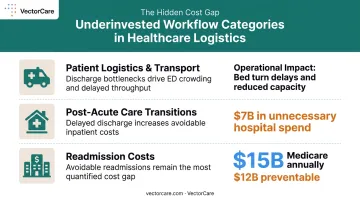
Organizations that treat logistics coordination as a back-office function rather than infrastructure absorb these costs in excess bed-days, staff time, and readmission penalties. The platforms that score highest here are those that address logistics as a systems problem, not a scheduling one.
Conclusion
The right healthcare workflow solution depends on which layer of the care continuum is creating the most friction. A hospital drowning in documentation burden needs something different than one losing days to discharge delays and transport phone tag. The strongest approach in 2026 is to map your top three operational bottlenecks first, then select platforms with demonstrated interoperability, published outcomes, and the ability to scale.
Evaluate each platform against your specific gaps: administrative volume, clinical documentation burden, care coordination delays, or patient transport inefficiency. The platforms reviewed here address each of those domains. Each works best when matched to the right problem.
For organizations looking to replace phone-based coordination with automated logistics workflows, reduce length of stay, and automate patient logistics from transport to home health, VectorCare was built specifically for that challenge — serving 2,500+ healthcare facilities nationwide and delivering over $500,000 in annual savings for a 250-bed hospital with 25 daily transports. Visit vectorcare.com to explore a demo.
Frequently Asked Questions
What are clinical workflow solutions?
Clinical workflow solutions are digital tools that streamline how healthcare professionals document, coordinate, and communicate across the care continuum. They reduce errors, delays, and administrative burden at every step of patient care.
What is a clinical workflow?
A clinical workflow is the structured sequence of steps healthcare professionals follow from patient intake through diagnosis, treatment, documentation, and follow-up. Depending on the care setting, workflows may run sequentially, in parallel, or conditionally based on patient needs.
What is clinical workflow optimization?
Clinical workflow optimization is the process of analyzing existing healthcare workflows to identify inefficiencies and bottlenecks. Those processes are then redesigned or automated to improve speed, accuracy, staff productivity, and patient outcomes.
What are examples of clinical workflows?
Common examples include:
- Patient admission and discharge coordination
- Medication administration (CPOE through eMAR)
- Lab result routing and critical value notification
- Surgical scheduling and OR coordination
- Inter-facility patient transport dispatch
What is the difference between clinical and administrative workflow solutions?
Clinical solutions focus on care delivery tasks performed by clinicians — documentation, order entry, care pathways, decision support. Administrative solutions handle operational functions like scheduling, billing, insurance verification, and credentialing. Most modern platforms now bridge both domains within a single EHR-connected environment.
How do healthcare workflow solutions integrate with EHR systems?
Modern solutions integrate through FHIR-based APIs and SMART on FHIR frameworks, allowing third-party tools to embed directly into EHR environments with bi-directional data exchange and no duplicate entry. ONC reported that 81% of non-federal acute care hospitals enabled API-based patient data access in 2024, confirming this integration model is now the standard.