The numbers reflect this shift. The global healthcare automation market has grown from a niche technology category into one of the most closely watched sectors in health IT investment. Understanding where the market stands today, where it's headed by 2035, and which segments are growing fastest gives healthcare leaders a sharper lens for prioritizing capital and technology decisions.
This article covers current market size and valuation, the 2035 forecast, key growth drivers, segment leaders, regional dynamics, adoption barriers, and why patient logistics automation is emerging as one of the most consequential sub-segments in the space.
Key Takeaways
- Precedence Research projects the global healthcare automation market will reach $119.19 billion by 2035, growing at a 9.79% CAGR.
- AI, robotic process automation, and IoT-enabled systems are reshaping every layer of healthcare delivery.
- North America holds the largest market share (36%+); Asia-Pacific is the fastest-growing region at an 11.35% CAGR.
- Therapeutic automation leads by product type; pharmacy and laboratory automation leads by application segment.
- Patient logistics automation is gaining traction as health systems prioritize cutting length of stay and administrative overhead.
Healthcare Automation Market Size: Where Things Stand Today
Defining the Market
Healthcare automation covers the use of technology, software, and intelligent systems to handle administrative, clinical, and operational tasks with reduced human intervention. That spans medication dispensing and diagnostic imaging at the clinical end, all the way to patient scheduling, billing workflows, and transport coordination at the operational end.
That scope variation explains why market figures differ across research sources.
Current Valuations
Two of the most-cited sources put the 2025 baseline in a tight range:
- Mordor Intelligence: $44.75 billion (2025)
- Precedence Research: $46.85 billion (2025)
Grand View Research reported the medical automation market at $52.09 billion in 2024, while Spherical Insights pegged the 2023 baseline at $38.7 billion. The differences come down to scope: whether medical logistics, training automation, and home care are included, and how "healthcare automation" is defined versus "medical automation."
The 2035 Forecast
The headline projection from Precedence Research puts the market at $119.19 billion by 2035 at a 9.79% CAGR. Cross-referencing against other forecasts:
- Mordor Intelligence: $69.06 billion by 2030 at 9.07% CAGR
- Spherical Insights: $99.8 billion by 2033 at 9.94% CAGR
Each uses different taxonomies, so direct comparisons have limits. The directional consensus holds regardless: consistent high-single-digit to low-double-digit growth through the mid-2030s.
Historical Context
A decade ago, healthcare automation was primarily associated with pharmacy dispensing robots and basic EHR adoption. Today the scope includes AI-driven predictive analytics, robotic-assisted surgery, automated dispatching, and cloud-based workflow platforms. COVID-19 served as a hard inflection point — health systems that had deferred automation investments were forced to move fast, compressing years of adoption into months.
What's Fueling This Growth: Key Market Drivers
Chronic Disease Burden and Aging Demographics
Non-communicable diseases are generating unsustainable care volume. According to the WHO, NCDs killed at least 43 million people in 2021, representing 75% of non-pandemic-related global deaths. Cardiovascular disease, diabetes, cancer, and chronic respiratory illness require ongoing monitoring, medication management, and frequent care encounters — all of which strain systems not designed for this volume.
Automation in diagnostics, therapeutic delivery, and care coordination directly addresses the throughput problem.
Acute Healthcare Workforce Shortages
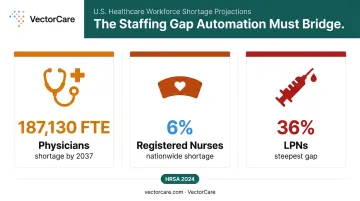
The staffing math doesn't work without automation. The AHA, citing Mercer and Lightcast projections, anticipates a shortage of roughly 100,000 critical U.S. healthcare workers by 2028. HRSA's 2024 workforce report projects further gaps across multiple roles:
- 187,130 FTE physician shortage by 2037
- 6% registered nurse shortage nationwide
- 36% LPN shortage — the steepest projected gap across clinical roles
Automation in this context isn't about replacing clinicians — it's about making existing staff capacity go further by eliminating tasks that don't require human judgment.
Pressure to Cut Costs and Improve Throughput
Hospitals operate on razor-thin margins. CAQH's 2023 Index Report found $89 billion in tracked U.S. administrative transaction spend — and identified $18.3 billion in potential savings from moving to fully electronic workflows. That's a significant opportunity sitting in administrative processes alone, before accounting for clinical or operational automation.
AI, IoT, and Cloud Infrastructure Maturation
ONC data shows predictive AI adoption among U.S. non-federal acute-care hospitals climbed from 66% in 2023 to 71% in 2024 — and these aren't pilot programs anymore. They're operational deployments requiring governance frameworks.
Cloud infrastructure has made enterprise-grade automation accessible at scale, while IoT-connected devices now feed real-time patient data into systems that act on it. Machine learning supports applications that weren't viable five years ago:
- Automated dispatching and transport coordination
- Predictive readmission modeling
- Intelligent bed management
Government Digitization Initiatives
Policy is accelerating adoption. Several major programs have moved from planning to active deployment:
- UK: £2 billion committed to digitize NHS services, with a target of 100% NHS trust EPR adoption by March 2025
- India: Ayushman Bharat Digital Mission created more than 73.98 crore ABHA accounts and linked over 49.06 crore health records as of early 2025
- Japan: Medical Digital Transformation Promotion Plan focused on standardizing healthcare digitization nationally
These programs build the shared data infrastructure that patient logistics platforms — including those managing NEMT, home health, and post-acute coordination — depend on to operate at population scale.
Key Market Segments: Where Automation Is Taking Hold
By Product Type: Therapeutic Automation Leads
The market is typically segmented by product/technology type, application, and end-user. By product type, therapeutic automation holds the largest share. Multiple sources — Grand View Research, Precedence Research, and MarketsandMarkets — identify therapeutic automation (robotic-assisted surgery, automated drug delivery, smart infusion systems) as the dominant category, with Grand View data suggesting it accounts for roughly 53%+ of revenue by product type.
Robotic-assisted procedures reduce variability, improve precision, and generate documented patient safety benefits at scale.
By Application: Pharmacy and Laboratory Automation Lead
Based on Mordor Intelligence's analysis, pharmacy and laboratory automation captured the largest application segment share at 36.23% in 2024 — not hospital workflow automation, which is a common but unverified claim in other summaries.
Medical logistics automation — covering patient transport coordination, ambulance dispatching, and discharge planning — sits within this landscape as a growing sub-category. Platforms like VectorCare's A.D.I. (Automated Dispatching Intelligence) operate here, automating patient transport request processing and provider matching in real time.
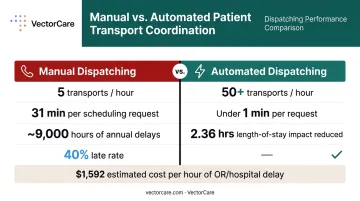
In practice, VectorCare's platform reduces individual transport scheduling from 31 minutes per ride under manual workflows to under 3 minutes. The platform is embedded directly within Epic EHR environments through its SMART on FHIR integration.
By End-User: Hospitals Dominate
Mordor Intelligence reports hospitals and surgical centers captured 45.67% of demand in 2024. This reflects both investment capacity and operational urgency — hospitals handle the highest volume of complex, multi-system workflows that benefit most from automation.
Research institutes, diagnostic centers, and home/ambulatory care settings are also growing rapidly, driven by the broader shift toward decentralized and home-based care delivery.
Regional Breakdown: Who's Leading the Charge
| Region | Market Position | Key Data |
|---|---|---|
| North America | Largest market | 36.24% global share (2024) |
| Asia-Pacific | Fastest growth | 11.35% CAGR vs. 9.07% global |
| Europe | Mature, steady | Germany projected at $4.9B by 2030 |
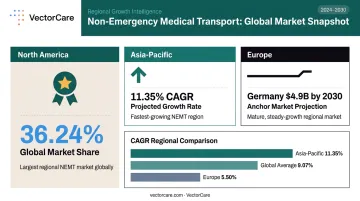
North America holds 36.24% of the global market — a lead built on advanced infrastructure, high technology adoption, strong venture capital, and favorable reimbursement structures. The concentration of major health tech companies in the U.S. is the primary driver.
At 11.35% CAGR — more than two points above the global average — Asia-Pacific is outpacing every other region. Government-backed digitization is a central driver: China's internet hospital network expanded from 100 facilities in 2018 to over 1,600 by mid-2021. Rising middle-class healthcare expenditure and rapid hospital infrastructure buildout are sustaining that momentum.
Europe's growth is steadier but deliberate. Germany, France, and the UK are advancing adoption through precision medicine programs and GDPR-aligned data infrastructure — with the UK's NHS digitization investment adding its own tailwind. Germany alone is projected to reach $4.9B by 2030.
Challenges Slowing Automation Adoption
Progress is real, but friction points remain significant. Three barriers consistently slow adoption across health systems of every size.
High Upfront Costs
Capital requirements stop many facilities before deployment even begins. A robotic surgery system requires $2 million to $3 million in initial investment, plus annual service fees of $100,000 to $170,000 and per-procedure instrument costs. For smaller health systems and facilities in low-to-middle-income countries, this math doesn't work.
Legacy System Integration
Cost barriers compound a second problem: existing infrastructure rarely plays well with modern automation. ONC data shows hospital interoperability improved from 46% engaging in all four interoperability domains in 2018 to 70% in 2023 — but that still leaves 30% of hospitals with incomplete integration environments. Automation platforms can't deliver full value when they can't exchange data cleanly with existing systems.
Regulatory Complexity and Workforce Resistance
Even when the budget and infrastructure align, compliance requirements and internal resistance extend timelines. HIPAA's security requirements for electronic protected health information apply at every layer of automation deployment. GDPR Article 9 adds restrictions specifically for health data processing in European markets.
Beyond compliance, healthcare workers' concerns about workflow disruption or job displacement slow organizational adoption — even when the technology is ready to go.
Patient Logistics Automation: A High-Growth Sub-Segment Worth Watching
Defining the Patient Logistics Automation Space
Patient logistics automation encompasses all non-clinical patient movement coordination: ambulance dispatch, non-emergency medical transport (NEMT), inter-facility transfers, home health scheduling, and DME delivery. For most of healthcare's history, this was treated as a back-office scheduling function. Today it's being recognized as infrastructure, not administration.
The NEMT market alone is projected to grow from $15.58 billion by 2028 to $31.87 billion by 2031, per Insight Partners data — and that's the transportation market, not the automation software layer on top of it.
Why This Sub-Segment Is Accelerating
Fragmented, phone-based patient logistics creates real, measurable damage. Research across multiple studies quantifies the cost:
- A peer-reviewed hospital transport study found approximately 9,000 hours of annual delay, with transporters late in ~40% of cases
- Transport delays contribute an estimated 2.36 hours of length-of-stay impact per patient
- That lost time carries an estimated cost per hour of delay for hospital and OR operations
The coordination problem is also a labor problem.
Health Affairs documented that poor care transitions caused $25 to $45 billion in wasteful medical spending (through avoidable complications and readmissions) — a figure from 2011 that has almost certainly grown.
VectorCare in Practice
That scale of waste is exactly what patient logistics automation is designed to eliminate. VectorCare's platform automates coordination across hospitals, payers, ambulance providers, and home health agencies. The platform's A.D.I. (Automated Dispatching Intelligence) replaces sequential phone-tree dispatching with automated provider broadcasting — sending transport requests to multiple credentialed vendors simultaneously while handling matching, assignment, and documentation within the EHR workflow.
In 2025, A.D.I. saved healthcare systems and suppliers more than 100,000 hours in 2025 in coordination tasks. In 2024, the platform generated 2.3 million broadcasts with contract value exceeding $570 million across 2,500+ healthcare facilities.
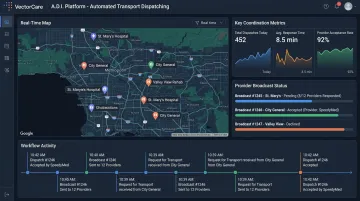
The SMART on FHIR Epic EHR integration pulls patient demographics, pickup location, clinical context, and insurance data automatically — reducing scheduling time to less than 3 minutes vs. ~31 minutes by phone (90% reduction) per request, with every event written back to the medical record.
Frequently Asked Questions
What is the size of the healthcare automation market in 2025?
Depending on scope and definition, estimates range from approximately $44.75 billion (Mordor Intelligence) to $46.85 billion (Precedence Research). Variance across sources reflects differences in whether medical logistics, training automation, and home care settings are included in the market boundary.
What is the projected growth rate of the healthcare automation market through 2035?
The CAGR sits in the 9–10% range across most major research sources. Precedence Research projects $119.19 billion by 2035 at a 9.79% CAGR — the longest published horizon available — driven by AI adoption, chronic disease burden, and global digitization programs.
Which segment of healthcare automation is growing the fastest?
Surgical robotics and patient logistics automation are among the fastest-growing sub-segments. By market share, therapeutic automation (robotic surgery, smart drug delivery) leads on product type; pharmacy and laboratory automation leads by application, per Mordor Intelligence.
Which region leads the global healthcare automation market?
North America leads with approximately 36% global market share, driven by the U.S. healthcare infrastructure, technology investment, and reimbursement environment. Asia-Pacific is projected to grow at an 11.35% CAGR through 2030 — the fastest of any region.
What are the biggest barriers to healthcare automation adoption?
The top three: high upfront implementation costs (particularly for robotic systems), integration complexity with legacy IT infrastructure, and regulatory compliance requirements under HIPAA and GDPR that vary by region and extend deployment timelines.
How does patient logistics fit into the healthcare automation market?
Patient logistics automation covers transport coordination, ambulance dispatch, and care transition management, and falls within the medical logistics and workflow automation segments. Fragmented manual coordination directly increases length of stay, administrative burden, and avoidable costs — which is why automated alternatives are drawing growing investment across care transitions.