Introduction
U.S. hospitals processed over 35.6 million admissions across roughly 907,000 staffed beds in 2024. HRSA projects a shortage of 187,130 FTE physicians by 2037.
These pressures don't exist in isolation. When volume climbs and staffing shrinks simultaneously, care coordination fractures — and in most health systems, that fracture is a workflow problem.
What structured workflow management actually delivers day-to-day — fewer delays, shorter stays, less staff burnout, lower costs — rarely gets the direct examination it deserves. This article covers those concrete outcomes: what good workflow management produces, what its absence costs, and how organizations can apply it effectively.
Key Takeaways
- Structured workflow management reduces repetitive manual tasks that consume staff time without adding clinical value
- Standardized care coordination cuts transport delays, handoff failures, and missed discharge windows
- Shorter length of stay and fewer readmissions follow when logistics workflows run in parallel with clinical care — not after it
- Missing or fragmented workflows create compounding costs: higher claim payouts, longer stays, and staff burnout
- Without EHR integration and consistent application across every coordination touchpoint, gains stay one-time rather than sustained
What Is Healthcare Workflow Management?
Healthcare workflow management is the deliberate design and coordination of sequenced tasks — clinical, administrative, and logistical — required to move patients through the care continuum effectively.
It covers more ground than most organizations realize:
- Scheduling and dispatching patient transport
- Coordinating interfacility transfers and bed assignments
- Managing discharge planning and post-acute placement
- Ensuring the right home health, DME, or SNF services are ready at the right time
The goal is less friction, so the right care happens at the right moment.
For health systems managing complex patient logistics, workflow management functions as foundational infrastructure. As VectorCare CEO David Emanuel has put it, patient logistics is fundamentally an infrastructure problem, not a scheduling one. When that infrastructure is missing or fragmented, everything downstream suffers.
Key Advantages of Healthcare Workflow Management
The advantages below aren't theoretical. They show up in the metrics healthcare leaders actually track: staff hours, cost per patient, on-time performance, length of stay, and readmission rates.
Advantage 1: Significant Reduction in Manual Work and Administrative Burden
One of the most direct benefits of structured workflow management is eliminating repetitive coordination tasks (phone calls, fax follow-ups, status checks, duplicate data entry) that consume staff hours without touching patient care.
In practice, workflow management replaces these "phone tag" loops with:
- Automated dispatching that creates, broadcasts, and assigns requests without human intervention
- Standardized communication protocols that eliminate back-and-forth between facilities and transport providers
- Real-time status tracking that removes the need to manually chase ETAs or confirm arrivals
VectorCare's A.D.I. (Automated Dispatching Intelligence) demonstrates what this looks like at scale. In one documented case, coordinators went from spending hours on faxing and phone calls per standing order renewal to a streamlined, automated process — A.D.I. has saved healthcare systems more than 100,000 staff hours as of 2025.
The burnout connection matters here. CDC data shows 46% of health workers reported frequent burnout in 2022, up from 32% in 2018 and administrative overload is a documented driver. Freeing clinical and coordination staff from repetitive tasks redirects their time toward patient-facing work and reduces cognitive load.
On cost: a peer-reviewed analysis estimated a 500-bed hospital loses over $4 million annually from communication inefficiencies. The number is older, but the underlying dynamic hasn't changed.
KPIs impacted: Staff hours saved per week, administrative cost per coordination event, manual task completion rate, staff satisfaction scores
When it matters most: High-volume environments: transfer centers, multi-facility health systems, NEMT providers, and air medical coordinators managing dozens to hundreds of concurrent requests
Advantage 2: Faster, More Reliable Care Coordination and Fewer Delays
Workflow management creates structured, visible handoffs between care teams, transport providers, and receiving facilities in place of informal, error-prone communication.
When workflows are defined and digitized, critical information flows automatically to the right people at the right moment:
- Patient status updates reach receiving teams before transport arrives
- Transport ETAs surface in real time rather than requiring manual follow-up
- Bed availability and receiving team readiness are confirmed before dispatch, not after
The impact on on-time performance can be dramatic. VectorCare's hospital partners have documented improvements from 50% to 99.2% on-time performance after implementing structured logistics workflows across their coordination touchpoints.
A 2022 malpractice claims analysis found communication failures in 49% of cases, with 40% involving failed handoffs. Mean total claim costs were $237,600 with communication failure versus $154,100 without. Delays aren't just operational inconveniences: they carry measurable financial and clinical risk.
Standardized handoff protocols reinforce this. Implementation of the I-PASS protocol reduced medical errors from 24.5 to 18.8 per 100 admissions and preventable adverse events from 4.7 to 3.3 without adding time to handoff conversations.
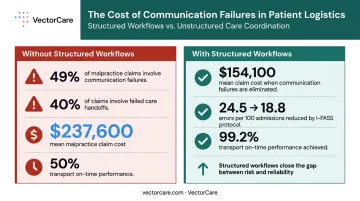
Structured care coordination, when sustained, produces compounding effects: fewer missed transport windows, faster bed turnover, and reduced bottlenecks downstream.
KPIs impacted: Transport on-time performance rate, time from order to execution, communication-related delay rate, transfer center response time
When it matters most: Critical patient transfers, same-day discharge coordination requiring NEMT or home health, and emergency transport where minutes affect outcomes
Advantage 3: Improved Patient Outcomes and Shorter Length of Stay
Those coordination gains from Advantages 1 and 2 translate into downstream outcomes: shorter hospital stays, fewer preventable readmissions, and smoother care transitions.
When discharge planning workflows are structured and triggered proactively, post-acute services are arranged in parallel with clinical discharge preparation — not after discharge orders are written. That sequencing shift eliminates idle time that extends length of stay beyond clinical necessity.
AHA data shows average hospital length of stay rose 19.2% in 2022 compared to 2019, with patients discharged to post-acute care seeing increases of nearly 24%. Much of that excess time isn't clinical: it's logistical.
The financial weight of each extra day is significant. KFF reports U.S. hospital expenses of $3,025 (KFF, 2023) per adjusted inpatient day, with California hospitals averaging $4,744. Even conservative LOS reductions across a high-census hospital translate to meaningful cost avoidance.
Shorter stays also free beds. For hospitals under occupancy pressure, that has direct implications for access and capacity, not just cost.
KPIs impacted: Average length of stay, 30-day readmission rate, discharge-to-placement time, bed occupancy and turnover rate
When it matters most: High-occupancy hospitals, health systems managing complex post-acute transitions, and payer programs like Medicare Advantage and PACE focused on reducing avoidable utilization
What Happens When Healthcare Workflow Management Is Missing
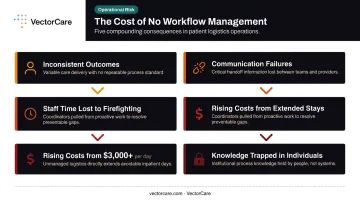
Operating without structured workflow management in patient logistics isn't a neutral state. The consequences compound over time:
- Outcomes vary by individual, not process. One coordinator completes a transfer smoothly; the next takes hours longer — patients experience the gap directly.
- Communication failures appear in nearly half of malpractice claims, with 40% involving failed handoffs. Without standardized workflows, the same failures repeat.
- Teams spend their time fixing problems that workflows would have prevented: chasing ETAs, re-ordering missed transports, re-contacting providers who never got the original request.
- Manual coordination at scale is expensive. Each extended inpatient day costs more than $3,000 — and discharge delays stacking up across a health system add up fast.
- Institutional knowledge stays trapped with specific individuals. When those staff leave or go absent, performance drops — and adding capacity across facilities has no reliable foundation to build on.
One VectorCare customer described their previous dialysis transport scheduling as "hours of faxing and phone calls each time a standing order was scheduled or renewed" — with little visibility into whether services were actually delivered. That's what manual coordination looks like at the ground level — and it's what structured workflows are built to replace.
How to Get the Most Value from Healthcare Workflow Management
Structured workflow management delivers its full return under specific conditions — most organizations achieve partial gains because they apply it inconsistently.
Apply It Across All Coordination Touchpoints
Automating transport dispatching but leaving discharge communication manual creates new handoff gaps. The value of workflow management erodes when only parts of the process are structured. Consistent application across clinical, logistical, and administrative layers is what prevents bottlenecks from simply moving rather than disappearing.
Integrate with Existing Systems
Workflow management tools that connect directly with EHR systems eliminate data re-entry and reduce errors. VectorCare's SMART on FHIR integration with Epic is a concrete example: patient data flows automatically from Epic into logistics workflows, eliminating the step where coordinators manually transcribe demographics, weight, and vitals before initiating a transfer request.
That coordination process previously took roughly 31 minutes: opening Epic, writing down patient data, calling providers sequentially. With the integration live, it drops to under 3 minutes.
ONC data shows 71% of U.S. hospitals used standards-based APIs in 2024, up from 55% in 2022 — meaning the infrastructure for this kind of integration is increasingly available and expected.
Review Performance Data and Act on It
Workflow management isn't a set-and-forget system. Organizations that review KPIs regularly and act on what they find are the ones that see sustained gains. The metrics worth tracking include:
- On-time transport rates by service type and provider
- Average time to placement for transfers and discharges
- Delay causes by category (communication, availability, documentation)
Each review cycle creates an opportunity to tighten a specific bottleneck — which is how partial gains become system-wide improvements over time.
Conclusion
The value of healthcare workflow management shows up in the data that actually matters: shorter stays, fewer delays, lower costs, and better care transitions. Those results come from operational change, not aspirational planning.
The organizations seeing the most consistent gains — reduced length of stay, fewer care gaps, lower readmission rates — share one pattern: they treat patient logistics as infrastructure, not administration. That means investing in coordination systems with the same intentionality they bring to clinical protocols. Platforms like VectorCare exist precisely for this: to make that infrastructure reliable, automated, and measurable across every patient transition.
Frequently Asked Questions
What are workflows in healthcare?
Healthcare workflows are the sequenced tasks, decisions, and handoffs performed by people and systems to deliver care — covering everything from scheduling a patient transport to coordinating a hospital discharge. How well they're designed determines whether patients move through the system safely and on time.
What are the 5 steps of workflow?
The five steps are:
- Task initiation — the trigger that starts the workflow
- Task execution — the core work performed
- Monitoring and tracking — progress oversight in real time
- Decision-making or approval — gates and escalations
- Completion and documentation — closure and record-keeping
What are the benefits of automated workflow management in healthcare?
Automation eliminates manual, repetitive tasks — such as dispatch requests and provider status chasing — reducing errors, freeing staff time, and enabling faster care coordination across high-volume environments. The measurable impact shows up in metrics like on-time transport performance, administrative hours saved, and reductions in coordination-related delays.
How does poor workflow management affect patient care?
Poorly managed workflows create handoff failures, communication gaps, and coordination delays that extend patient stays, delay necessary treatments, increase readmissions, and contribute to staff burnout. In busy hospitals, one missed handoff rarely stays isolated — it triggers a chain of delays across the shift.
What KPIs should healthcare organizations track for workflow performance?
Key metrics include average length of stay, transport on-time performance, time from order to execution, communication-related delay rate, administrative hours saved, and 30-day readmission rates. Together, these indicators reveal whether workflow management is delivering operational and clinical value.
How does workflow management reduce hospital length of stay?
Structured discharge planning workflows allow post-acute services — home health, DME, SNF placement — to be arranged in parallel with clinical discharge preparation rather than sequentially after discharge orders. This eliminates coordination-driven idle time and enables patients to transition faster to the appropriate next level of care.