Introduction
Ask a simple question across most healthcare systems — "What services does this facility offer, for whom, where, and when?" — and you'll quickly run into a familiar problem. The answer lives in a dozen different places: a PDF on a hospital website, a spreadsheet in a care coordinator's inbox, a phone call to someone who may or may not pick up.
That fragmentation has real consequences. A 2020 Health Affairs survey of privately insured patients receiving specialty mental health care found that 53% of directory users encountered inaccuracies, and those who did were twice as likely to receive out-of-network care and four times more likely to receive a surprise bill. Without a shared, structured way to represent service information, referrals get misdirected, transfers stall, and patients fall through gaps in care.
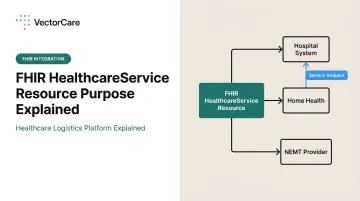
FHIR — HL7's modern interoperability standard — addresses this directly through the HealthcareService resource: a machine-readable representation of a single service or service category offered at a location. This post covers what the resource actually contains, how it connects to related FHIR resources, and where it shows up in real-world care coordination workflows — from referral routing to interfacility transfers.
Key Takeaways
- HealthcareService is an HL7-defined FHIR resource that captures structured details about a single healthcare service available at a location
- It stores service type, specialty, eligibility, availability, coverage area, referral requirements, and contact details in a queryable format
- It works alongside related FHIR resources — Organization, Location, Schedule, and PractitionerRole — to power service directories and referral workflows
- Real-world applications include national provider directories, referral systems, scheduling portals, and patient logistics platforms
- FHIR's RESTful design means HealthcareService records can be queried in real time across disconnected systems
What Is the FHIR HealthcareService Resource?
The HealthcareService resource is an HL7-defined FHIR DomainResource that describes the details of a healthcare service available at a location. This is not a software or API service — it represents real-world care delivery: a CT Head Scan, an Emergency Podiatry service, Non-Emergency Medical Transport, or Hospital-in-the-Home programs.
The Intersection of Three Entities
Conceptually, HealthcareService sits at the junction of three things:
- Organization — the entity responsible for delivering the care
- Location — the physical site or sites where delivery occurs
- Service — the specific clinical or support offering made available
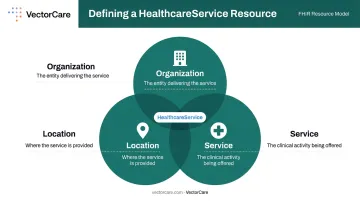
A single HealthcareService resource can reference multiple locations, but only when hours, contacts, and coverage areas are identical across all of them. If anything differs by location, separate resources are required.
What Qualifies as a HealthcareService?
The scope is intentionally broad. Official HL7 examples include:
- Clinical neuropsychology assessments
- Respite care at a nursing home or hostel
- 24-hour crisis telephone counseling
- Rural telehealth services
- Pharmacy dispensing services
- Day programs for adults with disabilities
That range — from inpatient clinical services to community-based and virtual care — is intentional. The resource is designed to describe any organized service a healthcare entity makes available.
The offeredIn Relationship
Added in R5 and carried into R6, the offeredIn element allows a specific schedulable service (for example, "MRI with Contrast") to reference a parent generic service (for example, "Radiology"). This enables hierarchical service catalogs inside FHIR directories — broad categories containing multiple specific, bookable entries.
How HealthcareService Differs from Related Resources
Two distinctions matter for implementers:
- Encounter records document what happened to a specific patient; HealthcareService describes available services independent of any individual
- ServiceRequest represents a clinician's order for a patient to receive a service; HealthcareService describes the service itself, not any particular order or episode
Key Elements of the FHIR HealthcareService Resource
Identity and Classification
These elements define what the service is and how it can be found:
| Element | Purpose |
|---|---|
identifier |
External business IDs (e.g., directory system IDs) |
active |
Boolean flag — is this record currently in use? |
name |
Human-readable label for consumer-facing display |
category |
Broad grouping (e.g., "Surgical Procedures," "Mental Health") |
type |
Specific service type within the category |
specialty |
Clinical specialty codes (e.g., "Cardiology," "Emergency Medicine") |
Category selection narrows the valid list of service types — a useful constraint for directory implementations that need consistent terminology.
Access and Eligibility
These elements answer the practical question: Can my patient access this service, and how?
eligibility— structured backbone with code, optional value, comment, and time period (value[x]andperiodsub-elements were added in R6)serviceProvisionCode— conditions of access: free, discounted, or fee-basedreferralRequired— boolean (added in the CI/R6 build)referralMethod— coded values for how referrals are accepted (phone, fax, electronic, etc.)appointmentRequired— boolean indicating whether booking is mandatory before attendance
These elements make eligibility filtering automatable via FHIR APIs, removing the need for manual verification calls.
Geographic and Operational Elements
location— references to Location resources where the service is physically deliveredcoverageArea— references to Location resources defining the geographic area the service is available to — distinct from where it is physically basedavailability— a structured datatype (introduced in R5) consolidating hours of operation and not-available periods into a single element, replacing R4's separateavailableTime,notAvailable, andavailabilityExceptionsfields
Contact and Endpoint Elements
contact— ExtendedContactDetail covering mailing addresses, billing contacts, booking phone numbers, and web URLs (organizational contacts only — not individual practitioners)endpoint— references to FHIR Endpoint resources providing electronic access points
If contact and availability details are identical to the referenced Location, they can be omitted from the HealthcareService record entirely to avoid duplication.
Descriptive and Supplementary Elements
These fields handle presentation, accessibility, and program affiliation — typically used to enrich consumer-facing directory listings:
comment— markdown field for supplementary consumer-facing descriptionextraDetails— markdown for information that doesn't fit other fieldsphoto— attachment for visual identification in service listscharacteristic— coded attributes like "wheelchair accessible" or "telehealth-capable"communication— languages the service is offered inprogram— government or external programs the service participates in (for example, Home and Community Care Programs)
How HealthcareService Relates to Other FHIR Resources
Primary Resource Relationships
| Resource | Relationship |
|---|---|
| Organization | providedBy — the entity that runs the service |
| Location | Where the service occurs physically |
| PractitionerRole | PractitionerRole.healthcareService links specific practitioners to the services they perform |
| OrganizationAffiliation | Can reference HealthcareService to constrain which services are available between two collaborating organizations |
The Scheduling Workflow Chain
HealthcareService integrates directly with FHIR's scheduling model. The standard pattern for enabling a bookable service in a directory follows this chain:
- HealthcareService — defines what is available
- Schedule (via
Schedule.actor) — represents actual availability windows - Slot — individual bookable time units within a schedule
- Appointment — the confirmed booking, with HealthcareService as a participant
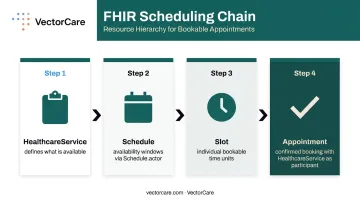
This chain is how patient-facing portals and referral tools expose real, bookable appointments without custom engineering on top of the standard.
That scheduling role is just one part of the picture. HealthcareService also appears directly inside clinical workflows as a named participant.
HealthcareService as an Actor in Clinical Workflows
In FHIR R5, HealthcareService can appear as a performer or participant in clinical resources. Confirmed examples from the R5 specification include:
- Encounter —
Encounter.participant.actorcan reference HealthcareService - ServiceRequest —
ServiceRequest.performercan reference HealthcareService
When HealthcareService appears in these roles, it represents the collective team operating under that service, not a single individual.
Real-World Use Cases for the HealthcareService Resource
National Provider Directories
HealthcareService is the backbone resource for consumer-facing service directories and machine-readable payer directories. A concrete example: Healthdirect Australia's National Health Services Directory (NHSD), version 1.4 (September 2024), aggregates health services and practitioner information using a FHIR R4 data model that explicitly includes HealthcareService alongside Organization, Location, PractitionerRole, and Endpoint.
In the US, the Da Vinci PDex Plan Net defines a FHIR R4 query-only interface for health insurers to publish plans, networks, and participating services — with a HealthcareService profile covering diagnostics, pharmacy, hospital, and ambulatory care. CMS's Interoperability and Patient Access final rule required impacted payers to implement public Provider Directory APIs by January 1, 2021.
Patient Referral and Care Coordination
Referral workflows have traditionally relied on phone-based lookups, with coordinators manually checking:
- Which services a facility offers
- Whether they accept the patient's insurance
- Whether a referral is required and through which method
HealthcareService makes this automatable. The eligibility.code, referralRequired, and referralMethod elements allow FHIR-native referral tools to filter candidates and identify the correct intake process without human intervention.
Appointment Booking and Scheduling Portals
Patient-facing booking portals query HealthcareService records to surface available services, link them to Schedule and Slot resources, and create confirmed Appointments — end-to-end digital booking without a human coordinator in the middle.
Patient Logistics and Transport Coordination
Structured service directory data is foundational for automated patient logistics platforms that match patients to available services — transport type, home health, DME, skilled nursing — based on clinical need, coverage area, and availability.
VectorCare's Epic-integrated patient logistics platform uses SMART on FHIR APIs to automatically pull patient demographics, encounter details, and clinical context from Epic the moment a logistics request is initiated. This structured data layer eliminates the sequential phone-outreach process that previously took coordinators roughly 31 minutes per transport. With simultaneous multi-provider matching, that same workflow runs in under 3 minutes.
Implementation Considerations for HealthcareService
Single vs. Multiple Location Resources
The FHIR spec provides a clear decision framework:
- One resource, multiple location references — appropriate when availability, contacts, endpoint details, characteristics, and coverage areas are identical across all locations
- Separate resources per location — required when any of those attributes differ by site
This decision has downstream implications for directory management. Getting it wrong early creates data replication headaches that are difficult to unwind.
FHIR Version Considerations
| Change | Version Introduced |
|---|---|
availability datatype (replacing availableTime/notAvailable) |
R5 (not R6 as sometimes assumed) |
offeredIn element |
R5 |
referralRequired boolean |
CI/R6 build |
eligibility.value[x] and eligibility.period |
CI/R6 build |
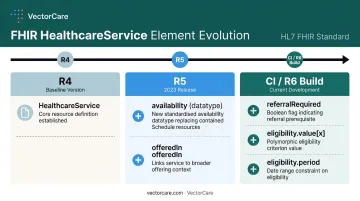
Confirm which FHIR version your target EHR or platform supports before building against the spec. R4, R5, and the CI/R6 ballot differ enough to affect implementation scope.
Search Parameters
HealthcareService supports a broad set of search parameters via standard FHIR RESTful APIs, enabling sophisticated service discovery without custom query logic:
active,service-category,service-type,specialtylocation,coverage-area,organizationeligibility,characteristic,communication
A query like "find all outpatient mental health services within 20 miles that accept Medicaid and do not require a referral" is executable against a conformant FHIR server using these parameters in combination.
Frequently Asked Questions
What is the FHIR standard in healthcare?
FHIR (Fast Healthcare Interoperability Resources) is an HL7 standard that defines structured data formats called "resources" and a RESTful API for exchanging electronic health information. It enables EHRs, apps, payers, and providers to share patient and operational data in a standardized way across systems.
Is FHIR HIPAA compliant?
FHIR is a data exchange standard, not a compliance framework. HIPAA compliance depends on how it is implemented — including HTTPS transport, access controls, audit logging, and business associate agreements. HealthcareService carries a "Business" security classification, so implementations must apply appropriate safeguards to any sensitive service records.
Is FHIR still used?
Yes, and adoption is growing. CMS's 2020 Interoperability and Patient Access final rule mandated FHIR APIs across Medicare Advantage, Medicaid, and marketplace payers, and major EHR vendors including Epic support SMART on FHIR. FHIR R6 is currently in active ballot development, reflecting continued global investment in the standard.
What is a FHIR-integrated healthcare platform?
A FHIR-integrated platform uses FHIR APIs to exchange data with EHRs, payers, and other health IT systems in real time. This gives clinicians and coordinators access to patient records, service directories, and clinical workflows without manual data entry or proprietary point-to-point interfaces.
How does HealthcareService differ from the Location resource?
Location represents the physical place where care occurs — a building, room, or geographic area. HealthcareService describes what is offered at or from that location. The two are complementary: HealthcareService references Location rather than replacing it.
What FHIR resources work alongside HealthcareService?
The primary companion resources are Organization (provider entity), Location (physical site), Schedule and Slot (availability windows), Appointment (confirmed booking), PractitionerRole (linking practitioners to services), and Endpoint (electronic access points). Together, they form a complete service directory and scheduling model in FHIR.