Introduction
Nearly every U.S. acute care hospital now runs an electronic health record system. According to ONC, 99.4% of non-federal acute care hospitals had adopted a certified EHR by 2024. Yet adoption and integration are very different things — and that gap is where hospitals lose time, money, and sometimes patient safety.
Despite near-universal EHR adoption, only 43% of hospitals routinely engaged in all four interoperability domains — send, receive, find, and integrate — in 2023. Meanwhile, 78% still relied on mail or fax to receive patient records as recently as 2021. Those numbers translate directly to operational friction: delayed discharges, manual data re-entry, fragmented handoffs, and staff hours consumed by phone calls instead of patient care.
The benefits of EHR integration show up in the same workflows where these failures currently live — and that's where this article focuses.
TL;DR
- EHR integration connects patient health records with clinical and operational systems, enabling automatic data flow without manual re-entry
- Core benefits include faster care coordination, reduced administrative burden, improved patient safety, and stronger compliance documentation
- Extending integration into patient logistics — transport, discharge, and transfers — directly cuts delays and reduces length of stay
- Without integration, rising costs, staff overload, and coordination failures worsen as patient volume scales
- FHIR-based EHR connectivity enables logistics platforms to pull patient data automatically, eliminating manual hand-offs between clinical and transport teams
What Is EHR Integration?
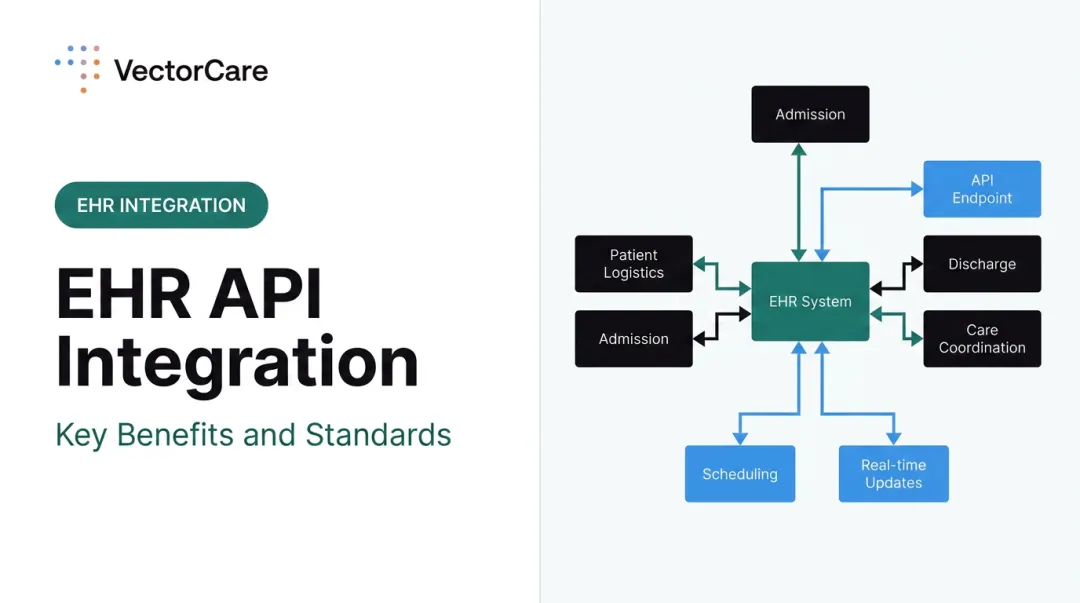
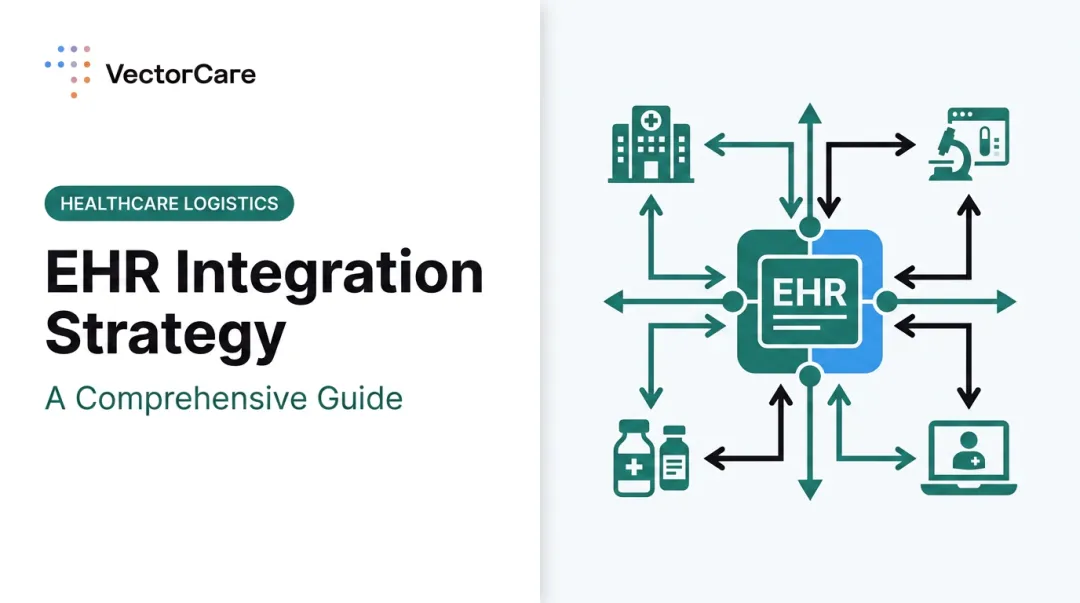
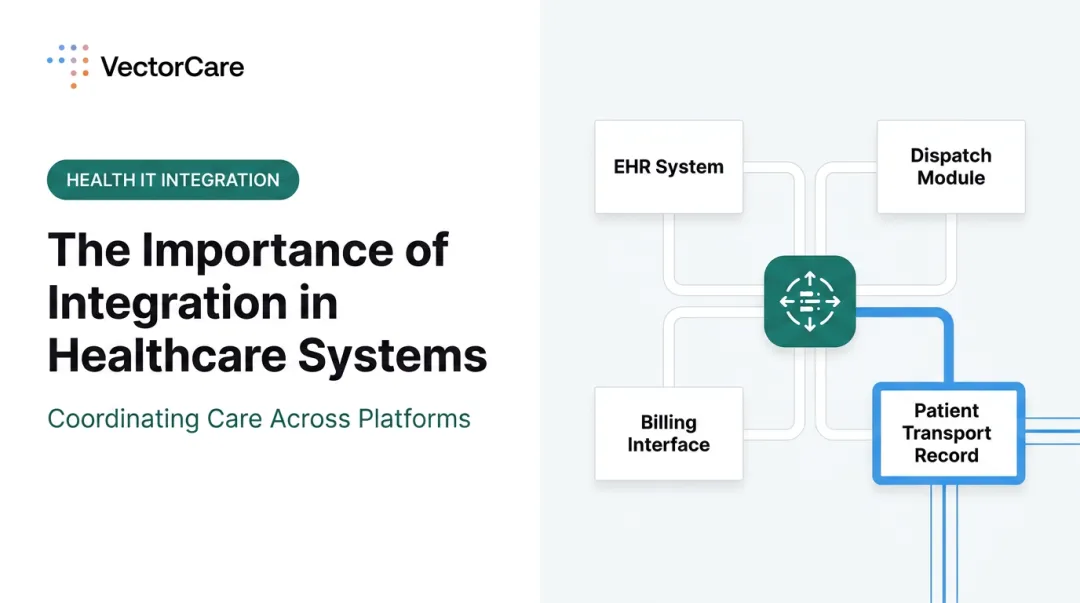
EHR integration is the process of connecting an electronic health record system with other platforms — clinical, operational, or logistical — so that patient data moves automatically between them. No manual re-entry. No toggling between systems. No phone call to confirm what's already documented.
In practice, integration spans a wide range:
- Clinical connections — lab results, pharmacy systems, radiology feeds
- Operational connections — discharge coordination tools, transport ordering platforms, DME ordering
- Financial connections — billing systems, prior authorization workflows, payer portals
- Population health — analytics platforms that pull longitudinal data across patient cohorts
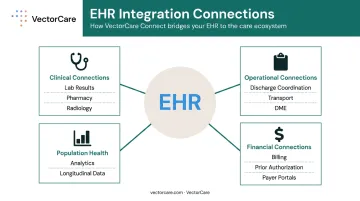
Each of these connection types depends on a shared language. That's where FHIR (Fast Healthcare Interoperability Resources) comes in — the standard bearer for modern integration, with SMART on FHIR enabling third-party applications to embed directly into EHR environments like Epic. ONC data from 2022 shows that more than two-thirds of hospitals already used an HL7 FHIR API for patient access.
Integration is a means, not an end. What matters is whether the right data reaches the right person at the right moment — measured in faster discharges, fewer missed transports, and smoother handoffs between care teams.
Key Benefits of EHR Integration in Healthcare
The benefits below are grounded in operational impact. Each ties to outcomes healthcare organizations track: cost, efficiency, care quality, and compliance exposure.
Benefit 1: Eliminating Data Silos to Enable Real-Time Care Coordination
When systems are integrated, patient information — diagnoses, allergies, medications, transfer orders — flows automatically to every downstream team the moment it's needed. Without integration, that same information travels by phone, fax, or manual re-entry, introducing delays at every step.
Consider discharge coordination. In a non-integrated environment, a coordinator contacts a transport provider by phone, relays patient details verbally, waits for confirmation, and manually logs the result. With EHR integration, a discharge order placed in the record automatically triggers the logistics workflow — patient data is pushed downstream, a transport request is created, and providers are notified without any manual handoff.
VectorCare's SMART on FHIR Epic integration demonstrates exactly this: when a transport request is initiated, patient data is automatically extracted from the EHR and transmitted to the relevant transport providers in a HIPAA compliant format, eliminating the phone-based relay that historically consumed coordinator time.
Why the data silo problem is costly:
- A 2024 systematic review estimated the average cost of a 30-day all-cause adult readmission at $16,037
- Discharge throughput improvements from structured workflow interventions — such as the PROPEL Discharge initiative — increased discharges within 90 minutes of discharge order from 26.2% to 38.1%
- Health Affairs research linked hospital participation in health information exchange to lower unplanned 30-day readmission rates for AMI patients
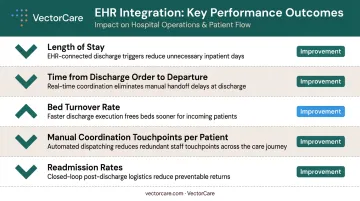
KPIs this benefit affects:
| KPI | Direction |
|---|---|
| Length of stay | ↓ |
| Time from discharge order to departure | ↓ |
| Bed turnover rate | ↑ |
| Manual coordination touchpoints per patient | ↓ |
| Readmission rates | ↓ |
Where this matters most: High-volume hospitals, multi-facility transfer centers, and systems coordinating non-emergency medical transport or home health at discharge — anywhere multiple teams need the same patient data at the same time.
Benefit 2: Reduced Administrative Burden Through Workflow Automation
EHR integration eliminates the repetitive work of re-entering patient information across systems. When an EHR event — a new discharge order, a transfer request — automatically triggers downstream workflows, coordinators gain back hours previously lost to manual processes.
The scale of the problem is significant. A time-motion study found primary care physicians spent roughly 5.9 hours of an 11.4-hour workday on EHR work. A 2021 nursing management study found nursing managers spent up to 49% of their work time completing and formatting documentation across disconnected hospital data systems.
That administrative drag has a measurable price tag. McKinsey estimated that roughly 30 administrative-simplification interventions could deliver up to $265 billion in annual U.S. healthcare savings.
Automation via standards like SMART on FHIR creates the mechanism for change. When VectorCare's platform is integrated with Epic, initiating a transport request automatically pulls patient demographics, clinical context, and destination data through FHIR APIs — no coordinator needs to re-enter that information, and no transport provider needs to receive it by phone.
Operational impact:
- Staff hours spent on administrative coordination
- Error rates from manual data entry
- Time-to-dispatch for transport or ancillary services
- Cost per logistics transaction
Where this matters most: Organizations managing high volumes of non-emergency transports, home health referrals, or DME orders at discharge — where each manual step multiplies across hundreds of daily transactions.
Benefit 3: Improved Patient Safety and Regulatory Compliance
Integrated systems ensure that accurate, current patient information — allergies, medications, active diagnoses, care instructions — is available to every provider involved in a patient's care. Automated data exchange replaces verbal handoffs and faxed summaries with structured, validated data pulled directly from the source record.
The patient safety case is compelling. Research consistently ties communication gaps to serious, preventable harm:
- The Joint Commission identified inadequate handoff communication as a root cause of adverse events — including wrong-site surgery, delayed treatment, falls, and medication errors
- CRICO data covering 2009-2013 linked communication failures to 30% of malpractice claims, 1,744 deaths, and $1.7 billion in malpractice costs over five years
- Joint Commission research estimates that 80% of serious medical errors involve miscommunication during patient transfers
- The NEJM I-PASS study found that a standardized handoff protocol reduced medical errors 23% and preventable adverse events 30%
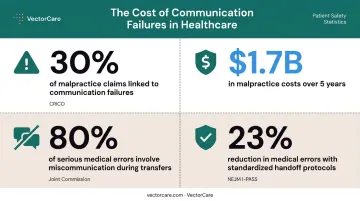
EHR integration extends these gains by ensuring the data underlying those handoffs is accurate and complete — not relayed verbally or reconstructed from a fax.
On the compliance side: Integrated systems with automated documentation create defensible records. CMS's documentation requirements make clear that insufficient medical records can result in claim denials — and HFMA reported that 22% of healthcare leaders can save up to $500,000 in annual savings for a 250-bed hospital with 25 daily transports. VectorCare's platform maintains a full audit trail of dispatch decisions, timestamps, vendor communications, and patient data handoffs — documentation that supports both operational accountability and compliance reviews.
Key performance indicators:
- Adverse event rates during care transitions
- Documentation completeness scores
- Denied claims from documentation gaps
- Patient safety incident frequency
Where this matters most: Complex transfers between facilities, ICU-to-step-down transitions, and any setting where multiple providers make time-sensitive decisions based on shared patient data.
What Happens When EHR Integration Is Missing
Non-integrated environments don't fail all at once — they degrade gradually, with costs that compound over time.
On the operational side, the friction shows up daily:
- Staff spend hours on manual phone calls, faxes, and data re-entry
- Discharge coordinators wait on hold instead of processing the next patient
- Nurses track down transport status rather than providing direct care
- Patient movement slows, beds stay occupied longer, and capacity tightens
Those daily frictions accumulate into larger structural problems:
- Incomplete or inconsistent patient data raises the likelihood of medication errors, incorrect transport instructions, or missed care needs during transitions
- Administrative headcount grows to compensate for workflow gaps that technology should solve
- Manual processes that work at current volume break down as patient volume grows, creating capacity bottlenecks that are difficult to unwind
The compliance dimension adds another layer of risk. Organizations without integrated documentation can't reliably demonstrate audit trails, which leaves them exposed during regulatory reviews and increases denied claim rates.
The ONC data shows how common this still is: as of 2021, 69% of hospitals still used mail or fax to send summary-of-care records. For an industry that runs on real-time decisions, that gap has real consequences.
How to Get the Most Value from EHR Integration
EHR integration delivers the most value when embedded into actual workflows — not treated as a back-end IT project. The goal is to surface the right data where decisions are made, not just to connect systems.
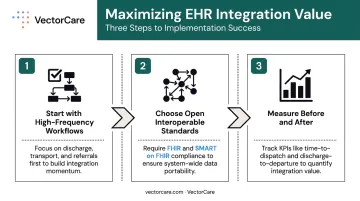
Three conditions consistently produce stronger outcomes:
1. Start with high-frequency, high-volume workflows. Discharge coordination, transport ordering, and referral management are ideal starting points. Time savings and error reduction at those workflow nodes compound quickly across hundreds of daily transactions. VectorCare's own deployment approach reflects this: the PACE transportation integration was chosen as an early implementation because the workflow was clear, the volume was high, and the pain was specific.
2. Choose platforms built on open, interoperable standards. FHIR and SMART on FHIR are the regulatory direction. CMS's 2020 Interoperability and Patient Access Final Rule requires FHIR-based APIs for patient data access, and ONC's Cures Act certification requires the same of EHR vendors. Platforms built on these standards are sustainable and compatible with future systems, without requiring costly custom builds for each new integration.
VectorCare's SoFaaS (SMART on FHIR as a Service) platform, available now, takes this further: it enables healthcare vendors to build, deploy, and scale EHR-embedded applications in weeks rather than months.
3. Measure before and after — not just after. Track KPIs like time-to-dispatch, manual touchpoints per patient, and discharge-to-departure time before integration goes live. VectorCare's internal data shows one clear example: integrating transport coordination with Epic cut air medical transport confirmation time from roughly 31 minutes by phone to under 3 minutes. That result only becomes visible when there's a baseline to compare against.
Conclusion
EHR integration's value shows up in concrete operational measures: discharge timelines, coordination errors, staff hours, and claim denial rates. The data that already exists in health records becomes useful only when it reaches the teams and systems that need it, at the moment they need it.
The organizations seeing the strongest returns from integration have one thing in common: they treated it as operational infrastructure, not a technology project. They started where the workflow pain was most acute, chose standards-based platforms that could scale, and tracked the before-and-after numbers closely.
Those that delay keep building manual workarounds: more headcount, longer delays, and compliance exposure that compounds with every additional patient. Patient logistics is foundational healthcare infrastructure — and EHR integration is the operational layer high-performing health systems are building around it.
Frequently Asked Questions
What is an EHR integration?
EHR integration is the process of connecting an electronic health record system with other software platforms so patient data flows automatically between them. This eliminates manual re-entry and application switching, enabling automatic data exchange across clinical, operational, and logistics systems.
What are the benefits of integration in healthcare?
The primary benefits include reduced administrative burden, faster care coordination, improved patient safety, stronger compliance documentation, and the ability to connect clinical decisions to downstream workflows like transport ordering and discharge planning.
What are the advantages of EHR systems?
EHR systems provide centralized records, reduced documentation errors, and better accessibility across care teams. EHR integration extends those advantages further — converting stored data into automated workflows that trigger real-time action across connected platforms.
How does EHR integration improve patient logistics and transport coordination?
When an EHR is integrated with a patient logistics platform, transport requests and discharge orders automatically trigger downstream workflows — eliminating manual phone calls and reducing the gap between a clinical decision and actual transport execution. VectorCare's SMART on FHIR Epic integration does exactly this, pushing patient data to transport providers the moment a request is initiated.
What is SMART on FHIR and why does it matter for EHR integration?
SMART on FHIR is an interoperability standard that lets third-party applications embed securely into EHR environments like Epic using HL7 FHIR, OAuth2, and OpenID Connect. Clinicians get real-time access to external tools — like transport ordering — without leaving the patient record.
What are the biggest challenges of EHR integration?
The most common barriers are interoperability between different vendor systems, staff adoption, data migration quality, and maintaining HIPAA-compliant security throughout. Platforms built on open standards like FHIR significantly reduce these friction points by providing a shared technical foundation across vendors.