MACPAC counted more than 60 million NEMT ride-days in FY2018 alone, with $2.6 billion in state and federal spending — and that figure excludes managed-care payments entirely. Every routing error, delayed reassignment, and missed pickup on top of that volume eats directly into margins that were already thin.
Here's the real issue: NEMT dispatch isn't a scheduling problem. It's an infrastructure problem. AI doesn't sit on top of your existing workflow as a nice-to-have. It replaces the workflow's foundation, making consistent, scalable dispatch decisions possible at a volume no manual team can match.
Key Takeaways
- Manual dispatch buries costs in deadhead miles, no-shows, and billing denials.
- AI dispatch automates trip assignment and rerouting, freeing dispatchers for exceptions.
- NEMT routing accounts for wheelchair needs and appointment windows that GPS misses.
- Predictive analytics shift dispatch from reactive firefighting to proactive planning.
- SMART on FHIR integration closes the data gap between EHR records and trip assignment.
The Real Cost of Running NEMT Dispatch Manually
Manual dispatch failures don't stay isolated. They cascade.
Here's how one scheduling error compounds:
- An inefficient route causes a late pickup.
- The late pickup pushes a driver into overtime.
- Overtime pushes the trip past the billing window.
- A missed billing window turns a completed trip into a documentation problem, and sometimes a denied claim.
What started as a five-minute routing mistake becomes a revenue loss weeks later, buried in an aging report nobody reviews closely.
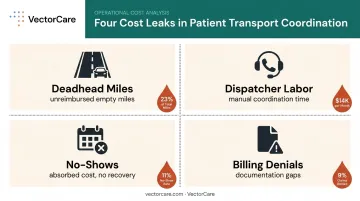
Four cost drivers show up repeatedly in manual NEMT operations:
- Deadhead miles: empty miles between drop-off and next pickup that Medicaid never reimburses, per Federal Transit Administration research. Every empty mile is a straight loss.
- Dispatcher labor consumed by routine coordination (phone calls, spreadsheet updates, manual reassignment) instead of exception handling.
- No-shows absorbed with no recovery mechanism, since the trip is scheduled and staffed before the cancellation happens.
- Billing denials from documentation gaps: incomplete trip records are a well-documented compliance risk in Medicaid NEMT, where missing pickup, drop-off, or eligibility documentation can render otherwise valid claims noncompliant.
There's also a hard ceiling most providers don't talk about. A dispatcher juggling trip assignment, live tracking, and patient calls simultaneously can only manage so many vehicles before something slips.
That ceiling barely registers at five vehicles. At fifty, it becomes a serious financial liability, and the fix needs to happen before the fleet scales, not after.
How AI Transforms NEMT Dispatch Operations
Traditional dispatch software gives a human better tools to make a decision. AI dispatch makes the decision — evaluating traffic, driver availability, patient location, vehicle type, and appointment windows all at once, consistently, every time.
Automated Dispatching Intelligence: From Manual to Autonomous
VectorCare built its A.D.I. (Automated Dispatching Intelligence) module around exactly this shift. Instead of a dispatcher manually matching a trip to a driver, A.D.I. evaluates driver qualifications, vehicle accessibility, proximity, and historical performance in the time it takes to read this sentence.
At scale, that speed matters. VectorCare's platform processes roughly 3.23 trip requests per minute (2024), broadcasting to available providers in parallel. No manual dispatch team can sustain that cadence across a growing fleet.
When a driver cancels or traffic delays a pickup, the same logic applies to reassignment. Instead of a dispatcher scrambling through a phone tree to find an open vehicle, the system detects the disruption and reroutes automatically, without waiting for a human to notice first.
Predictive Analytics: Anticipating Problems Before They Happen
Machine learning models trained on historical trip data surface patterns a dispatcher would never catch manually:
- Which patient populations show elevated no-show risk
- Which routes experience recurring congestion at specific hours
- When demand is likely to spike by day or time window
That last point matters more than it sounds. Rather than dispatching the nearest available vehicle reactively after a request comes in, predictive demand analytics let providers pre-position vehicles where demand is about to concentrate. The result: fewer idle miles and less overtime, without the scramble of last-minute reassignments.
Smarter Routes, Lower Miles: AI Route Optimization in NEMT
Standard GPS solves one problem: point A to point B. NEMT routing has to solve an entire day's manifest as a single constraint problem, factoring in:
- Appointment time windows that can't slip
- Vehicle accessibility, including wheelchair lifts and stretcher capacity
- Multi-passenger load sequencing without violating any single patient's window
- Driver shift limits and qualifications
That's a different computational problem entirely, and it's why route optimization built for healthcare logistics looks nothing like a consumer navigation app.
Trip consolidation is one of the highest-value decisions this unlocks. When the system identifies overlapping trips that can share a vehicle without blowing an appointment window, fewer vehicles need to run per shift.
When utilization is optimized through the platform, wheelchair transport providers can complete more trips per shift than manual scheduling typically allows.
Over-specification is another quiet cost. A wheelchair-accessible van gets dispatched for a trip that only needed a sedan, tying up higher-cost capacity for no clinical reason.
VectorCare's platform pulls clinical context directly into the routing decision. A documented fall in a patient's chart, for instance, should never produce a route in a vehicle without a wheelchair lift. Likewise, a trip with no mobility need shouldn't consume that vehicle's availability.
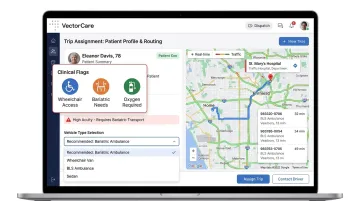
Static, night-before route plans also break the moment real-world conditions shift. AI systems recalculate continuously, using live traffic data and driver position, so on-time performance holds up even when the morning's plan doesn't survive first contact with traffic.
Cutting the Hidden Costs and Improving the Patient Experience
No-shows are partly a patient behavior problem and partly a dispatch response problem. Providers without automated reminders and predictive flagging just absorb the cost: a staffed vehicle, a driven route, and no reimbursement to show for it.
Automated, multi-channel reminders timed at strategic intervals reduce that exposure from the demand side. Structured, time-stamped status updates captured at each stage of a trip — pickup, en route, arrival — replace a dispatcher's memory or a driver's end-of-shift notes.
That same timestamp trail protects billing integrity. Incomplete pickup and drop-off records generate denials that turn a completed, driven trip into a net loss. Capturing accurate, time-stamped documentation as trips complete keeps billing clean and auditable.
On the patient side, reliability compounds. Consistent pickups and accurate ETAs reduce anxiety for populations managing chronic conditions or mobility limitations. A 2022 systematic review found that interventions addressing non-emergent transportation barriers were associated with fewer missed clinic visits — a direct link between transportation reliability and care access.
Put these pieces together and the savings compound rather than stack in isolation. VectorCare's platform has been linked to:
- A 90% reduction in scheduling time (roughly 31 minutes to under 3 minutes)
- More than 100,000 hours saved by A.D.I. across the healthcare systems and suppliers using it (2025)
These results show up when dispatch infrastructure changes, not just dispatch software.
AI + EHR Integration and What to Look for in a Platform
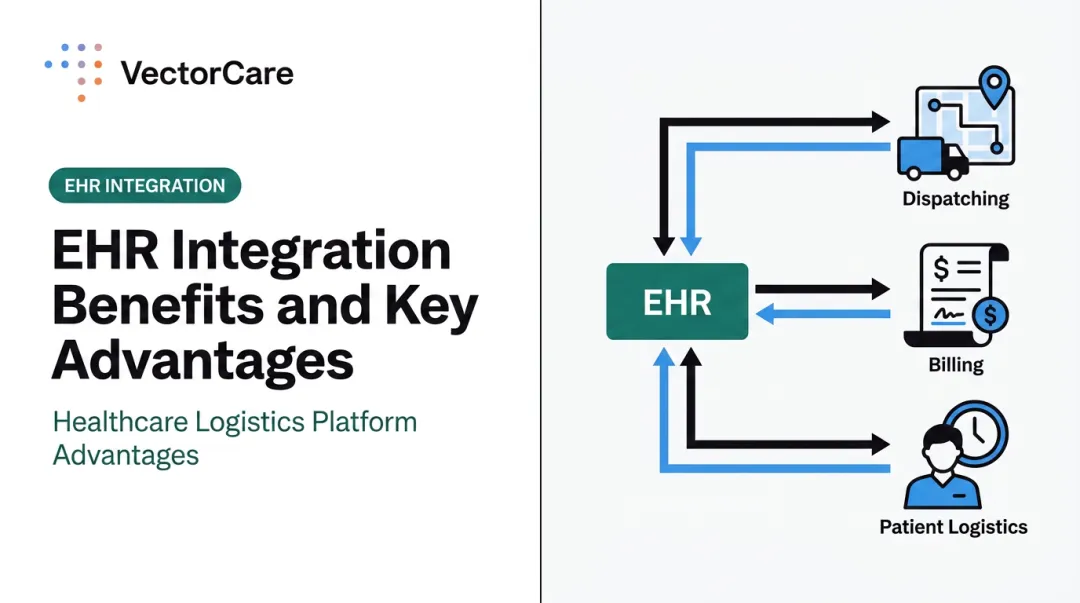
Most dispatch workflows operate blind to a patient's full clinical picture. Mobility needs, special instructions, and scheduled care live in the hospital's EHR, not in the dispatch tool assigning the trip. That gap creates errors: a vehicle mismatch, a missed accessibility need, a delay nobody could predict without that missing information.
VectorCare's SMART on FHIR integration with Epic closes that gap by pulling patient data directly at the point of trip creation. Demographics, pickup and destination details, and clinical context populate automatically.
That automation cuts scheduling time from roughly 31 minutes down to under 3 minutes in documented workflows, with no manual re-entry and no mismatch between what the chart says and what the dispatcher sees.
That same connected data layer matters for compliance. When patient records, trip logs, and care coordination sit on one infrastructure instead of three disconnected systems, documentation accuracy improves and audit exposure drops.
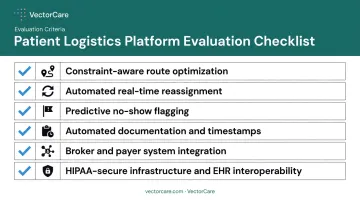
Not every platform marketed as "AI-powered" delivers this. Before choosing one, confirm it actually includes:
- Constraint-aware route optimization, not basic GPS repurposed for healthcare
- Automated real-time reassignment that doesn't wait on a dispatcher
- Predictive no-show flagging built on historical trip patterns
- Automated documentation and timestamp capture at pickup and drop-off
- Direct integration with broker and payer systems
- HIPAA-compliant infrastructure and EHR interoperability built from the ground up — not adapted from general logistics software
That last point isn't optional for anyone working with hospitals, health systems, or Medicaid-managed care organizations. Healthcare data security has to be the foundation, not a feature added later.
Frequently Asked Questions
What is AI-powered dispatch in NEMT, and how does it differ from traditional scheduling software?
AI dispatch makes trip assignment, routing, and rerouting decisions automatically using real-time data. Traditional software just organizes a schedule for a human to execute manually.
How does AI reduce costs for NEMT providers?
Four levers: fewer deadhead miles from smarter routing, fewer no-shows via automated reminders, fewer billing denials from automated documentation, and less dispatcher labor spent on routine coordination.
Can AI dispatch handle last-minute cancellations or schedule changes?
Yes. Automated real-time reassignment detects the disruption and reroutes or reassigns within seconds, preventing the delay cascade that manual reassignment typically triggers.
How is AI route optimization different from standard GPS navigation for NEMT?
GPS solves point-to-point navigation. AI route optimization accounts for appointment windows, vehicle accessibility, multi-passenger sequencing, and driver qualifications all at once. GPS was never built to handle these constraints.
Will AI dispatch replace human dispatchers?
No. AI handles routine, data-heavy decisions while dispatchers focus on exceptions, complex patient situations, and relationship management. Service improves without removing the human element.
How does AI dispatch integrate with EHR systems like Epic?
Through SMART on FHIR integration, which automatically pulls patient data from the EHR into the dispatch workflow at trip creation. This eliminates manual re-entry and reduces assignment errors.