This guide covers what HIPAA-compliant invoicing software actually means, when HIPAA applies to your invoices, which features matter, which tools fall short, and how to evaluate vendors before sharing a single line of patient billing data.
Key Takeaways
- Any invoice linking a patient's identity to a health service, diagnosis, or treatment date is PHI—and must be handled accordingly
- HIPAA does not certify or approve software; the covered entity bears responsibility for evaluating compliance
- Every software vendor handling PHI on your behalf must sign a Business Associate Agreement (BAA) before you share data
- Consumer tools like QuickBooks, PayPal, and Wave explicitly prohibit healthcare PHI in their terms of service
- Healthcare logistics platforms embed compliance controls directly into billing workflows, reducing exposure at every handoff
What Is HIPAA-Compliant Invoicing Software?
HIPAA-compliant invoicing software is a billing platform that incorporates the administrative, technical, and physical safeguards required to protect PHI throughout the invoicing lifecycle—from generation and transmission through storage and access.
HIPAA does not certify or officially approve any software product. As HHS has stated directly, no Security Rule standard requires an organization to certify compliance, and HHS does not endorse private compliance assertions. The responsibility sits with the covered entity or business associate to evaluate whether a platform's controls actually meet HIPAA's Privacy Rule and Security Rule requirements.
Invoicing vs. Payment Processing: An Important Distinction
These two functions operate under different rules:
- The invoice (containing patient name, service type, diagnosis code) is subject to HIPAA because it contains PHI
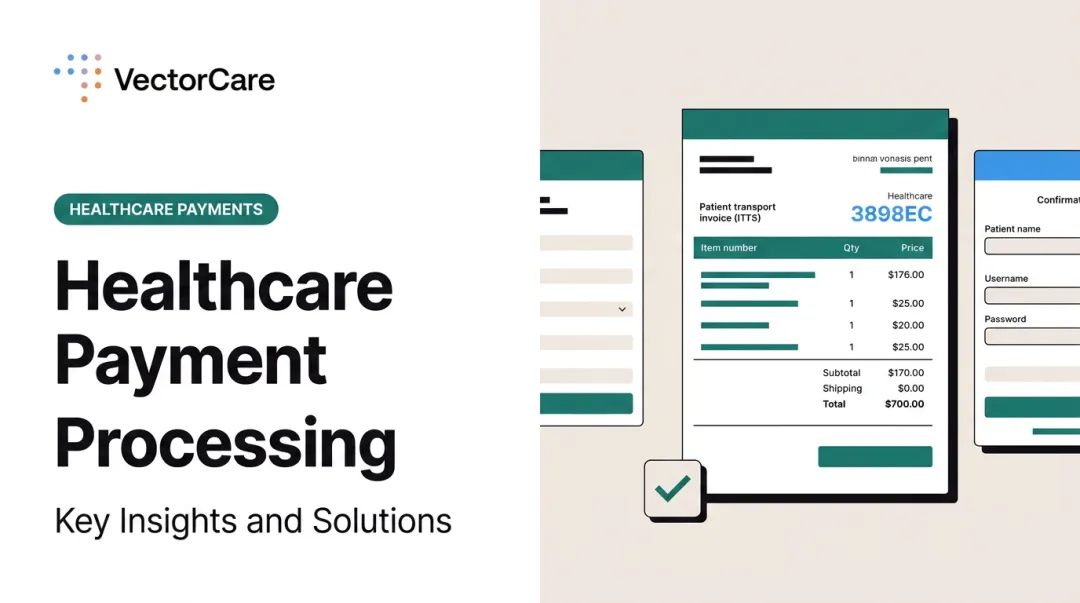
- The payment transaction itself (a credit card charge, ACH transfer) is not subject to HIPAA for the financial institution processing it in its normal banking role
- The triggering invoice that precedes that payment remains covered
This means you can use Stripe or Square for the payment transaction while still needing a compliant platform for the PHI-containing invoice that precedes it.
Who Is Directly Affected
This applies to two categories of organizations:
- Covered entities: hospitals, clinics, ambulance providers, home health agencies, and NEMT operators
- Business associates: billing companies, clearinghouses, and software vendors handling PHI on behalf of covered entities
- Hybrid entities: organizations that perform both covered and non-covered functions, such as a health system operating an in-house transport division
The BAA Requirement
Any software vendor whose platform creates, receives, maintains, or transmits PHI on behalf of a covered entity must sign a Business Associate Agreement (BAA). Under 45 CFR 164.308(b), covered entities may only permit business associates to handle ePHI after obtaining documented satisfactory assurances. Without a BAA, using that platform for healthcare invoicing is a HIPAA violation, even if its technical security controls are otherwise sound.
When Does HIPAA Apply to Healthcare Invoices?
HIPAA applies to an invoice the moment it contains individually identifiable health information—any combination of patient identity markers with health-related data.
What Crosses Into PHI Territory
Concrete examples where invoices become PHI-covered documents:
- A transport invoice listing a patient's name and pick-up location (a dialysis center or hospital)
- A home health billing statement referencing visit type and patient ID
- A DME invoice tying a patient name to a specific medical device ordered
- Any billing record that connects a patient's identity to a treatment date or service type
A basic invoice for office supplies with no patient information is not subject to HIPAA. The moment patient identity connects to a health service, the rules apply.
The Minimum Necessary Standard
HHS guidance on minimum necessary requirements states that for payment uses and disclosures, covered entities must make reasonable efforts to limit PHI to what's actually required for the billing purpose. This means:
- Identifying which staff members need access to what categories of PHI
- Establishing protocols for routine disclosures
- Requiring individual review criteria for non-routine disclosures
Over-inclusion of PHI in invoices is a common compliance risk. If a field isn't required to process the payment, it shouldn't be on the invoice.
Third-Party Transmissions
Limiting PHI on an invoice only solves part of the problem. How that invoice travels matters just as much.
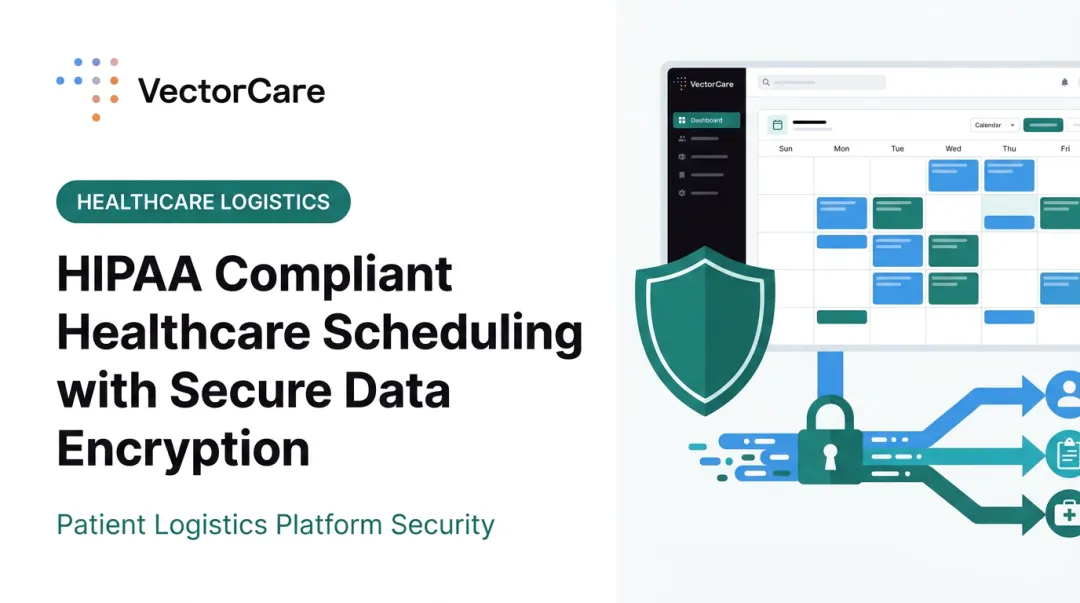
HIPAA applies whenever PHI is transmitted, whether the recipient is the patient, an insurance payer, or a vendor. Emailing an invoice containing PHI requires appropriate safeguards. Under the Security Rule, transmission encryption is an addressable implementation specification — organizations must evaluate it through documented risk analysis and implement suitable protections. Skipping that step is a compliance failure, not a judgment call.
Must-Have Features of HIPAA-Compliant Invoicing Software
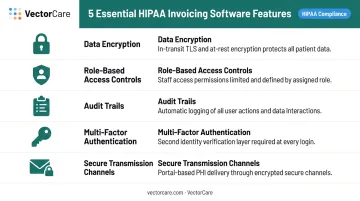
Data Encryption
PHI in invoices must be protected both when stored and when transmitted. In practical terms for billing staff evaluating software:
- In transit: Look for TLS encryption protecting data as it moves between systems or to recipients
- At rest: Look for strong encryption protecting stored invoice records
HIPAA doesn't mandate a specific encryption standard like AES-256 by name—it references NIST guidance, which supports multiple key lengths. What matters is that encryption is implemented and documented as part of your risk management approach.
Role-Based Access Controls (RBAC)
HIPAA-compliant platforms must restrict who can view, create, edit, or transmit invoices containing PHI. Staff should access only what their role requires.
This matters especially for multi-team healthcare organizations. A dispatcher coordinating a transport shouldn't have access to billing reconciliation records, and a billing clerk doesn't need to see clinical notes. Proper RBAC keeps PHI exposure tightly bounded to each functional role, reducing your breach surface at the organizational level.
Comprehensive Audit Trails
Under 45 CFR 164.312(b), audit controls are a required implementation specification. The system must automatically log every action taken on an invoice:
- Who accessed it
- What changes were made
- When each action occurred
Audit logs are critical for both internal oversight and demonstrating compliance during an OCR investigation.
Multi-Factor Authentication (MFA)
Password-only access is insufficient for systems containing PHI. According to the 2026 Verizon Data Breach Investigations Report, compromised credentials appear in 11% of healthcare breaches, with credential abuse as the initial access vector in 11% of cases.
MFA adds a second identity verification layer that cuts unauthorized access risk even when passwords are stolen — making it a practical control, not just a compliance checkbox.
Secure Transmission Channels
Invoices must travel through encrypted channels, not standard email or consumer file-sharing apps. Many compliant platforms offer built-in secure portals where payers, patients, or vendors access invoices without PHI being exposed in transit. This portal-centric model eliminates the compliance gap that opens when billing documents circulate through uncontrolled email threads.
Common Invoicing Tools That Fall Short of HIPAA Standards
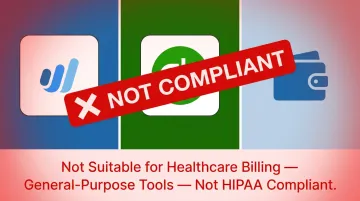
Several widely-used business tools are not appropriate for healthcare invoicing:
| Tool | Official Status |
|---|---|
| QuickBooks Online | Intuit explicitly states it is "not compliant with HIPAA standards" and advises against entering IIHI |
| PayPal Invoicing | Terms state covered entities agree not to use Invoicing in ways that cause PayPal to create, receive, maintain, or transmit PHI |
| Wave | Terms state "Wave isn't HIPAA compliant and shouldn't be used by businesses in the medical or healthcare industry" |
| Venmo | No explicit HIPAA, PHI, or BAA statement in official user agreement |
| Zelle | No explicit HIPAA, PHI, or BAA statement in official service agreement |
The core problem with generic tools: they lack PHI-grade audit trails, cannot execute a BAA, and often have no encryption designed for healthcare data. Any invoice containing PHI sent through them constitutes a potential impermissible disclosure.
Microsoft Word or Excel invoices aren't inherently non-compliant. The compliance issue isn't always the file format — it's the transmission method and access controls around the document. A password-protected Excel invoice sent through a HIPAA-compliant secure channel is a different situation than an unprotected PDF emailed through Gmail.
How to Choose a HIPAA-Compliant Invoicing Vendor
Questions to Ask Every Vendor
Before sharing any PHI with an invoicing software vendor, get clear answers to these:
- Does the platform support role-based access controls and MFA?
- Is data encrypted in transit and at rest, and how is that documented?
- Are audit logs maintained automatically for all invoice actions?
- Will you sign a BAA before we share any patient data?
- What is your breach notification process and timeline?
The absence of a BAA is a disqualifying factor. Full stop.
Evaluating the BAA Itself
Once a vendor agrees to sign, review the agreement carefully. Under 45 CFR 164.504(e), a proper BAA must:
- Specify permitted uses and disclosures of PHI
- Require appropriate safeguards and Security Rule compliance for ePHI
- Mandate breach and incident reporting
- Flow restrictions down to subcontractors
- Address return or destruction of PHI upon termination
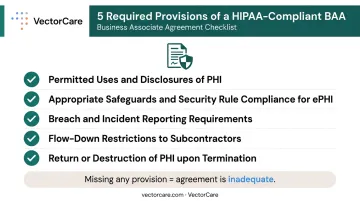
If any of these provisions are missing, the agreement isn't adequate.
Integration Security Matters Too
A signed BAA covers the vendor — but the vendor isn't the only risk. Invoicing software connects to EHRs, billing platforms, scheduling systems, and payer portals, and each integration creates an additional pathway for PHI exposure.
Secure API communications and controlled permissions matter across the entire ecosystem. Cloud and downstream service providers that maintain ePHI are business associates even if they can't directly view the data. HHS is clear on this: BAA restrictions must flow downstream to subcontractors.
HIPAA-Compliant Invoicing in Patient Logistics Operations
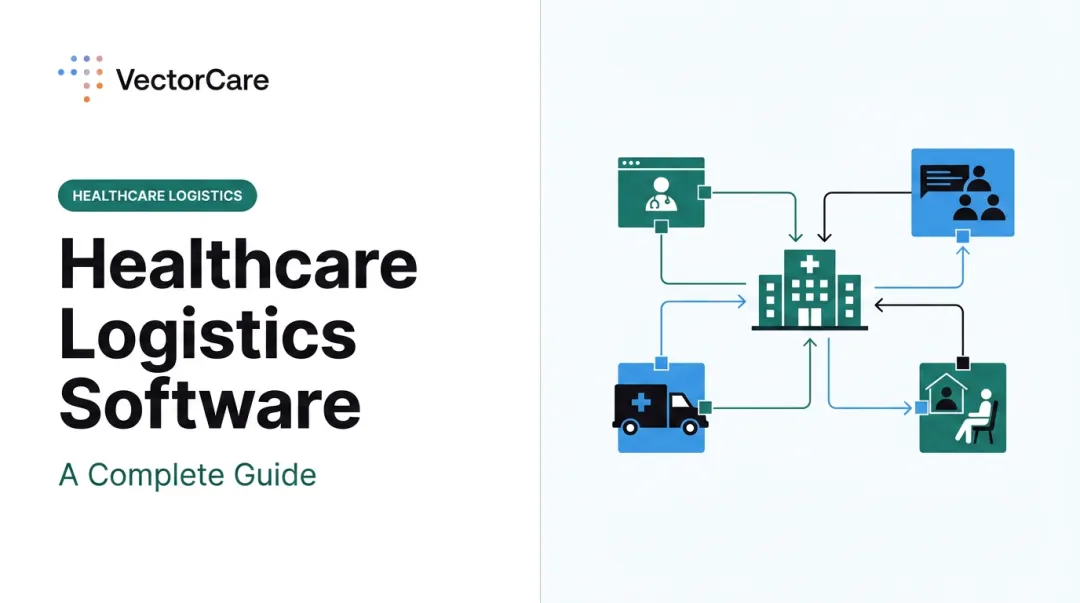
Patient logistics organizations face distinct invoicing compliance challenges. Every transport request, home health visit, and DME delivery generates billing records rich with PHI: patient identity, transport origin and destination (often a clinical facility), service type, and timing tied directly to a medical condition.
The compounding risk appears when invoicing is handled outside the core logistics platform. Common failure points include:
- Billing data copied into spreadsheets with no access controls
- Records emailed as unencrypted attachments
- PHI managed through consumer invoicing tools not built for healthcare
Each creates compliance exposure that's difficult to audit and nearly impossible to remediate.
For NEMT providers, ambulance companies, home health agencies, and DME suppliers, a platform purpose-built for healthcare logistics addresses this differently. VectorCare's HIPAA compliant cloud-based system, for example, transmits patient information—including sensitive clinical data—directly through the platform rather than through uncontrolled communication channels. That portal-centric model keeps PHI within a controlled environment across coordination, dispatch, and reconciliation.
That same standard applies when logistics platforms connect to EHR systems. With Epic FHIR integrations, billing and invoicing data flows need to be evaluated end-to-end—every handoff between the logistics platform and the EHR is a potential PHI exposure point if the integration isn't built on secure, standards-based API architecture with appropriate access controls.
Frequently Asked Questions
What does HIPAA-compliant invoicing mean?
HIPAA-compliant invoicing means generating, storing, transmitting, and managing invoices containing PHI using platforms and processes that meet HIPAA's Privacy Rule and Security Rule requirements—including encryption, access controls, audit trails, and a signed BAA.
Can invoices include PHI?
Invoices frequently contain PHI. Any invoice that links a patient's identity to a health service must be handled under HIPAA rules—limiting PHI to what is minimally necessary and transmitting it only through secure, compliant channels.
Which payment methods are HIPAA-compliant for invoicing?
HIPAA governs the invoice itself, not the payment transaction. Processors like Stripe or Square are acceptable for handling payment, but the PHI-containing invoice must be generated and transmitted separately through a compliant platform—consumer apps like Venmo or PayPal are not appropriate for healthcare invoicing.
Does HIPAA apply to all healthcare invoices?
HIPAA applies when an invoice contains PHI. A basic invoice for office supplies with no patient information is not covered. Any invoice linking a patient's identity to a health service, treatment date, or diagnosis code is subject to HIPAA requirements.
Does a software vendor need to sign a BAA for invoicing?
Any vendor whose platform creates, receives, maintains, or transmits PHI as part of invoicing must sign a BAA—using a platform without one in place is a HIPAA violation, regardless of its technical security features.
What happens if you use non-HIPAA-compliant invoicing software?
Sending PHI through a non-compliant invoicing tool constitutes an impermissible disclosure under HIPAA. This can result in OCR investigations, civil monetary penalties, and reputational damage—and penalties can apply even when the disclosure was accidental.