Introduction
A 300-bed hospital reports 92% occupancy, yet the ED has patients boarding in hallways. Nurses are hunting for open beds while three patients upstairs have been medically cleared for hours, still waiting on a ride home. The hospital isn't full. It's stuck.
This is patient flow failure, and it rarely starts where you see it. The bottleneck showing up in your ED is almost always a symptom of breakdowns happening elsewhere in the building.
The scale of the problem is growing. Median ED boarding time jumped from 121 minutes in 2020 to 192 minutes in 2022. Roughly 25% of admitted patients now wait more than seven hours after the admission decision, according to AHRQ's national boarding summit report.
This post breaks down what patient flow actually means, where it breaks most often, how to measure it, and what's working to fix it — including the overlooked role of discharge logistics.
Key Takeaways
- Poor patient flow is a systemwide problem that directly impacts safety, revenue, and staff burnout
- Discharge delays and transport coordination gaps consume hours of bed capacity every day
- Predictive census modeling and early discharge planning outperform reactive bed management
- Automating logistics coordination closes the gap between "discharge order" and "patient gone"
What Is Patient Flow in a Hospital?
Patient flow is the full movement of a patient through the health system: arrival (ED walk-in, scheduled admission, or transfer), triage, and treatment. It continues through diagnostics, inter-unit transfers, and discharge planning, ending in departure or transition to another care setting.
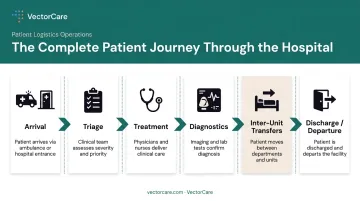
A backed-up ED almost always signals a systemic breakdown that spans multiple departments. The real cause is often elsewhere: a discharge stalled in case management, a bed that's clean but not yet flagged, a transport request sitting unanswered. Fixing the ED in isolation rarely fixes flow.
This isn't a new realization. The Joint Commission introduced its patient flow standard in 2004 (now LD.04.03.11), requiring hospitals to identify and mitigate impediments to patient flow across the entire facility, not just the emergency department. That single standard pushed patient flow from an ED-level headache into an enterprise-wide operational requirement, one that now touches:
- Bed management and housekeeping turnaround
- Case management and discharge planning
- Transport, NEMT, and post-acute coordination
- Staffing models and shift-level capacity
Why Patient Flow Is a Strategic Priority
Flow used to be an ops metric buried in a director's dashboard. It's now a boardroom issue, and for good reason.
Patient safety and outcomes. Boarding puts patients at real risk. A landmark study of 41,256 admissions found mortality rose from 2.5% for patients boarding under two hours to 4.5% for those boarding 12 hours or more. Mean hospital length of stay climbed from 5.6 to 8.7 days over the same range, according to a 41,256-patient mortality study on ED boarding times. Boarded patients are also more likely to have delayed or missed clinical orders.
Capacity without construction. You can't always build your way out of a capacity crunch. Improving turnover, cutting excess LOS, and eliminating avoidable delays creates effective capacity without a single new bed.
Financial performance. Poor flow stretches average LOS, shrinks throughput, and raises labor cost per patient day. It can also erode performance under value-based contracts tied to readmissions and length-of-stay benchmarks.
Staff satisfaction. When flow breaks down, nurses and care coordinators absorb the failure manually, hunting for beds, chasing transport, and making the same phone call three times. That cognitive load is a direct contributor to burnout.
Competitive positioning. Hospitals that move patients efficiently see fewer diversions and better patient satisfaction scores, giving them stronger footing to accept transfer volume that compounds into market share over time.
The Most Common Patient Flow Bottlenecks
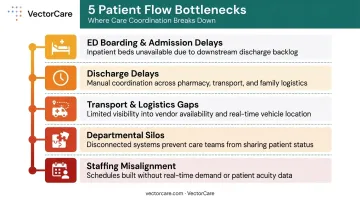
Not every hospital's flow problem looks the same, but a handful of failure points show up almost everywhere.
- ED boarding and admission delays. When inpatient beds aren't available, admitted patients back up in the ED, blocking new arrivals. This typically signals slow discharges and poor bed visibility, not an ED staffing problem.
- Discharge delays — the "medically cleared but stuck" patient. A physician writes the discharge order, but pharmacy holds, transport arrangements, post-acute placement, insurance authorization, or DME setup often stall the exit for hours. That delay compounds across every unit in the building.
- Patient transport and logistics coordination gaps. Once a patient is cleared, someone still has to arrange the ride, confirm home health, or schedule DME delivery. At most hospitals, that happens through phone calls, faxes, and manual follow-up, and every delayed step keeps a bed occupied. Platforms like VectorCare automate this layer, shrinking the gap between discharge order and departure.
- Departmental silos. ED, nursing, case management, transport, and ancillary services often lack shared real-time visibility. Teams duplicate work, miss handoffs, or delay action because they don't know someone else already handled it.
- Staffing misalignment. Staffing plans built on historical averages frequently miss the actual volume and acuity showing up on a given shift, limiting how many beds can be safely activated.
How to Measure Patient Flow Performance
You can't fix what you can't see clearly. These are the core metrics hospitals use to diagnose where flow is breaking:
| Metric | What It Signals |
|---|---|
| Length of Stay (LOS) / GMLOS | Overall efficiency of care progression per admission |
| ED boarding time | Gap between admission decision and ED departure |
| Door-to-admission time | Speed of moving admitted patients out of the ED |
| Bed turnover rate | How quickly a vacated bed becomes available again |
| Discharge-by-noon rate | Whether discharges are front-loaded or backlogged into the afternoon |
| Discharge-to-clean time | Housekeeping and turnover speed |
| 30-day readmission rate | Whether discharges were premature or poorly coordinated |
Lagging vs. leading indicators matter. LOS and readmissions tell you what already happened, while predictive discharge volumes 24–48 hours out and real-time bed availability show what's about to happen. Hospitals that only track lagging metrics stay in reactive mode instead of anticipating problems before they hit.
The bigger issue: these metrics usually live in separate systems, including EHR, staffing software, transport logs, and bed management platforms, so when data is scattered, root causes stay hidden. That's why more hospitals are consolidating visibility into unified dashboards or command-center models rather than pulling reports from five different places.
Proven Strategies to Improve Patient Flow
Shift from Reactive to Predictive Capacity Management
Instead of reacting to a full ED, leading hospitals use predictive census modeling to anticipate demand 24–48 hours ahead and align staffing, bed assignments, and discharge targets in advance. Structured daily throughput huddles, with named owners for each barrier, turn that predictive data into coordinated action instead of a report nobody acts on.
Start Discharge Planning at Admission
Discharge planning that begins near admission, rather than the day of departure, gives teams runway to arrange post-acute placement, authorizations, and transport before they become urgent.
The evidence backs this. A Cochrane review of 33 trials covering 12,242 patients found individualized discharge planning reduced LOS by a mean of 0.73 days. Readmissions dropped by 11% over roughly three months, according to Cochrane's evidence summary.
Standardize Multidisciplinary Rounds and Escalation Pathways
Inconsistent rounding, meaning different structure, attendance, or documentation from unit to unit, leads to inconsistent barrier resolution. Standardized protocols with clear escalation timelines create predictable care progression instead of ad hoc problem-solving.
Automate Patient Logistics Coordination
For most hospitals, the last mile of flow (arranging transport, NEMT, home health initiation, and DME delivery at discharge) still runs on phone calls, faxes, and manual follow-up. Every one of those steps adds avoidable hours to bed occupancy.
This is the layer VectorCare was built to fix. Instead of a coordinator calling providers one at a time, the platform broadcasts a request to a credentialed vendor network simultaneously and dispatches automatically. Hospital partners using this approach have reported:
- A 90% reduction in scheduling time (roughly 31 minutes to under 3 minutes)
- Over $500,000 in annual savings for a 250-bed hospital running 25 daily transports
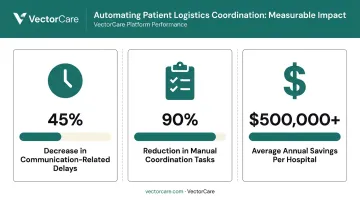
One concrete example: the Orange County Health Care Agency cut average transport arrangement time from 45 minutes down to 4.5 minutes per request after adopting the platform. That's a tenfold reduction that translates directly into faster bed turnover.
Use Data to Target the Right Bottlenecks
Not every hospital has the same flow problem. Some struggle with ED-to-inpatient transitions, others with surgical backlog, others with post-acute placement. Breaking down admission and discharge data by unit, time of day, and day of week tells leaders exactly where to point resources instead of launching broad initiatives with no clear target.
How Technology Supports Better Patient Flow
Real-time visibility tools. Bed management platforms, RTLS, and EHR-integrated dashboards give a live, unified view of patient location, status, and pending actions. This visibility cuts the manual legwork of tracking movement and speeds up bed and transfer decisions.
Predictive and AI-driven tools. Building on that real-time picture, AI models increasingly forecast discharge volumes, flag patients at risk of extended stays, and recommend proactive interventions. This shifts operations from resolving bottlenecks after they form to catching barriers before they delay a discharge.
Integration across the care continuum. These predictions work best when systems are connected: the most effective setups link internal hospital systems (EHR, staffing, bed management) with external logistics networks — transport providers, NEMT, home health, DME suppliers. SMART on FHIR integration lets patient data flow automatically into logistics requests, and VectorCare's platform is built on SMART on FHIR within Epic. No re-entry, no faxing, fewer coordination errors.
Frequently Asked Questions
What is patient flow in a hospital?
Patient flow is the movement of patients through all stages of hospital care: arrival, admission, treatment, transfers, and discharge. Effective flow means patients get timely care while the hospital uses its beds, staff, and resources efficiently.
What causes poor patient flow in hospitals?
The most common causes are ED boarding from unavailable beds, discharge delays from post-acute coordination gaps, departmental silos, staffing misalignment, and limited real-time visibility across care teams.
How does discharge planning affect patient flow?
Discharge planning that starts near admission, rather than on departure day, gives teams time to arrange post-acute placement, transport, home health, and authorizations in advance. This shortens the gap between the discharge order and physical departure.
What metrics are used to measure patient flow in hospitals?
The most tracked metrics are length of stay, ED boarding time, bed turnover rate, door-to-admission time, and discharge-by-noon rates. Leading hospitals also track 24–48-hour discharge forecasts.
How does patient transport affect hospital patient flow?
Transport coordination, including NEMT scheduling, inter-facility transfers, and home health or DME setup, is a frequently overlooked bottleneck that keeps patients physically in beds after they're medically cleared. Automating this layer directly reduces avoidable length of stay.
What is the role of technology in improving patient flow?
Technology supports flow through real-time visibility tools like bed management and RTLS, predictive analytics for discharge forecasting, and logistics automation platforms that coordinate transport and post-discharge services. These tools reduce manual coordination and enable proactive operations.