Introduction
Picture this: a patient is medically cleared for discharge at 10 a.m. By 3 p.m., they're still in their hospital bed — not because of their condition, but because transport wasn't arranged, DME hasn't been ordered, and the home health agency hasn't confirmed a visit.
That bed is now occupied for five hours at a cost the hospital can't recover, and the patient's recovery is already delayed before they leave the building.
This scenario plays out across health systems every day, and the root cause is rarely clinical. It's a logistics failure.
This article explains what logistic health services are, how they work, and why their performance directly shapes patient outcomes and operational costs. Whether you're a hospital administrator, care coordinator, or payer trying to make sense of this space, here's what you need to know.
Key Takeaways
- Logistic health services coordinate patients, supplies, and care across the full continuum
- Two distinct branches exist: supply-side logistics (goods) and patient-side logistics (people and services)
- Poor logistics causes missed appointments, delayed discharges, and preventable readmissions
- Manual coordination is the primary bottleneck, and technology is rapidly replacing it
- Platforms like VectorCare treat patient logistics as infrastructure, not a scheduling task
What Are Logistic Health Services?
Logistic health services are the systems, processes, and providers responsible for coordinating the movement of patients, medical supplies, equipment, and care services from one point of care to another. The goal is straightforward: ensure the right care reaches the right person at the right time.
That definition sounds simple. The execution is anything but.
Healthcare Logistics vs. Commercial Logistics
In commercial logistics, a delay means a late package. In healthcare logistics, a delay means a patient misses dialysis, a surgical supply doesn't arrive for an OR case, or a newly discharged patient returns to the ER because their home health visit was never scheduled.
The stakes are clinical. Delays don't just create operational headaches: they interrupt treatment, extend hospital stays, and create gaps in care continuity that can compound into serious harm.
The Scope of Logistic Health Services
This field spans two parallel domains. Movement of goods covers medical supplies, pharmaceuticals, durable medical equipment (DME), lab specimens, and temperature-controlled materials. Movement and coordination of people covers patient transport, NEMT, home health visits, care transition planning, and interfacility transfers.
Managing both simultaneously, across dozens of vendors and care settings, makes healthcare one of the most complex logistics environments of any industry.
From Scheduling Problem to Infrastructure Problem
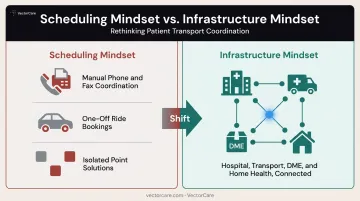
VectorCare CEO David Emanuel built his company around a specific observation: patient logistics has historically been treated as a scheduling problem when it is actually an infrastructure problem. The distinction matters.
A scheduling mindset produces point solutions: a ride booking tool, a fax to a DME vendor. An infrastructure mindset produces interconnected systems that coordinate people, data, and services across the entire care continuum.
That framing helps explain why the field has been under-automated relative to its importance. What once looked like a back-office function is now recognized as foundational healthcare infrastructure, touching every care transition from hospital discharge to home recovery.
The Two Branches of Healthcare Logistics
Supply-Side Logistics
Supply-side logistics manages the flow of physical goods into and across healthcare facilities. This includes:
- Surgical supplies and sterile equipment
- Pharmaceuticals (including temperature-sensitive biologics)
- Lab specimens requiring chain-of-custody handling
- Durable medical equipment (DME) inventory and distribution
- PPE and consumables
Clinicians depend on this branch functioning invisibly. When it breaks down through shortages, delivery failures, or cold chain lapses, the consequences are immediate. ASHP reported 309 active drug shortages at the end of Q2 2023, the highest level in nearly a decade.
Patient-Side Logistics
Patient-side logistics (often called patient logistics) coordinates the movement of patients themselves and the services that follow them home. This branch covers:
- Non-emergency medical transport (NEMT)
- Air and ground ambulance coordination
- Home health scheduling
- DME delivery and setup
- Care transition planning and interfacility transfers
Why Fragmentation Creates Risk
These two branches are typically managed by separate teams, using different vendors, different software systems, and different communication channels. That fragmentation creates gaps nobody owns.
A 2022 observational study found that receiving the first nursing visit more than two days after hospital discharge was associated with significantly higher risk of rehospitalization or emergency department visits. The clinical team did its job; the logistics connecting hospital to home fell through instead. Closing that gap means running both branches on shared systems and communication, not separate ones.
Key Types of Logistic Health Services
Patient Transportation Services
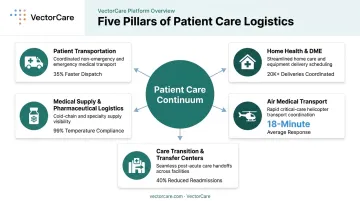
Non-emergency medical transport (NEMT) covers scheduled rides to medical appointments, inter-facility transfers, and ground ambulance coordination for patients who don't require emergency care. This is distinct from EMS. NEMT serves patients who are stable but unable to use conventional transportation due to mobility limitations, distance, or medical need.
The scale here is substantial. CMS estimates approximately 3–4 million Medicaid beneficiaries used NEMT annually between 2018 and 2021, representing 4–5% of the entire Medicaid population. For chronic care patients managing dialysis, chemotherapy, or regular specialist visits, reliable NEMT keeps them out of the emergency department.
Home Health and DME Logistics
When a patient leaves the hospital, their recovery doesn't pause. Home health agencies need to schedule nursing visits. DME suppliers need to deliver and set up equipment. These two services must be coordinated with the discharge timeline, or the gap between hospital and home becomes a clinical liability.
The window for initiating home health after discharge is tightly compressed, often just a few days. Miss it, and readmission risk rises.
VectorCare's platform is designed to replace the fax-and-phone workflows that currently govern DME ordering and home health referrals, connecting hospitals to a credentialed network of providers through a single system embedded in clinical workflows.
Medical Supply and Pharmaceutical Logistics
Moving medications, devices, and specimens through the healthcare supply chain requires specialized handling that general commercial logistics can't provide. Cold chain requirements, hazmat compliance, sterility standards, and regulatory documentation all add layers of complexity. WHO guidance requires documented temperature monitoring, excursion management, and qualification processes for time-sensitive pharmaceuticals. These requirements demand purpose-built infrastructure, not adapted commercial freight systems.
Air Medical Transport Coordination
For critical or time-sensitive patient transfers, rotor-wing and fixed-wing air transport requires its own logistics layer. Providers must identify available aircraft, negotiate transport, confirm clinical capability, and track patients in transit. A large share of air medical activity is interfacility transfer, which means much of it is logistics coordination, not scene response.
VectorCare gives health systems a single point of access for air medical coordination alongside ground and NEMT services.
Care Transition and Transfer Center Logistics
Transfer centers manage the flow of patients between facilities, often under pressure, often by phone. Acceptance rates and status-update requirements vary widely from center to center, particularly for critically ill patients awaiting transfer.
The wide variability in these timelines shows how much manual coordination introduces into care that shouldn't wait. The delay comes from logistics, not clinical complexity.
Why Logistic Health Services Matter for Patient Outcomes
Logistics performance and patient outcomes are inseparable. When transport is delayed, patients miss critical appointments. When DME isn't delivered, post-discharge recovery stalls. When transfers are poorly coordinated, patients experience avoidable readmissions and longer lengths of stay.
Avoidable 30-day readmissions carry significant cost, and CMS's Hospital Readmissions Reduction Program penalizes eligible hospitals up to 3% of Medicare payments for excess readmissions — creating direct financial exposure tied, in part, to logistics performance.
Logistics failures that drive these numbers include:
- Missed follow-up appointments when transport wasn't arranged
- First home health visit delayed beyond the critical two-day window
- DME not delivered before discharge, forcing patients to return for inpatient-level care
- Transfer delays that leave patients in facilities ill-equipped for their acuity
On the supply side, frontline clinicians still spend meaningful time manually counting and tracking supplies instead of caring for patients, time that translates directly into fewer hours at the bedside.
Organizations that address these gaps see real returns. VectorCare's platform cuts scheduling time from approximately 31 minutes by phone to under 3 minutes, a 90% reduction, and can deliver over $500,000 annually for a 250-bed hospital with 25 daily transports.
How Technology Is Reshaping Logistic Health Services
Automated Dispatching Replaces Phone Tag
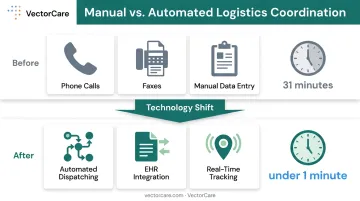
The traditional transport coordination workflow (call a provider, get a voicemail, call another, confirm availability, document the request, follow up) is being replaced by automated dispatching platforms that complete that sequence automatically.
VectorCare's Automated Dispatching Intelligence (ADI) broadcasts a transport request simultaneously to an entire credentialed provider network, receives bids, and confirms booking without a human intermediary. By 2025, ADI had saved healthcare customers more than 100,000 hours of coordination time. What previously took approximately 31 minutes per transport request can now take under 3 minutes, a 90% reduction.
EHR Integration Eliminates Manual Data Entry
The most significant friction in healthcare logistics is data, not coordination speed. Every time a care coordinator switches between a clinical system and a logistics tool, they're re-entering patient information that already exists somewhere else. That redundancy creates errors, wastes time, and increases compliance exposure.
VectorCare's SMART on FHIR integration with Epic solves this directly. Patient demographics, appointment details, and clinical context are automatically pulled from the EHR when a logistics request is initiated. The medical record updates automatically upon completion. That eliminates app switching, re-entry, and transcription errors.
Real-Time Visibility Drives Better Decisions
Real-time transport request management can meaningfully reduce response times. Even a modest per-request improvement becomes significant when multiplied across thousands of monthly requests, or when that delay affects a time-sensitive transfer.
More broadly, platforms that provide live tracking, provider scorecards, and performance analytics give operations teams the data to identify bottlenecks, hold vendors accountable, and make evidence-based decisions about their logistics networks. VectorCare's Trust module tracks on-time performance, completion rates, and billing accuracy across its credentialed vendor network, turning what was once anecdotal knowledge into auditable data.
Frequently Asked Questions
What are the main types of logistic health services?
The main categories are patient transportation (NEMT and air medical), home health and DME delivery coordination, medical supply chain and pharmaceutical logistics, and care transition coordination across facilities. Each operates differently but all share the goal of keeping care moving reliably.
What do logistic health services do?
They plan, coordinate, and execute the movement of patients, supplies, equipment, and care services across the care continuum, ensuring timely, reliable delivery that supports clinical outcomes and keeps operations running efficiently.
Who are logistics service providers?
Providers include ambulance and NEMT companies, air medical operators, home health agencies, DME suppliers, medical courier services, and technology platforms like VectorCare that connect and coordinate all of these providers for hospitals, payers, and health systems.
What is the difference between healthcare supply chain logistics and patient logistics?
Supply chain logistics moves goods like supplies, devices, and pharmaceuticals into facilities. Patient logistics coordinates the services that follow a patient, including transport, home health visits, DME delivery, and care transitions. Both are essential, yet often managed in silos.
How do logistic health services impact patient outcomes?
Poor logistics leads to missed appointments, delayed discharges, and preventable readmissions. Well-managed logistics reduces length of stay, improves care continuity, and ensures patients receive needed services after leaving a clinical setting, when recovery risk is highest.
How does technology improve logistic health services?
Technology automates manual coordination tasks, integrates with EHR systems to eliminate redundant data entry, provides real-time tracking and visibility across provider networks, and generates the analytics healthcare operations teams need to optimize performance and reduce costs.