Introduction
Healthcare organizations generate enormous volumes of data every day — from EHR entries and billing claims to staffing logs and patient transport records. Yet many operational and clinical decisions still get made reactively, based on incomplete information or yesterday's reports.
The financial stakes are significant. US hospitals and health systems spent an estimated $19.7 billion in 2022 just trying to overturn denied claims — a cost that better revenue cycle analytics could meaningfully reduce. That figure covers one use case. The opportunity across clinical, operational, and financial domains is substantially larger.
This guide covers what healthcare business intelligence tools actually do, where they create the most impact, what features matter most, and how to avoid the implementation pitfalls that derail most deployments.
Key Takeaways:
- Healthcare BI converts disconnected clinical, operational, and financial data into actionable decisions
- Highest-impact use cases include readmission prevention, patient flow, revenue cycle, and population health
- HIPAA compliance, FHIR-based EHR integration, and real-time dashboards are table-stakes features
- Data silos and change management resistance cause most BI implementations to fail
- Transport and logistics data is an overlooked BI input with measurable operational impact
What Is Healthcare Business Intelligence?
Healthcare BI is the practice of collecting, integrating, and analyzing data from clinical, operational, and financial systems — then translating that data into actionable insights that help leaders move faster and more confidently.
The distinction from basic reporting matters. A static monthly dashboard tells you what happened. A BI system tells you what's happening now, surfaces patterns across data sources, and flags anomalies before they become crises.
What Data Sources Feed Healthcare BI?
The value of BI multiplies when sources are unified rather than siloed. Core inputs include:
- Electronic health records — clinical notes, diagnoses, medications, labs
- Billing and claims data — denial patterns, reimbursement timelines, coding accuracy
- Patient satisfaction surveys — HCAHPS scores, experience data
- Staffing and scheduling systems — shift coverage, labor costs, vacancy rates
- Supply chain records — utilization, procurement, waste
- Patient logistics and transport data — discharge timing, transport delays, length-of-stay drivers
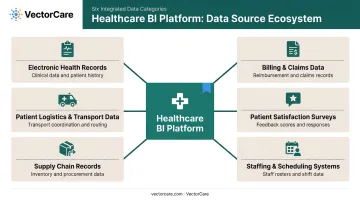
Patient logistics data is often the missing layer. Platforms like VectorCare generate structured, timestamped logistics data across millions of patient transport events — data that can reveal bed-throughput patterns, discharge bottlenecks, and coordination gaps that no EHR alone captures.
Why Healthcare BI Is More Complex
Healthcare BI operates under constraints that most industries don't face:
- HIPAA and GDPR govern data access, storage, and transmission
- Clinical sensitivity means errors carry patient safety consequences, not just business consequences
- Unstructured data — physician notes, imaging reports — requires NLP to make it queryable
- Life-critical decisions make real-time accuracy a requirement
Without robust governance built into the architecture, BI outputs can't be trusted at the point of decision — which is where healthcare organizations need them most.
Key Use Cases of Healthcare Business Intelligence Tools
Clinical Decision Support
BI tools surface patterns in patient data that clinicians would otherwise miss:
BI tools surface patterns in patient data that clinicians would otherwise miss:
- Readmission risk flags before discharge decisions are made
- Medication adherence gaps across chronic disease populations
- High-risk patient identification for proactive outreach
The COACH randomized trial across 10 hospitals demonstrated this concretely: a risk-stratified intervention for heart failure patients reduced the 30-day composite of death or cardiovascular hospitalization from 14.5% to 12.1%. The critical element wasn't the algorithm alone — it was that predictive scores triggered defined clinical workflows, not merely populated a dashboard.
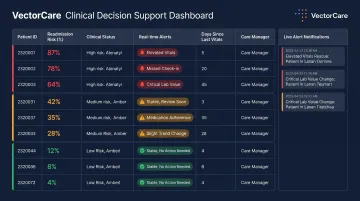
When physicians can query their own clinical data without waiting for analyst reports, they uncover context-driven insights that no pre-built dashboard replicates.
Operational and Patient Flow Analytics
Hospitals use BI to monitor bed capacity in real time, predict staffing demand from historical trends, and reduce bottlenecks before they cascade into delays.
That same intelligence extends beyond the hospital walls. In patient logistics and transport coordination, it means tracking which transports are pending, where patients are in the discharge sequence, and where delays are forming.
VectorCare's A.D.I. (Automated Dispatching Intelligence) applies this principle directly, using real-time logistics data to automate dispatching decisions and recover thousands of staff hours previously consumed by manual coordination.
Financial and Revenue Cycle Analytics
BI tools analyze claims data, denial patterns, undercoding gaps, and reimbursement timelines to identify where revenue is leaking. With $19.7 billion spent annually on denial rework alone, revenue cycle analytics has one of the clearest ROI cases in healthcare BI.
Population Health Management
BI enables segmentation of patient cohorts by risk factor, chronic condition, or geography — allowing health systems and payers to deploy preventive interventions where they're most needed.
Predictive identification of high-risk patients combined with nurse-led stepped care is especially relevant for Medicare Advantage plans and PACE organizations managing medically complex populations.
Regulatory Compliance and Quality Reporting
Johns Hopkins Hospital documented spending 108,478 person-hours and over $5 million in personnel costs to report 162 quality metrics. Electronic metrics averaged 40 hours per metric annually, compared to 836 hours for claims-based metrics — a stark illustration of what automation can recover.
BI tools that automate quality measure extraction and audit trail generation don't just reduce burden; they make accreditation and CMS compliance less operationally disruptive.
What to Look for in Healthcare BI Tools
EHR and Systems Integration
A healthcare BI tool is only as strong as its data connections. Evaluate for:
- Native or low-friction integration with major EHRs such as Epic
- Support for modern interoperability standards, particularly SMART on FHIR
- Integration with billing, scheduling, supply chain, and — increasingly — patient logistics platforms
SMART on FHIR, defined by the HL7 standard and supported across major EHRs, enables apps to access FHIR data through standardized OAuth 2.0 authorization. In practice, this means patient demographics, clinical context, and logistics workflows can surface natively inside the EHR. VectorCare's SMART on FHIR Epic integration does exactly that — eliminating manual data entry and system-switching for care coordination teams.
Real-Time Analytics and Dashboards
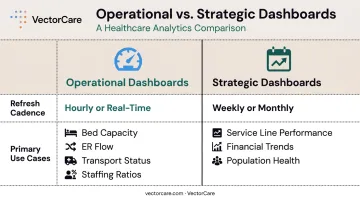
Healthcare cannot wait for weekly reports. The right tool supports both:
| Dashboard Type | Refresh Cadence | Use Cases |
|---|---|---|
| Operational | Hourly or real-time | Bed capacity, ER flow, transport status, staffing ratios |
| Strategic | Weekly or monthly | Service line performance, financial trends, population health |
Both types serve distinct purposes. Applying strategic reporting cadences to operational problems is a common and costly mistake — one that delays decisions that needed to happen hours ago.
HIPAA Compliance and Data Governance
Every healthcare BI platform must support:
- Role-based access controls scoped to user function
- Full audit trails for every data access and query
- Encryption at rest and in transit
- HIPAA-compliant data storage
For research or pharmaceutical contexts, also ask about SOC 2 Type I, CFR Part 11, and GDPR readiness. Strong governance is what makes BI insights credible and defensible across an organization — not just a box to check during procurement. VectorCare, for example, holds SOC 2 Type I certification and is HIPAA compliant, with role-based access controls that limit data exposure to relevant parties only.
Ease of Use and No-Code Functionality
If clinicians and operations managers need an IT ticket every time they want a custom report, adoption will stall. Look for:
- Drag-and-drop dashboard builders
- Natural language querying (ask questions in plain English, get charts)
- Pre-built templates for common healthcare KPIs
- Role-specific views that surface the right data at the right level of detail
Scalability and AI Readiness
Healthcare predictive analytics is forecast to grow from $14.6 billion in 2023 to $67.3 billion by 2030 — a 24% CAGR. The tools chosen today must handle larger datasets, more concurrent users, and more complex queries as organizations scale.
When evaluating for scale, prioritize:
- Cloud-native architecture that scales without infrastructure overhauls
- Efficient data caching for fast query performance under load
- Built-in or extensible machine learning capabilities for predictive analytics
Common Challenges in Healthcare BI Implementation
Data Silos and Interoperability Barriers
Most healthcare organizations run on a patchwork of legacy systems that don't natively communicate. Even hospitals with data-exchange capability often face incomplete integration in practice.
Without a unified data architecture, BI produces fragmented views. Stakeholders distrust the numbers, and adoption stalls before it starts.
Data Quality and Governance Gaps
Even with the right tools, poor data quality undermines outputs.
Governance can't be an afterthought. Automated data validation, deduplication, and lineage tracking need to be in place before deployment, not bolted on after problems surface.
Organizational Resistance and Change Management
BI tools surface data that sometimes contradicts clinical intuition — and that friction is where adoption breaks down. Clinicians push back on outputs they don't trust. Administrators struggle to act on dashboards they weren't trained to read.
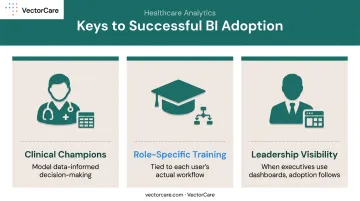
Successful implementations share three characteristics:
- Clinical champions who model data-informed decision-making
- Role-specific training tied to each user's actual workflow
- Leadership visibility: when executives use the dashboards publicly, adoption follows
Best Practices for Healthcare BI Implementation
Start with a Defined Use Case and Clear Ownership
Broad enterprise deployments rarely succeed on the first attempt. Instead:
- Identify the highest-impact starting point — patient flow, denial management, or transport coordination are common entry points
- Assign a named business owner accountable for outcomes, not just implementation
- Define success metrics upfront — what does a win look like in 90 days?
Early measurable wins build organizational trust and create momentum for broader rollout.
Build a Unified Data Strategy Before Choosing Tools
Align clinical, financial, and operational stakeholders on:
- Shared metric definitions (how is "readmission" defined across departments?)
- Data governance policies and access tiers
- Architecture decisions that compound over time — choosing FHIR-compatible systems early expands what's analytically possible later
The tool stack should serve the strategy, not determine it.
Design Dashboards Around Roles, Not Just Data
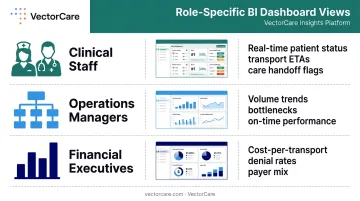
Clinical staff, operations managers, and financial executives need fundamentally different views of the same underlying data. Role-specific dashboards that surface the right KPIs at the right granularity drive adoption far more effectively than generic reports.
Iterate with end users during the design phase. Frontline staff consistently flag workflow gaps and missing context that designers overlook — catching those issues before launch is far cheaper than rebuilding after go-live.
Each role typically needs a distinct view:
- Clinical staff: Real-time patient status, transport ETAs, and care handoff flags
- Operations managers: Volume trends, bottlenecks, and on-time performance
- Financial executives: Cost-per-transport and payer mix
Frequently Asked Questions
What AI programs are used in healthcare?
The main categories include:
- Machine learning for predictive analytics (readmission risk, disease detection)
- Natural language processing for clinical notes and documentation
- AI-powered scheduling and patient flow automation
- Generative AI for documentation and clinical decision support
The FDA regulates qualifying AI-enabled software as medical devices.
What is healthcare business intelligence?
Healthcare BI is a set of tools and processes for collecting, integrating, and analyzing clinical, operational, and financial data to help healthcare organizations make faster, evidence-based decisions. The goal is improved patient outcomes, operational efficiency, and financial performance — not just better reports.
How does healthcare BI differ from general business intelligence?
Healthcare BI must handle regulated, clinically sensitive data governed by HIPAA and PHI requirements, integrate with complex systems like EHRs, and support decisions that carry patient safety implications. Data governance, compliance, and real-time accuracy requirements are substantially more stringent than in most other industries.
What data sources do healthcare BI tools use?
Primary sources include electronic health records, billing and claims data, patient satisfaction surveys, staffing and scheduling systems, supply chain records, laboratory data, and — increasingly — real-time patient logistics and transport data from platforms coordinating discharge, NEMT, and interfacility transfers.
What features should I look for in a healthcare BI tool?
Prioritize EHR integration with FHIR support, HIPAA-compliant data governance, real-time operational dashboards, no-code or low-code usability for non-technical staff, and AI or predictive analytics capabilities for forward-looking decisions.
Can smaller healthcare organizations benefit from BI tools?
Yes. Modern cloud-based healthcare BI platforms are scalable and accessible for organizations of all sizes. A single-facility practice or NEMT provider can start with a targeted use case like scheduling optimization or transport coordination, then expand as results accumulate.