Introduction
Patient transport coordination in healthcare is genuinely complex. On any given day, a busy hospital discharge unit manages ambulance requests, NEMT bookings, home health referrals, and DME orders — often simultaneously, through phone calls, faxes, and handwritten notes passed between coordinators.
That complexity has a cost. Average hospital length of stay increased 19% from 2019 to 2022, with discharge delays cited as a primary driver. Manual transport coordination sits at the center of that problem.
Automated dispatch software changes the underlying process, not just the pace. This article covers the operational outcomes that hospital administrators, transfer center managers, and payer organizations track — and why they matter.
Key Takeaways
- Automated dispatch cuts transport request-to-confirmation time from approximately 31 minutes by phone to under 3 minutes — a 90% reduction
- Real-time transport visibility allows care teams to manage delays proactively, not reactively
- Faster discharge transport compresses length of stay, directly affecting bed capacity and revenue
- EHR integration via SMART on FHIR removes duplicate data entry and reduces transcription errors
- Platform-generated performance data gives facilities leverage to renegotiate transport contracts
What Is Automated Dispatch Software in Healthcare?
Automated dispatch software is a digital coordination platform that handles the full request lifecycle — receiving service requests, matching providers based on predefined criteria, broadcasting to a qualified network, and tracking fulfillment — without a coordinator making a single phone call, email, or fax.
In healthcare, this applies across the full patient logistics spectrum:
- Non-emergency medical transportation (NEMT)
- Ground and air ambulance dispatch
- Home health visit scheduling
- DME delivery coordination
- Skilled nursing facility and interfacility transfers
That distinction matters. Automated dispatch is operational infrastructure — not a scheduling convenience bolted onto an existing workflow. It's what makes patient movement consistent, auditable, and scalable across a health system. VectorCare, for instance, was built specifically on this model: patient logistics as core infrastructure, not a back-office function managed through spreadsheets and phone trees.
Key Advantages of Automated Dispatch Software for Patient Logistics
The advantages below are grounded in what healthcare administrators actually measure: cost per transport, on-time performance, length of stay, staff utilization, and communication error rates. Each one reflects a measurable process change, backed by operational data.
Eliminating Manual Coordination and Reducing Communication Delays
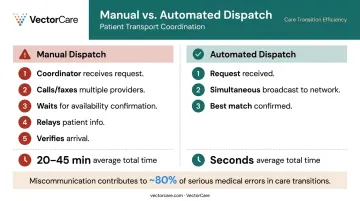
Manual transport coordination follows a predictable, slow loop. A coordinator calls or faxes multiple providers to find availability, confirms coverage, relays patient information, and verifies arrival. Depending on volume and time of day, that process takes approximately 31 minutes per request.
Automated dispatch breaks that loop entirely. The system receives a request, broadcasts it simultaneously to all qualified providers, assigns the best match based on availability and predefined criteria, and confirms the booking — in under 3 minutes.
Why this matters operationally:
Every minute saved in transport coordination translates directly to faster patient throughput. A discharged patient waiting for transport occupies a bed that another patient needs. At scale, those minutes accumulate into hours of wasted capacity per day.
There's also a patient safety dimension. Miscommunication contributes to approximately 80% of serious medical errors in care transitions. Manual handoffs multiply the opportunities for information gaps. Automated dispatch reduces those handoff points and creates a documented audit trail for every transaction.
The administrative burden is real too. Health insurance administration alone — prior authorizations, referrals, and claims paperwork required by health plans — accounts for time US workers value at $21.6 billion annually. Time nurses, case managers, and coordinators spend chasing transport confirmations is time not spent on clinical work.
KPIs impacted:
- Transport request-to-confirmation time
- Manual calls per transport
- Communication error rate
- Case manager time-on-task
- Discharge coordination cycle time
When this matters most: High-volume hospital discharge units, transfer centers managing multi-facility networks, and any facility coordinating multiple transport types simultaneously.
Real-Time Visibility and EHR-Integrated Dispatch
Without automated dispatch, transport status lives in someone's head or on a sticky note. Care teams have no way to know whether a transport is confirmed, when a vehicle will arrive, or whether a delay is building until it's already a problem.
Automated dispatch software changes this entirely. Every active request is tracked in real time: current status, assigned provider, estimated arrival, and delay flags. Platforms like VectorCare go further, pulling patient data directly from the EHR at the point of request initiation.
How EHR Integration Changes the Workflow
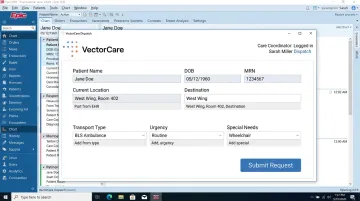
VectorCare's SMART on FHIR integration with Epic is a concrete example of what this looks like in practice. When a care coordinator initiates a transport request from within Epic, the platform automatically extracts:
- Patient demographics
- Height and weight
- Allergies
- Insurance details and care instructions
This eliminates manual transcription — and the errors that come with it. The integration also writes transport status back into the medical record automatically, so the patient chart reflects logistics reality without requiring separate documentation.
For facilities with FHIR-based API availability, this kind of integration is increasingly achievable without custom engineering.
The proactive delay management benefit:
When a transport is running late, care teams don't find out when the driver doesn't show. The system flags the delay automatically, giving bed management time to adjust discharge plans rather than scrambling after the fact. That proactive window — even 15–20 minutes — can prevent a cascade of throughput problems downstream.
KPIs impacted:
- Transport status visibility rate
- Duplicate data entry incidents
- EHR-to-dispatch initiation time
- Delay notification speed
- Discharge-to-transport arrival gap
When this matters most: Transfer centers coordinating across multiple facilities, high-volume discharge planners, and payer organizations overseeing transport utilization across a member population.
Reducing Cost While Improving Patient Throughput
Delayed transport has a direct financial cost. A patient awaiting discharge transport is occupying a bed, generating overhead, and blocking admission capacity — without generating the revenue associated with a new admission. Automated dispatch compresses that window.
The mechanism works in both directions:
- Faster discharge transport = faster bed turnover = more admissions capacity without adding physical beds
- Provider performance tracking = cost accountability across the transport supply chain
The Financial Case
VectorCare's documented outcomes illustrate the scale of impact:
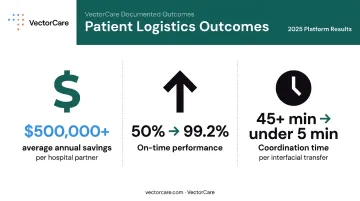
- Over $500,000 in annual savings for a 250-bed hospital with 25 daily transports
- On-time performance improvement from 50% to 99.2%
- Scheduling time reduced from approximately 31 minutes by phone to under 3 minutes — a 90% reduction
For context on what delayed discharge actually costs: the AHA's 2022 analysis tied a 19% LOS increase directly to discharge bottlenecks, many of which involve transport coordination failures.
Provider Network Optimization
Automated dispatch generates a performance record for every transport: timestamped, logged, and comparable across providers. That data changes the contract negotiation dynamic. VectorCare tracks vendor performance within the platform, so a facility walks into renegotiation with its own numbers rather than relying on the vendor's.
Historically, transportation vendors held an information advantage over the facilities they served. Automated dispatch closes that gap. Facilities can:
- Identify which providers are causing delays
- Renegotiate contracts based on documented performance
- Eliminate costly last-minute transport escalations
- Consolidate toward higher-performing preferred vendors
KPIs impacted: Patient length of stay, discharge transport turnaround time, cost per transport, on-time transport rate, and bed utilization rate. When this matters most: High-census hospitals managing discharge bottlenecks, health systems operating under value-based care contracts, and Medicare Advantage payers managing transport as part of a total cost-of-care model.
What Happens When Automated Dispatch Is Missing
Manual dispatch doesn't just stay inefficient as volume grows — the problems compound, and they compound fast. Each gap in process creates downstream failures that are difficult to unwind without structural change.
The most common failure points include:
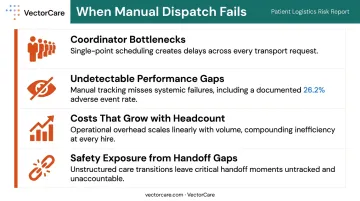
- Coordinator bottlenecks: When every transport request runs through a human making phone calls, one sick day or overwhelmed shift causes requests to queue up and discharge delays to accumulate. Care teams lose confidence and develop workarounds — calling their own contacts, relying on informal provider relationships — that no one can track or replicate at scale.
- Undetectable performance gaps: Without data, facilities can't identify which providers are causing delays or which transport types are being misused. Adverse events occur in 26.2% of intrahospital transports of critically ill adults, and manual systems offer no way to detect or address the patterns driving those events.
- Costs that grow with headcount: Manual dispatch requires more coordinator staff as volume increases — it never gets more efficient. Without performance data, facilities also lose leverage in contract negotiations. Vendors set the terms.
- Safety exposure from handoff gaps: Manual transfers of information between coordinators, providers, and clinical staff create conditions for the wrong transport level being dispatched, incorrect patient details being relayed, or a transport being missed entirely.
How to Get the Most Value from Automated Dispatch Software
Deploying automated dispatch software is the starting point, not the finish line. The facilities that see compounding ROI treat it as infrastructure and measure it like infrastructure.
Three practices separate facilities that see real, lasting returns from those that don't:
Run All Transport Types Through One Engine
Partial adoption creates data gaps that undermine the platform's optimization capacity. NEMT, ground ambulance, home health, and DME should all run through the same dispatch engine. Siloed coordination — handling high-acuity transfers on-platform while leaving NEMT on the phone — defeats the purpose entirely.
Set Baseline Metrics Before Go-Live
You can't demonstrate ROI you didn't measure. Before implementation, track:
- Transport request-to-confirmation time
- On-time rate by transport type
- Coordinator hours per transport
Measure those same metrics monthly after go-live. The comparison tells the story.
Act on the Operational Intelligence
Automated dispatch doesn't just move transports — it generates data: which providers are underperforming, where delays cluster, how volume shifts across the week. VectorCare surfaces this through built-in analytics in its Insights module. That data becomes valuable when operations leaders use it — to renegotiate underperforming contracts, adjust staffing models, or extend the platform to additional care settings. The technology surfaces the picture. The decisions still require people.
Conclusion
Automated dispatch software earns its place in healthcare operations through control, visibility, and consistency — across a patient logistics infrastructure that directly affects care quality, bed capacity, and cost.
Those gains build on each other. As transport data accumulates over months, provider networks grow more optimized, workflows become more predictable, and cost savings per facility increase. That's why the strongest-performing health systems treat automated dispatch not as a software purchase, but as operational infrastructure — one that keeps reducing delays, lowering length of stay, and improving coordination as long as it's actively used.
Frequently Asked Questions
How does automated dispatch software reduce patient length of stay?
Automated dispatch compresses the time between a discharge order and transport confirmation, reducing the window patients occupy beds while waiting for pickup. Faster transport turnaround means faster bed turnover, which translates directly to more available capacity without adding physical beds.
What is the difference between automated dispatch software and traditional patient transport coordination?
Traditional coordination relies on a human coordinator making sequential phone calls or sending faxes to find an available provider, a process that can take approximately 31 minutes by phone per request. Automated dispatch broadcasts the request simultaneously to a qualified provider network and assigns the best match in under 3 minutes, eliminating the coordinator bottleneck.
How does automated dispatch software integrate with EHR systems like Epic?
Advanced platforms use SMART on FHIR standards to embed directly within the EHR workflow, automatically pulling patient demographics, clinical data, and insurance details into the transport request. The best implementations also write transport status back into the medical record, eliminating parallel documentation.
Is automated dispatch software HIPAA-compliant?
Reputable healthcare dispatch platforms are built on HIPAA compliant cloud infrastructure, meaning patient data transmitted through the dispatch workflow is encrypted and access-controlled. VectorCare, for example, handles protected health information within a HIPAA compliant architecture across all transport request workflows.
What types of healthcare facilities benefit most from automated dispatch software?
High-volume discharge facilities, multi-site health systems, transfer centers, payer organizations managing NEMT benefits, and home health agencies with high daily transport volumes see the greatest operational and financial impact. The gains are most pronounced where transport volume and complexity make manual coordination a clear bottleneck.
How quickly can hospitals see ROI from automated dispatch software?
Most facilities see measurable improvements in on-time transport rates and coordinator time savings within 60–90 days of go-live. Financial ROI from reduced length of stay and transport cost optimization typically becomes clear over the 6–12 month mark — provided baseline metrics were tracked before implementation.