Introduction
Healthcare has shifted — and the logistics infrastructure behind that shift is what actually makes it possible. More patients receive care at home, in skilled nursing facilities, or in community settings — yet most health systems still coordinate that care through phone calls and faxes. The term "direct-to-patient logistics" gets used in two very different contexts: pharmaceutical supply chains (drug delivery for clinical trials) and healthcare operations (coordinating transport, home health, and equipment directly to patients). This guide focuses on the operational meaning.
That distinction matters because the coordination burden is enormous. Medicaid alone recorded 63.5 million NEMT ride-days in 2021 — and that figure undercounts total activity.
Phone-and-fax discharge coordination creates bottlenecks at exactly the moment care continuity is most critical. The infrastructure hasn't kept pace with where care is actually happening.
Here's what modern direct-to-patient logistics looks like — and why it's become foundational infrastructure, not a back-office function.
Key Takeaways
- Direct-to-patient logistics coordinates care services — transport, home health, DME — to the patient's location, not the other way around.
- The process follows a defined sequence: need identified → request initiated → providers matched → service delivered → outcome documented.
- Manual phone-based coordination creates discharge delays, longer stays, and care gaps that cost systems significantly.
- Automation — EHR integration, AI-driven dispatch — eliminates the manual bottlenecks that cause delays, errors, and care gaps.
- Hospitals, payers, SNFs, NEMT providers, DME companies, and home health agencies all depend on this infrastructure.
What Is Direct-to-Patient Logistics?
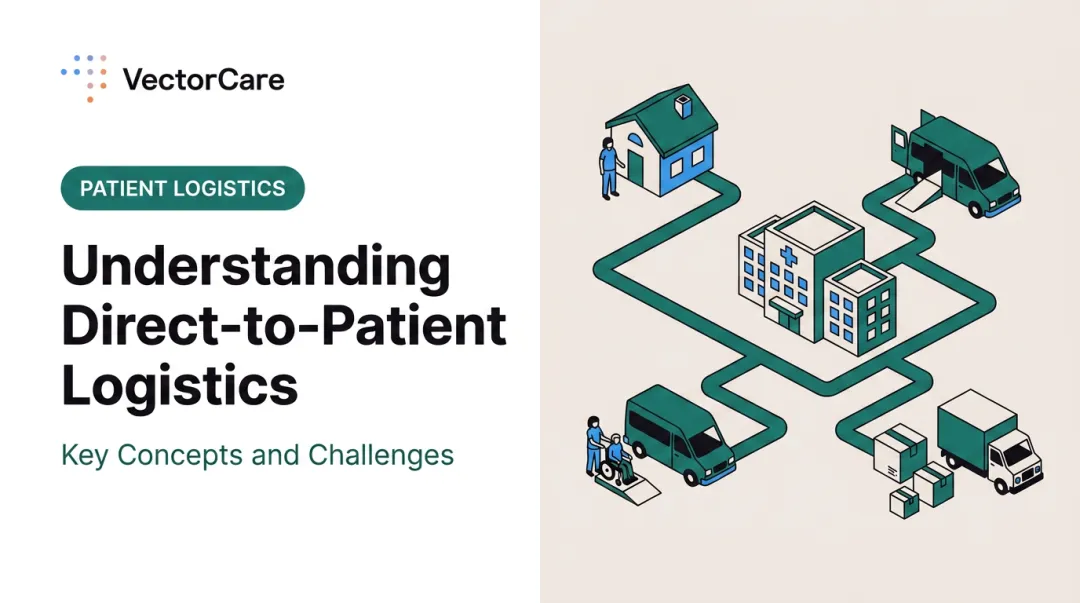
Direct-to-patient logistics is the coordinated delivery of healthcare services — non-emergency medical transport, home health visits, durable medical equipment, infusion services, and skilled nursing transitions — directly to wherever the patient is. That might be their home, a rehab facility, or a community care setting. The defining characteristic is that care reaches the patient, rather than requiring the patient to navigate a fragmented system to find it.
This is distinct from the pharmaceutical concept of direct-to-patient delivery, which refers to shipping medications to trial participants' homes. Both terms share "direct-to-patient," but the operational meaning in healthcare logistics is about coordinating services, not distributing products.
What It Solves
Historically, patient logistics has been treated as a scheduling problem — handled through manual phone calls, faxed referrals, and provider call-down lists. The consequences of that approach are measurable:
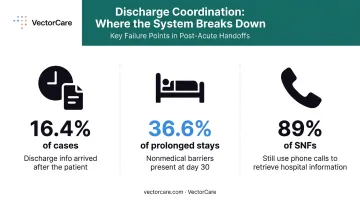
- A national survey of 471 hospital-SNF pairs found that discharge information arrived after the patient in 16.4% of cases — and sometimes arrived late in another 33.8%
- In prolonged hospital stays, nonmedical barriers (including post-acute placement difficulties) were present in 36.6% of stays at day 30
- 89% of SNFs still used phone conversations at least sometimes to retrieve hospital information
These aren't edge cases. They're the predictable result of treating logistics as an administrative side task rather than operational infrastructure.
What It Is Not
Direct-to-patient logistics is not simply booking a ride or dropping off a piece of equipment. It encompasses the full coordination layer:
- Provider matching based on clinical requirements, geography, and licensing
- Dispatching across multiple concurrent service types
- Communication and compliance documentation
- Real-time oversight of active requests
A hospital discharging a patient with oxygen needs, a follow-up home health visit, and transport to a SNF isn't managing one logistics event — it's managing three simultaneously, often involving different providers, different timelines, and different documentation requirements.
Why It Matters Now
Value-based care has changed the stakes. Two federal programs illustrate the financial exposure:
- Hospital Readmissions Reduction Program (HRRP): CMS can cut applicable hospital payments by up to 3% for excess readmissions
- Transforming Episode Accountability Model (TEAM, 2026–2030): Holds hospitals accountable for total episode spending, including post-acute services
That accountability extends directly to the discharge handoff. A poorly coordinated transition to home health or a SNF is no longer just an operational inconvenience — it's a measurable cost that flows back to the hospital.
How Direct-to-Patient Logistics Works
Direct-to-patient logistics operates through four connected stages. The reliability of the whole process depends on how tightly each stage connects to the next.
Stage 1: Initiation
A logistics request begins with a care event — a discharge order, a clinical referral, a scheduled follow-up. In traditional settings, a care coordinator calls providers one by one, checks availability, and negotiates timing manually. That sequence is where delays accumulate.
The gap between when a discharge order is placed and when transport is confirmed is almost entirely a product of manual coordination. Automated initiation closes that gap faster than any staffing adjustment can.
Platforms like VectorCare accelerate this through SMART on FHIR integration with Epic, allowing clinical staff to initiate a logistics request from directly within the patient's chart. Patient demographics and clinical details populate automatically, eliminating manual re-entry and reducing the time from clinical decision to logistics action.
Stage 2: Provider Matching and Dispatch
Once a request is initiated, it needs to reach the right provider — fast. "Right" means clinically appropriate, geographically viable, properly credentialed, and currently available.
- Timestamps and completion status
- Provider identity and service type
- Compliance and billing data
- Inputs for future coordination decisions
Research from a Cochrane review found that individualized discharge planning reduced length of stay by 0.73 days and unscheduled readmissions by a relative 11% among older medical patients — with moderate-certainty evidence. That kind of outcome is only reproducible when the coordination behind it is documented well enough to analyze — and act on.
Stage 3: In-Transit Tracking and Coordination
Once a provider is dispatched, the request enters live coordination. Every party — the requesting team, the transport or delivery provider, and receiving staff — shares a single real-time view of status, location, and ETA. Automated updates replace phone-and-fax check-ins: pickup confirmation, en-route milestones, delays, and exceptions surface the moment they happen. Secure messaging keeps clinical context attached to the request, and escalation rules flag any trip that drifts outside its expected window so coordinators can intervene before a delay affects care.
Stage 4: Completion, Documentation, and Reconciliation
The final stage closes the loop. On arrival or setup, the provider captures proof of completion — delivery confirmation, signatures, timestamps, and any required documentation — directly against the original request. That record flows back into the EHR and the logistics platform, giving a complete audit trail. From there, VectorCare Pay can generate invoices against contracted rate cards while Insights reports on on-time performance, cost, vendor quality, and volume — turning each completed request into data that improves the next one.
Where Direct-to-Patient Logistics Is Used
Care Settings and Workflow Stages
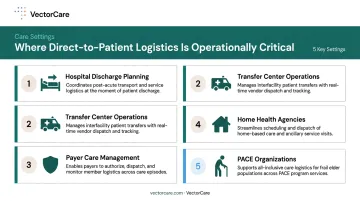
Direct-to-patient logistics is most operationally critical at specific friction points in the care continuum:
- Hospital discharge planning — where transport delays directly affect bed availability and length of stay
- Transfer center operations — managing inter-facility transport across ground and air
- Payer care management — ensuring post-acute services are confirmed before a member leaves the facility
- Home health agencies — coordinating high volumes of recurring visit schedules across a dispersed workforce
- PACE organizations — managing transportation for elderly participants who require multiple services per week
Organizations That Depend on It
The organizations operating within direct-to-patient logistics networks include:
- 6,100 U.S. hospitals (per AHA 2024 data), each managing outbound discharge coordination
- 14,634 Medicare-participating SNFs in 2024, which need inbound patient information before the patient arrives
- 12,234 Medicare-certified home health agencies, providing 65.4 million in-person visits in 2024
- 195 PACE programs serving 88,726 participants across 33 states
- NEMT operators, DME suppliers, ambulance providers, and payers — all operating on different systems that effective logistics platforms must bridge
One important distinction: hospitals need outbound coordination (getting patients to the right post-acute setting), while transport providers need inbound dispatch management (receiving requests and managing their network). Effective platforms — including VectorCare, which serves more than 2,500 healthcare facilities — address both sides.
Air Medical Transport: An Illustration of Scale
Long-distance and critical care transfers add another layer of complexity. FAA data for 2023 shows helicopter air ambulance operators transported 385,366 patients using 1,315 helicopters across 1,021 bases — with 418,669 accepted flight requests and 314,339 declined.
Air transport coordination involves aircraft availability, flight routing, crew certification, and receiving facility confirmation, all under time pressure. No coordination team can manage that volume through phone calls and fax.
Conclusion
Direct-to-patient logistics isn't a single transaction. It's a coordinated infrastructure that connects clinical decisions to care delivery across multiple service types, providers, and care settings. Efficient coordination moves patients through the system on time. Gaps in that coordination show up as longer stays, delayed services, and avoidable readmissions.
Healthcare administrators and care coordinators who understand how this process works — from initiation through documentation — are better positioned to evaluate tools that can reduce those delays. Fixing one workflow won't resolve a systemic coordination problem. What's required is a platform that connects the entire logistics layer: transport, home health, DME, and post-acute handoffs, managed through a single coordinated system. That's the model VectorCare was built around, and the same framing that makes direct-to-patient logistics worth getting right.
Frequently Asked Questions
What does "direct to patient" mean?
"Direct to patient" refers to delivering care services or medical products to the patient's location — bypassing facility-based or distribution-center models. In healthcare operations, this means coordinating transport, home health, or DME to reach the patient wherever they are; in pharmaceutical contexts, it refers to drug delivery for clinical trials.
What does a patient logistics specialist do?
A patient logistics specialist coordinates patient movement and care service delivery — managing transport requests, communicating with providers, supporting timely discharge, and documenting outcomes. Today, this role depends on digital platforms to handle high request volumes without manual phone-based coordination.
Do clinical trials pay for transportation?
Many clinical trials cover participant transportation costs through reimbursement or stipend programs. Reducing travel burden improves enrollment and retention, so most sponsors treat logistics support as a protocol requirement rather than an optional benefit.
What is the difference between NEMT and direct-to-patient logistics?
NEMT (non-emergency medical transport) is one specific service type within direct-to-patient logistics, covering rides to and from medical appointments. Direct-to-patient logistics is the broader coordination infrastructure that manages NEMT alongside home health, DME, air transport, and other services — often through a single platform or network.
How does technology improve direct-to-patient logistics coordination?
Technology replaces manual phone-based coordination with automated request broadcasting, real-time provider matching, status tracking, and EHR integration. Processes that once took approximately 31 minutes by phone now complete in under 3 minutes — a 90% reduction — reducing delays and giving coordinators visibility across all active requests at once.
What types of healthcare organizations use direct-to-patient logistics?
Hospitals, transfer centers, skilled nursing facilities, home health agencies, DME providers, NEMT operators, payers, PACE organizations, and state health departments all depend on direct-to-patient logistics to move patients safely and efficiently across every level of care.