The problem isn't a lack of software options. It's that "patient management software" covers three fundamentally different operational problems. The global practice management system market hit $17.2B in 2026, and that's just one slice of the category. Clinical documentation platforms, care coordination tools, and patient logistics systems each address distinct failure points — and choosing the wrong type is the most common reason implementations underperform.
This guide breaks down the main categories of patient management software in 2026, organized by what they actually solve.
Key Takeaways
- Patient management software spans three subcategories: clinical/practice management, care and population health management, and patient logistics
- Top 2026 platforms share three non-negotiable traits: AI automation, FHIR integration, and HIPAA compliance
- No single platform covers all three subcategories; match the tool to your specific operational gap
- For patient transport and logistics coordination, VectorCare is a purpose-built patient logistics platform
- FHIR-based EHR integration has shifted from a market preference to a compliance-linked requirement
What Is Patient Management Software? An Overview for 2026
Patient management software is a broad category of healthcare technology that helps organizations organize, coordinate, and optimize how patients move through the care continuum — from scheduling and intake through transport, discharge, and post-acute follow-up.
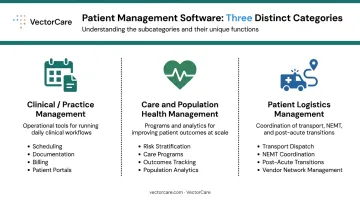
The category now spans three distinct subcategories:
- Clinical/practice management — scheduling, documentation, billing, and patient portals
- Care and population health management — risk stratification, care programs, and outcomes tracking across patient populations
- Patient logistics management — coordinating the physical movement of patients between facilities, including transport dispatch, NEMT, and post-acute transitions
Why 2026 matters specifically: The CMS Interoperability and Prior Authorization Final Rule (CMS-0057-F) requires FHIR-based API implementation with key operational provisions beginning in 2026. ONC's HTI-1 rule adds another layer, making USCDI Version 3 the baseline for certified health IT starting January 1, 2026.
FHIR capability is now a compliance requirement, not a feature. Any platform that can't connect to your EHR via standard APIs will create data silos rather than resolve them.
Platforms in this category should be evaluated on:
- Automation depth
- EHR integration capability
- Scalability across facility types
- Regulatory compliance posture
- Real-world deployment track record
Patient Management Software Systems in 2026
These platforms were evaluated on five dimensions: automation capability, EHR integration depth, HIPAA compliance and security certifications, real-world deployment scale, and fit for specific healthcare settings.
VectorCare
VectorCare is a patient logistics management platform in the US, purpose-built for hospitals, transfer centers, SNFs, NEMT providers, home health agencies, and payers. Founder and CEO David Emanuel built the platform around a straightforward observation: most health systems treat patient transport as a scheduling problem when it's actually an infrastructure problem — and that distinction changes how the solution is designed.
The platform unifies transport, home health, DME, and all non-emergency patient services into a single automated ecosystem, serving over 2,500 healthcare facilities nationwide.
What sets VectorCare apart:
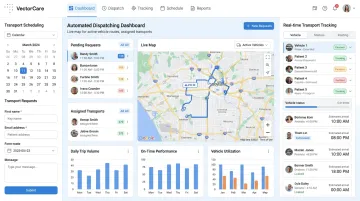
- A.D.I. (Automated Dispatching Intelligence) replaces phone calls, faxes, and manual matching with fully automated dispatch decisions
- SMART on FHIR Epic integration auto-populates patient data directly inside EHR workflows, cutting scheduling time from 31 minutes to under 3 minutes
- Broadcast network processed over 2.3 million broadcasts, with contract value exceeding $570 million
- Ground and air medical transport unified in one platform
- SoFaaS™ (SMART on FHIR as a Service), launched in 2026, lets healthcare vendors build and deploy their own EHR-embedded applications on VectorCare's infrastructure
Real-world results include cutting scheduling time from 45 minutes to 4.5 minutes per transport request at Orange County Health Care Agency, over $500,000 in annual savings for a 250-bed hospital with 25 daily transports, and a 90% reduction in scheduling time across the platform.
| Category | Details |
|---|---|
| Best For | Hospitals, transfer centers, SNFs, NEMT providers, home health agencies, payers, and air medical transport coordinators |
| Key Features | A.D.I. automated dispatching, SMART on FHIR Epic integration, AI scheduling agents, real-time transport tracking, no-code workflow builder, broadcast network, SoFaaS platform |
| Compliance & Deployment | HIPAA compliant, SOC 2 Type I; cloud-based SaaS; nationwide US coverage across 2,500+ facilities |
Epic (MyChart + Patient Management)
Epic is the dominant clinical EHR and patient management platform for large US health systems. According to KLAS Research's 2024 acute care market share report, Epic covers more than half of US acute-care multispecialty beds — and added 176 hospitals from 2024 purchase decisions, its largest recorded net gain.
Its patient management suite includes scheduling, clinical documentation, MyChart patient portal, revenue cycle management, and care coordination — all within a single, deeply integrated environment.
What sets Epic apart:
- Unmatched penetration in large US health systems and academic medical centers
- Epic Showroom supports third-party SMART on FHIR apps, including VectorCare's transport coordination app
- AI Charting, ambient documentation via DAX Express, and native chart summarization tools introduced through partnerships with Nuance and Abridge
- FHIR-based interoperability makes Epic a central node in most large health system tech stacks
One caveat: Epic's implementation complexity and cost make it less accessible to smaller or independent facilities.
| Category | Details |
|---|---|
| Best For | Large health systems, academic medical centers, and integrated delivery networks requiring a comprehensive clinical patient management platform |
| Key Features | Inpatient/outpatient scheduling, clinical documentation, MyChart patient portal, RCM, telehealth, AI ambient scribe, care coordination, Epic Showroom marketplace |
| Compliance & Deployment | HIPAA-compliant; cloud and on-premise deployment; enterprise contract-based pricing |
How to Choose the Right Patient Management Software
The most common mistake buyers make is evaluating platforms on feature checklists alone — without first mapping the tool to their specific operational bottleneck.
The five evaluation dimensions that matter:
- Automation depth — Does it eliminate manual tasks, or just digitize them?
- EHR integration — Does it connect via FHIR/HL7 standards, or require workarounds?
- HIPAA compliance and security certifications — Is there a BAA? What additional certifications exist?
- Deployment track record — How many similar organizations use it, and what are their outcomes?
- Operational fit — Is it built for your specific workflow: clinical, logistical, or population-level?
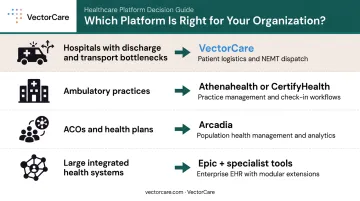
No single platform covers all three subcategories equally:
- Hospitals with discharge and transport bottlenecks need a logistics platform like VectorCare
- Ambulatory practices managing scheduling, billing, and patient flow need a clinical practice-management system (PMS)
- ACOs and health plans managing at-risk populations need a dedicated care management and population health platform
- Large integrated health systems managing everything in one environment need Epic — with specialist tools layered on top
That last point connects directly to integration capability — which has become a hard requirement in 2026. With CMS FHIR API mandates now in effect for major payer types and ONC's USCDI v3 baseline live for certified health IT, any platform that cannot connect to your existing EHR via FHIR-based APIs will generate new data silos rather than close existing ones.
Conclusion
Patient management software in 2026 spans at least three distinct categories, each solving a different class of operational problem. The platforms that perform best were built for a specific workflow — not because they have the longest feature list.
Evaluate any platform through a concrete operational lens before committing:
- What manual tasks will it eliminate day one?
- Where does it connect with systems already in use?
- Can it scale with your patient volume or facility footprint?
For healthcare organizations still coordinating patient transport, transfer center operations, or NEMT through phone calls and faxes, VectorCare is a HIPAA compliant platform with documented results across 2,500+ facilities nationwide. Connect with the VectorCare team to see how it fits your specific logistics workflow.
Frequently Asked Questions
What is patient management software?
Patient management software is healthcare technology that helps organizations manage and coordinate patient care workflows. It spans clinical documentation and scheduling tools, care and population health management platforms, and patient logistics systems — each built for a distinct use case.
How does patient logistics software differ from clinical patient management software?
Clinical patient management software handles scheduling, documentation, billing, and patient portals within a care setting. Patient logistics software manages the operational coordination of moving patients between facilities — transport dispatch, NEMT, air medical coordination, and post-acute transitions. They solve different problems and are typically used together.
What features should I look for in patient management software in 2026?
Prioritize AI-powered automation, FHIR-based EHR integration, HIPAA compliance, real-time tracking or visibility, and scalability across facilities. Beyond features, confirm the platform is purpose-built for your use case — clinical, logistical, or population health — before evaluating anything else.
Is patient management software HIPAA compliant?
Reputable platforms are HIPAA-compliant and many carry additional certifications — HITRUST, SOC 2, ISO 27001, or PCI DSS depending on the vendor. Always verify compliance documentation and confirm a Business Associate Agreement (BAA) is available before purchasing.
How does patient management software integrate with EHR systems?
Modern platforms integrate via HL7 FHIR standards or direct API connections, enabling bidirectional data exchange with EHRs like Epic. SMART on FHIR apps (such as VectorCare's Epic integration) embed directly into EHR workflows, so staff can initiate transport requests or care coordination tasks without ever leaving the patient chart.
What is the ROI of implementing patient management software?
ROI varies by platform type and use case. McKinsey estimates that AI-enabled revenue cycle operations could reduce cost to collect by 30–60% — though this is a modeled range, not a guaranteed outcome. For logistics-focused deployments, VectorCare reports over $500,000 in annual savings for a 250-bed hospital with 25 daily transports, and a reduction in scheduling time from 45 minutes to 4.5 minutes at Orange County Health Care Agency.