Introduction
A single missed shift update can ripple fast. One paramedic calls out sick, a supervisor can't reach a replacement before the unit goes unstaffed, and suddenly a community has a delayed response window during what could be its worst moment. That's not a scheduling inconvenience — it's a life-safety failure.
The operational demands on EMS agencies have grown beyond what manual tools can handle. Today's schedulers must manage 24/7 rotating crews, fatigue compliance, certification expiration tracking, and call-off backfill — often simultaneously, often at 2 a.m.
According to the American Ambulance Association, EMS organizations report an average annual loss of $295,388 per organization (2023, lost revenue) due to staff shortages — a figure that reflects exactly what poor workforce management costs.
Purpose-built EMS scheduling software addresses these failures directly. This guide covers the top platforms for 2026, what separates them, and how to match the right tool to your agency's workflow.
Key Takeaways
- EMS scheduling software automates shift rotations, fatigue rules, certification tracking, and last-minute shift coverage — no more phone chains or spreadsheets.
- Crew scheduling and patient transport coordination are two distinct functions that may require separate or complementary platforms.
- Top 2026 picks — Aladtec, ESO Scheduling, Vector Solutions, UKG TeleStaff, and VectorCare — serve different agency sizes and needs.
- Choosing wrong costs more than the subscription; mismatched tools create compliance gaps and staffing failures.
What Is EMS Scheduling Software?
EMS scheduling software is a workforce management platform that automates the creation, adjustment, and compliance monitoring of emergency personnel schedules. It replaces paper rosters, Excel grids, and phone-based call chains with rules-driven digital systems that respond to real-time staffing changes.
Two Distinct Categories
Most comparisons treat EMS scheduling as a single category. It isn't. There are two separate problems that require different tools:
Crew/shift scheduling tools manage who works when. They handle:
- Rotational shift patterns (24/48, Kelly, California Rotation)
- Fatigue and rest-period enforcement
- Certification and credential tracking
- Overtime allocation and call-off coverage
Patient transport coordination platforms manage which unit responds to which patient request. They handle:
- Automated dispatch of ambulance, air medical, or NEMT providers
- EHR-connected transport logistics
- Multi-provider coordination across hospital and field networks
- Real-time transport tracking and documentation
Agencies often need both, but the two tools solve different problems. Buying a crew scheduler won't fix a transport dispatch bottleneck.
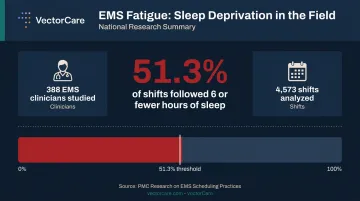
The crew scheduling side carries real safety stakes. Research covering 388 EMS clinicians and 4,573 shifts found that 51.3% of shifts followed six or fewer hours of sleep, a direct consequence of scheduling practices that ignore fatigue accumulation. Purpose-built platforms with fatigue enforcement rules built in are designed to close that gap before it becomes a patient safety issue.
Top EMS Scheduling Software for 2026
The platforms below were selected based on proven EMS deployment, depth of scheduling automation, compliance capabilities, and real-world fit across agency sizes. Each serves a distinct operational profile.
Aladtec (by TCP Software)
Aladtec is a public-safety-specific platform built for EMS, fire, law enforcement, and dispatch. TCP Software acquired it in October 2021 and has continued developing it as a dedicated crew scheduling tool with deep rule-based configuration.
Where Aladtec earns its reputation is in handling the complexity that general workforce tools can't: 24/48 patterns, California Rotation, simultaneous fatigue rule tracking, and union-compliant scheduling — all configurable without custom development.
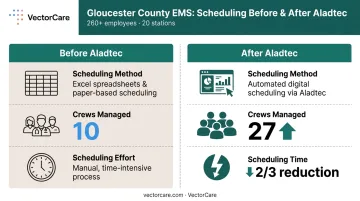
A real-world result: Gloucester County EMS (260+ employees, 20 stations) replaced Excel and paper schedules with Aladtec and reported a two-thirds reduction in scheduling time while expanding from 10 to 27 crews during the COVID-19 period.
| Feature Area | Detail |
|---|---|
| Key Features | 24/7 rotational scheduling, fatigue safeguards, certification tracking, 200+ pre-built digital forms, built-in communication tools, audit-ready compliance reporting |
| Best For | EMS and fire agencies of any size needing complex rotation support and compliance documentation |
| Integrations | Payroll, RMS, ePCR, and CAD integrations; enforces union, labor law, and agency-specific fatigue/rest rules |
Capterra rating: 4.6/5 (17 reviews, April 2026)
ESO Scheduling
ESO Scheduling is a web-based platform purpose-built for EMS and fire departments. Its native understanding of EMS operations sets it apart from adapted HR tools — the platform doesn't just assign people to shifts, it ensures those people are credentialed, available, and compliant.
Automatic schedule generation, sick-call management, open shift filling, and overtime alerts are all handled within a single EMS-native interface. ESO's broader ecosystem — connecting Scheduling with Personnel Management, EHR, and Activities products — makes it useful for agencies already invested in the ESO suite.
| Feature Area | Detail |
|---|---|
| Key Features | Automated schedule generation, overtime alerts, certification tracking, time-off bank automation, dynamic dashboards, built-in reporting, absence flagging |
| Best For | EMS agencies and fire departments seeking a dedicated, end-to-end workforce management platform |
| Integrations | Payroll integration, holiday pay automation, EMS-specific compliance reporting; syncs with ESO Personnel, EHR, and Activities modules |
Capterra rating: 4.5/5 (32 reviews, March 2026)
Vector Solutions (Vector Scheduling)
Formerly CrewSense (acquired January 2019), Vector Scheduling addresses one of EMS scheduling's most painful daily problems: filling open shifts without burning hours on manual phone calls. Its automated callout system sends instant text, email, and in-app notifications when coverage gaps appear — cutting the time between identifying a vacancy and filling it.
The connection to Vector's broader training and compliance suite adds value for mid-to-large agencies that want scheduling linked to training records and qualification tracking. The platform's feature depth and pricing reflect a mid-to-large agency use case — volunteer or single-station operations may find it more than they need.
| Feature Area | Detail |
|---|---|
| Key Features | Automated callout/callback tools, real-time shift coverage visibility, overtime tracking, fatigue alerts, roster management, multi-channel open shift notifications |
| Best For | Mid-to-large EMS and fire agencies with frequent overtime, shift changes, and high-volume callout scenarios |
| Integrations | Integrates with Vector LMS and Vector Check It; supports union rule enforcement and fatigue management policies |
UKG TeleStaff
UKG TeleStaff Cloud is the enterprise end of the EMS scheduling market. Built for large public safety organizations with complex workforce agreements, it automates shift bidding, vacation awards, vacancy backfill, and compliance management across multi-division staffing structures.
TeleStaff's rules engine handles the most demanding union, HR, and labor environments — FLSA compliance, fatigue limits, certification-based assignments, and seniority-driven bidding can all be configured without manual override. The Extra Duty Events module adds support for special event staffing, invoicing, and tracking.
Smaller agencies should proceed carefully: TeleStaff's enterprise scope requires meaningful configuration investment that may not be justified for departments under 100 personnel.
| Feature Area | Detail |
|---|---|
| Key Features | Rules-based shift automation, bidding management, minimum staffing enforcement, skills/certification-based assignments, instant multi-channel notifications, Extra Duty Events module |
| Best For | Large public safety agencies and municipalities with complex union contracts, advanced compliance requirements, and multi-division staffing |
| Integrations | Full UKG workforce management ecosystem; compliance automation for union rules, FLSA, fatigue limits, and labor contracts |
VectorCare
Crew scheduling tools handle who works the shift. VectorCare handles what happens after — which unit moves which patient, and how fast. It's a HIPAA compliant, AI-powered patient logistics platform that automates transport coordination and dispatch across hospitals, ambulance providers, NEMT services, and air medical networks.
VectorCare's A.D.I. (Automated Dispatching Intelligence) processes incoming transport requests continuously and broadcasts them simultaneously to multiple providers. What used to take approximately 31 minutes by phone now completes in under three minutes — a 90% reduction. Its SMART on FHIR integration with Epic pulls patient data directly into the transport request, eliminating manual transcription at the point of order.
Demonstrated outcomes include a reduction from 45 minutes to 4.5 minutes per transport request (as documented with Orange County Health Care Agency) and platform-wide generation of 2.3 million broadcasts (2024).
| Feature Area | Detail |
|---|---|
| Key Features | A.D.I. automated dispatch, SMART on FHIR Epic integration, real-time transport tracking, AI-powered scheduling, no-code workflow builder |
| Best For | Hospitals, health systems, ambulance providers, fire/EMS departments, and NEMT operators needing automated patient transport coordination |
| Integrations | HIPAA compliant cloud; Epic EHR SMART on FHIR integration; integrates with CSI Aviation, Priority Dispatch Corp, and 2,500+ healthcare facilities nationwide |
How to Choose the Right EMS Scheduling Software
What the Selection Should Actually Test
Most agencies evaluate scheduling software on how it looks in a demo. That's the wrong test. The right evaluation tests the platform against your actual operational scenarios:
- Simulate a simultaneous multi-unit callout. Does the system auto-notify qualified replacements in seniority order? Can a supervisor approve swaps from a mobile device at midnight?
- Run a union rule conflict. If someone is scheduled past their fatigue threshold, does the platform flag it automatically or require a supervisor to catch it manually?
- Check certification lapse tracking. What happens when a paramedic's certification expires mid-schedule cycle — does the platform block assignment or just note it?
Common Mistakes to Avoid
- Evaluating on UI alone, without pressure-testing against real compliance edge cases
- Deploying enterprise tools at small agencies — TeleStaff-level complexity is excessive for a 15-person department
- Treating crew scheduling and transport coordination as the same problem — they're not, and the tools that solve them often differ
Matching Tool to Operational Context
| Agency Profile | Best Fit |
|---|---|
| Small/volunteer EMS, simple rotations | Aladtec |
| EMS/fire department, end-to-end workforce management | ESO Scheduling |
| Mid-to-large agency, high callout volume | Vector Solutions |
| Large municipality, complex union contracts | UKG TeleStaff |
| Hospital or EMS agency coordinating patient transport | VectorCare |
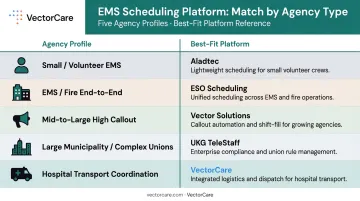
Note that transport coordination tools like VectorCare solve a different problem than crew scheduling platforms — they manage the dispatch, vendor network, and patient logistics layer rather than shift rotation. Agencies dealing with both problems often need both types of tools working together.
Conclusion
EMS scheduling software isn't a back-office convenience. The right platform directly affects response readiness, crew wellbeing, compliance exposure, and patient outcomes. The wrong tool — or no tool — surfaces quickly: overtime costs spike, certification gaps go untracked, and staffing failures hit during holidays and surge events when margins are thinnest.
Evaluate platforms not just on their feature lists but on scalability, vendor support depth, and integration with your existing systems. Pilot under realistic operational pressure before committing — a platform that performs in a controlled demo may struggle when three units call off during a holiday shift.
For agencies and healthcare systems looking to automate patient transport coordination — not just crew scheduling — VectorCare offers a platform built specifically for patient logistics, with AI-driven dispatch, Epic EHR integration, and a nationwide network of transport providers. Reach out to learn more.
Frequently Asked Questions
What is EMS scheduling software?
EMS scheduling software is a digital platform that automates emergency personnel schedules — including shift rotations, fatigue enforcement, certification tracking, and call-off management. Unlike general HR tools, it's built for public safety's 24/7 coverage requirements and compliance-heavy environment.
How much does EMS scheduling software cost?
None of the major platforms (Aladtec, ESO Scheduling, Vector Scheduling, UKG TeleStaff) publish public pricing — all route buyers through a demo or sales process. Enterprise tools like TeleStaff use custom quotes tied to agency size, while smaller-agency platforms tend to offer more flexible entry points.
What features should EMS scheduling software have?
Core requirements include:
- 24/7 rotation support and fatigue/rest-period enforcement
- Certification and credential tracking
- Real-time call-off management
- Mobile self-service for field crews
- Overtime tracking and audit-ready compliance reporting
What is the difference between EMS crew scheduling and transport coordination software?
Crew scheduling tools manage who works which shifts — handling fatigue rules, certifications, and rosters. Transport coordination platforms manage which unit moves which patient — automating dispatch, logistics, and EHR-connected workflows. Agencies often need both, but they solve fundamentally different problems.
Can EMS scheduling software integrate with EHR systems?
Most crew scheduling tools integrate with payroll and HR systems, not clinical EHRs. Transport coordination platforms are the exception — VectorCare, for example, offers direct SMART on FHIR integration with Epic, automatically pulling patient data into transport requests and eliminating manual entry.
What is the best EMS scheduling software for small agencies?
Aladtec is a strong fit for smaller and volunteer EMS agencies, offering purpose-built EMS features, modular configuration, and a manageable onboarding process. Enterprise platforms like UKG TeleStaff are typically over-engineered and cost-prohibitive for departments under 50-100 personnel.