Introduction
Scheduling delays don't stay contained. A single bottleneck — a missed handoff, an unfilled slot, a transport that wasn't arranged until a patient was already medically cleared — cascades into overloaded waiting rooms, extended inpatient stays, frustrated staff, and real revenue loss.
Many healthcare organizations still treat scheduling as an administrative function rather than a core operational one. The data shows what that costs.
A 2022 survey by AMN/Merritt Hawkins found the mean wait for a new-patient appointment across five specialties was 26.0 days.
That delay isn't just inconvenient. Lead times over four weeks are strongly associated with a higher risk of no-shows compared to same-day scheduling.
This guide covers best practices across two dimensions of patient scheduling: clinical appointment scheduling (managing patient flow in ambulatory and inpatient settings) and patient logistics scheduling (coordinating transfers, transport, and care transitions). Both directly shape outcomes and operational efficiency.
Key Takeaways:
- Long scheduling lead times are one of the strongest predictors of no-show risk
- Hybrid scheduling models outperform any single approach in complex care environments
- Self-scheduling cuts no-shows but raises cancellations — both metrics need tracking
- Transport, discharge, and transfer scheduling is where fragmentation hits hardest
- Automation and EHR integration are the fastest path to coordination that scales
Why Poor Scheduling Hurts More Than You Think
The instinct is to blame resource shortages when scheduling breaks down. Usually, that's wrong. The evidence points more often to flawed processes and underused capacity.
The Clinical Cost
Scheduling delays create a chain reaction in clinical outcomes:
- Higher no-show rates — lead times over four weeks are linked to substantially higher no-show risk
- Worsening chronic conditions — delayed follow-up care means missed medication adjustments, unmonitored labs, and avoidable deterioration
- Unnecessary ED visits — patients who can't access timely outpatient care route through the emergency department instead
- Reduced care plan adherence — every scheduling friction point reduces the likelihood a patient completes their care
The Operational Cost
Unfilled slots and the staff time burned on manual scheduling tasks both represent direct revenue loss. An MGMA analysis identifies unused provider time, underutilized slots, high call burden, and reduced daily patient volume as the primary financial consequences of scheduling dysfunction — and 23% of practice leaders reported worsening appointment waits in a 2024 poll.
On the inpatient side, a 2022 Cochrane review found that individualized discharge planning shortened medical patient length of stay and reduced unscheduled readmissions. Across a hospital running at consistent volume, that difference compounds into recovered bed capacity and measurable reductions in readmission-related costs.
Choosing the Right Scheduling Model
No single scheduling model works universally. Most high-performing organizations use hybrid approaches tailored to their patient population, care complexity, and volume patterns.
| Model | How It Works | Best For |
|---|---|---|
| Time-slot scheduling | Fixed, individual appointment blocks | Predictable outpatient visit types |
| Wave scheduling | Groups of patients booked in overlapping windows | High-volume settings with variable visit length |
| Open-access scheduling | Appointments offered the day the patient calls | Primary care, AHRQ-supported model with fewer no-shows |
| Priority scheduling | Urgency-based sequencing | Settings where acuity must determine access order |
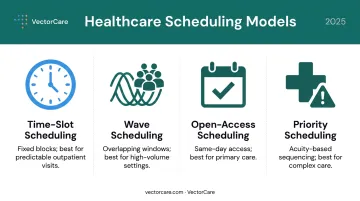
A practical note: Open-access scheduling has the clearest evidence base for primary care, with documented reductions in no-shows, better continuity, and higher patient satisfaction. Wave scheduling improves provider utilization but increases patient wait times when overbooking thresholds are crossed.
Choosing a model means honestly mapping visit complexity, provider capacity, and care type against your actual volume patterns — then building in flexibility where those patterns vary.
Best Practices for Appointment Scheduling
Standardize Templates by Visit Type
Treating every appointment as the same length is one of the most avoidable scheduling mistakes in practice. A new patient intake, a 15-minute follow-up, and a complex chronic disease management visit require fundamentally different time allocations — and forcing them into identical blocks creates predictable bottlenecks.
Standardize templates by:
- Visit type (new patient, follow-up, telehealth, procedure)
- Provider specialty and panel complexity
- Patient acuity flags from the care record
When templates reflect actual visit needs, providers run on time more consistently and capacity gaps shrink.
Build Buffer Time Into Every Session
Buffer slots — intentional open windows at the end of a block or between appointments — absorb the delays that clinical environments generate constantly: late arrivals, longer-than-expected conversations, documentation catch-up. Without buffer time, a single 10-minute overrun can push every subsequent appointment of the day. With it, one disruption stays contained.
A practical approach is reserving 10–15% of session capacity as flexible buffer, placed strategically rather than uniformly.
Enable Patient Self-Scheduling
Patients increasingly expect on-demand digital access for healthcare the same way they manage every other service. Phone-based scheduling limits access to business hours, consumes staff time, and adds friction at every step.
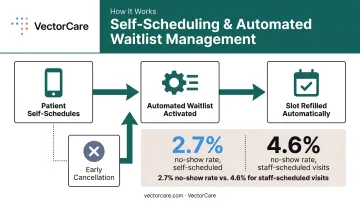
A 2022 JAMIA study of nearly 2 million transactions found self-scheduled appointments had a 2.7% no-show rate versus 4.6% for staff-scheduled visits — but also a higher cancellation rate (37.6% vs. 27.0%). Fewer no-shows, more cancellations, and a lower kept-appointment rate overall.
Self-scheduling doesn't automatically mean more completed appointments, but it does shift patient behavior toward earlier cancellation — which creates time to fill the slot. Two design choices determine whether that opportunity gets captured:
- Make cancellation frictionless so patients act early rather than ghosting
- Pair self-scheduling with an automated waitlist so vacated slots refill immediately
Use Smart Waitlists to Fill Cancellations
A cancellation handled reactively is a revenue loss. A cancellation handled by an automated waitlist system is a patient access opportunity.
Waitlist management tools can automatically identify the next appropriate patient when a slot opens, send outreach, and confirm the new appointment — without a staff member manually working through a list. The result is higher utilization, better patient access, and protected revenue.
Send Automated Reminders Across Multiple Channels
Multi-channel reminders sent at strategic intervals reduce no-show rates meaningfully. Text, email, and voice each reach different patient segments — no single channel captures everyone.
Effective reminders should:
- Go out at 72 hours and again at 24 hours before the appointment
- Include a clear one-tap option to confirm, cancel, or reschedule
- Not require a phone call to act on
The cancel/reschedule option in the reminder is not optional. Removing barriers to cancellation is how you convert no-shows into rescheduled appointments.
Reserve Capacity for Urgent and Same-Day Access
Holding a defined portion of daily capacity for urgent or same-day appointments prevents emergent clinical needs from colliding with routine schedules — and reduces unnecessary ED use.
This requires two things: a defined percentage of slots protected each day, and clear triage criteria guiding staff decisions on what qualifies. Without the second piece, urgent slots either fill with routine requests or staff spend time triaging every call individually.
Best Practices for Patient Logistics and Care Transitions
Clinical appointment scheduling is one layer of the problem. For hospitals, transfer centers, SNFs, home health agencies, and NEMT providers, scheduling extends to coordinating patient movements between care settings — and this layer is where fragmentation is most severe.
Most transfer coordination still happens through phone calls, faxes, and manual handoffs. The result is delays that extend patient length of stay and increase clinical risk — not just operational friction.
Coordinate All Parties Simultaneously
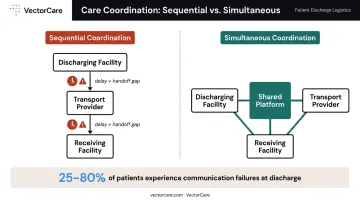
The default in most organizations is sequential coordination: call the receiving facility, then arrange transport, then notify the sending team. Each handoff introduces a wait.
Simultaneous coordination — where all parties (discharging facility, receiving facility, transport provider) are aligned through a shared workflow at the same time — is where delays are most consistently recovered. VectorCare's platform enables this by giving all stakeholders real-time visibility into the same transport request, rather than passing information through a chain of phone calls.
The stakes are clear: The Joint Commission reports that medication discrepancies and communication failures at discharge, and unintentional discrepancies during internal transfers, are common and clinically significant.
Integrate Scheduling with Clinical Data
When logistics platforms connect directly to EHR systems, manual data re-entry disappears — along with the errors it introduces. Patient demographics, acuity flags, insurance status, and discharge details populate transport requests automatically, ensuring the transport matches the patient's actual clinical needs.
VectorCare's SMART on FHIR integration with Epic automates this process, embedding the logistics workflow directly inside the clinical record rather than requiring care coordinators to toggle between systems. Every logistics event is documented back to the medical record without manual note entry.
For air transport specifically, VectorCare's platform reduces the scheduling workflow from approximately 31 minutes by phone to under 3 minutes — a 90% reduction — driven by real-time availability visibility and automated data population.
Make Transport Status Visible to Everyone
Faster data integration only helps if everyone can act on it. Real-time tracking closes the communication loop that generates status calls, delays, and uncertainty. When the hospital discharge team, transport crew, and receiving facility can each see the same live status of a patient's transfer:
- Status phone calls are eliminated
- Receiving facilities can prepare before the patient arrives
- Delays are visible immediately, allowing proactive response
When status is visible to everyone by default, teams stop chasing information and start managing care.
How Technology and Automation Are Transforming Scheduling
Scheduling automation has moved well beyond calendar software. Current systems can match patients to the right provider, visit type, time slot, and transport resource based on defined rules — reducing administrative burden and minimizing human error at every step.
Automated Dispatching Intelligence
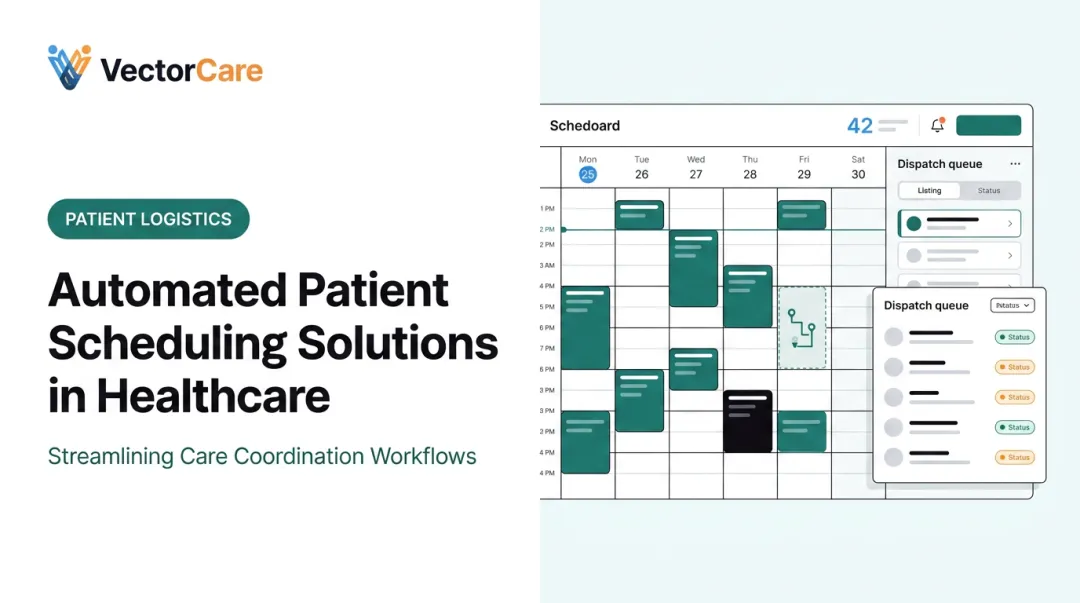
Manual back-and-forth for transport scheduling consumes staff hours that don't scale. Automated dispatching handles the creation of logistics events, broadcasts requests to available providers, and manages timing and confirmation — without a coordinator making sequential phone calls.
VectorCare's A.D.I. (Automated Dispatching Intelligence) applies this to patient logistics at scale, having saved healthcare organizations over 100,000 staff hours by automating coordination workflows that previously required manual effort across every request.
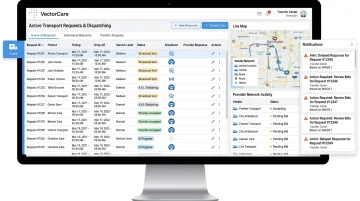
The platform processes 3.23 requests per minute (2024), scheduling and broadcasting transport requests to available providers automatically — a workflow that previously required nurses and case managers to coordinate each trip individually.
Predictive Analytics for Demand Management
A 2024 implementation of AI-based scheduling at a 600-bed hospital reported a 6% capacity utilization increase and a 10% monthly increase in patients seen.
VectorCare's Insights module surfaces operational patterns for logistics operators — including bottleneck detection, unfulfilled trip analysis, and vendor performance tracking — enabling demand-based staffing decisions rather than reactive ones.
EHR Integration as a Prerequisite
Scheduling technology that doesn't connect to clinical records creates a new data entry problem. SMART on FHIR standards are enabling tighter integration between logistics platforms and hospital EHRs — a 2024 scoping review found FHIR implementations have reduced redundant data entry in documented care coordination cases.
For coordinators, that integration produces three immediate operational gains:
- Patient information flows automatically from the clinical record into the logistics request
- Manual re-entry is eliminated, recovering hours previously lost to duplicate data handling
- Logistics requests stay current with the clinical record, reducing errors from outdated or mismatched patient data
Common Patient Scheduling Mistakes to Avoid
The most damaging scheduling mistakes share a common root: treating scheduling as a fixed administrative process rather than a dynamic operational system.
Appointment-level mistakes:
- Uniform appointment lengths regardless of visit type or complexity
- No buffer time, allowing one delay to cascade through the day
- Phone-only scheduling that limits access to business hours
- Barriers to cancellation or rescheduling, converting potential reschedules into no-shows
- Disconnected reminders, intake, and follow-up workflows
Logistics-level mistakes:
- Siloing clinical discharge scheduling from transport coordination — patients who are medically ready to leave wait hours for transport because nobody started the logistics workflow until discharge was confirmed
- Incomplete DME or home health orders that keep patients inpatient an extra day or two while paperwork clears
- Using phone and fax for transport coordination while clinical documentation has been digitized, leaving the logistics layer unchanged
MGMA identifies unused slots, underutilized provider time, and high call volume as the direct cost drivers of scheduling dysfunction. Each gap has a price: lost revenue from unfilled capacity, staff time absorbed by phone coordination, and patients who quietly switch to a more accessible provider. Addressing these gaps isn't an optimization project — it's a revenue protection decision.
Frequently Asked Questions
How can patient scheduling be improved?
Use a scheduling model matched to your patient population and visit complexity, enable self-scheduling with frictionless rescheduling, automate reminders with confirmation options, and connect logistics coordination directly to clinical scheduling workflows. Smart waitlists and EHR integration close the remaining gaps.
What are the most common patient scheduling mistakes healthcare organizations make?
The most frequent and costly mistakes are uniform appointment lengths for all visit types, no buffer time, phone-only scheduling, barriers to rescheduling, and disconnected transport and discharge coordination. Each is solvable with the right processes and technology.
How does poor patient scheduling affect patient outcomes?
Delays in scheduling are linked to higher no-show rates, worsening of chronic conditions, increased unnecessary ED visits, and extended length of stay and higher readmission risk in inpatient settings.
What is the difference between clinical appointment scheduling and patient logistics scheduling?
Clinical appointment scheduling manages when patients are seen by a provider. Patient logistics scheduling coordinates the physical movement of patients between care settings, including transport, transfers, and discharge coordination. Both must be optimized for care continuity.
How can hospitals reduce scheduling-related delays in patient transfers and discharges?
Four practices make the biggest difference:
- Coordinate all parties simultaneously rather than sequentially
- Integrate EHR data directly into transport requests to eliminate duplicate entry
- Use automated dispatching to replace manual phone-based coordination
- Give all stakeholders real-time visibility into transfer status
What role does automation play in improving patient scheduling?
Automation handles reminders, self-scheduling, waitlist management, and — for logistics — dispatching and broadcast to provider networks. The result is fewer staff hours consumed by manual coordination and more consistent execution throughout the scheduling workflow.