Introduction
A single hospital transfer center doesn't just manage one provider network. It juggles credentialed clinicians, ground ambulance crews, NEMT vendors, home health agencies, and DME suppliers — often through five different phone lines and just as many spreadsheets.
That fragmentation has a price tag. Industry estimates put the cost of one delayed provider-onboarding day at $10,122 for a medical group, and more than half of surveyed practices reported rising credentialing-related denials in 2021.
Manual coordination doesn't scale. Delayed transfers pile up, administrative overhead balloons, and claims errors follow close behind. This guide breaks down the leading provider network management platforms, covering both clinical credentialing and logistics coordination, so you can match the right tool to the right operational gap.
Key Takeaways
- Provider network management now spans two layers: clinical credentialing and logistics coordination
- Automation cuts credentialing timelines from months to days
- Transportation scheduling drops from roughly 31 minutes by phone to under 3 minutes, a 90% reduction
- EHR integration through FHIR-based APIs is now a baseline requirement, not a differentiator
- VectorCare focuses on transport, home health, and DME coordination; Assured, Medallion, symplr, and Verisys lead credentialing
What Is Healthcare Provider Network Management?
Healthcare provider network management is the end-to-end process of building, maintaining, and optimizing a healthcare organization's network of providers. That includes recruiting providers, verifying credentials, managing contracts, tracking compliance, and coordinating service delivery.
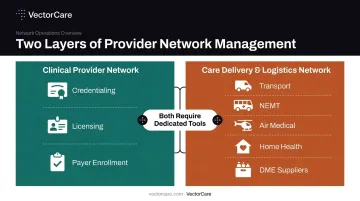
Most healthcare organizations are managing two distinct network layers at once:
- The clinical provider network: credentialing, licensing, and payer enrollment for physicians and other practitioners
- The care delivery/logistics network: transport services, NEMT, air medical, home health agencies, and DME suppliers that keep patients moving through the care continuum
Both layers require dedicated tools. A credentialing platform won't help a transfer center dispatch an ambulance, and a dispatch platform won't verify a physician's license. The solutions below address one layer, the other, or occasionally both. Your choice should come down to which layer is causing the most operational drag right now.
Healthcare Provider Network Management Solutions
Every platform here was evaluated on automation depth, EHR and payer system integration, breadth of provider types supported, real-time monitoring, compliance readiness, and documented customer outcomes.
VectorCare
VectorCare is a HIPAA compliant, cloud-based patient logistics platform that has spent over 14 years automating the non-clinical side of provider network management. It now serves 2,500+ healthcare facilities nationwide, connecting ground ambulance, NEMT, air medical, home health agencies, and DME suppliers into a single coordination layer.
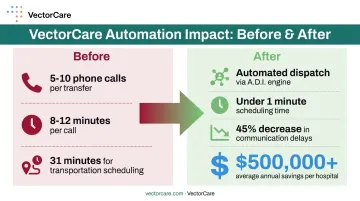
What sets it apart is the depth of automation. Its A.D.I. (Automated Dispatching Intelligence) engine handles dispatch decisions that once required multiple phone calls per transfer.
VectorCare's SMART on FHIR integration with Epic pulls patient demographics, encounter details, vitals, and insurance data automatically, dropping transportation scheduling time from roughly 31 minutes down to under 3 minutes.
VectorCare reports over $500,000 in annual savings for a 250-bed hospital with 25 daily transports.
| Category | Details |
|---|---|
| Key Features | A.D.I. automated dispatching, Epic SMART on FHIR integration, real-time transport tracking, AI-driven scheduling and negotiation, no-code workflow builder |
| Best For | Hospitals, transfer centers, health systems, payers, and county health agencies automating transport, NEMT, home health, and DME coordination |
| Integration & Compliance | HIPAA compliant cloud platform; SMART on FHIR Epic integration; supports NEMT, ground ambulance, air medical, and home health providers nationwide |
Assured
Assured is an AI-powered credentialing platform built for enterprise health systems and multi-entity provider groups. It automates primary source verification, licensing, payer enrollment, and continuous compliance monitoring through NCQA-certified workflows.
The standout number: Assured compresses credentialing turnaround from the industry-standard 60–120 days down to 48 hours, while continuously monitoring more than 2,000 verified data sources. Its own case study with Blossom Health documents an 80–90%+ first-pass approval rate (strong, though slightly below some vendor-marketing claims of 95%+).
| Category | Details |
|---|---|
| Key Features | Automated primary source verification, multi-state licensing across all 50 states, CAQH profile management, continuous exclusion and sanctions monitoring, PECOS integration, real-time compliance alerts |
| Best For | Enterprise health systems, multi-entity provider groups, growth-stage digital health organizations scaling clinical credentialing |
| Integration & Compliance | NCQA-certified CVO; SOC 2-compliant infrastructure; API-first architecture connecting to Epic, CAQH, NPPES, state boards, and PECOS |
Medallion
Medallion is a modern, AI-driven provider data management platform combining credentialing, licensing, payer enrollment, and continuous monitoring. It's built around one goal: cutting the time and error rate in clinical provider onboarding, with claimed data accuracy near 99.5%.
For health plans and large provider groups, Medallion's delegated credentialing workflows (NCQA-compliant) and CAQH integration reduce the manual re-attestation burden that typically eats up credentialing staff time. Real-time sanctions and exclusion monitoring runs across OIG, SAM, and state-level lists continuously — not just at renewal.
| Category | Details |
|---|---|
| Key Features | CVO credentialing, provider data management with real-time sync, direct and delegated payer enrollment, licensing with interstate compact support, continuous exclusion checks |
| Best For | Organizations with 200+ providers needing centralized data management and NCQA-compliant delegated credentialing |
| Integration & Compliance | NCQA-certified for credentialing; TJC-aligned; CAQH and EHR system integrations |
Symplr
Symplr is a cloud-based enterprise suite covering credentialing, privileging, payer enrollment, contracting, and directory management. It offers separate tools for health plans (symplr Payer) and provider organizations (symplr CVO), backed by HITRUST CSF certification.
This is the platform for large health systems that need one governance layer across multiple facilities rather than point solutions. The tradeoff: implementation is more involved than newer competitors, and the learning curve reflects its breadth. Symplr was named an IDC "Major Player" in provider data management for payers, which speaks to its enterprise credibility.
| Category | Details |
|---|---|
| Key Features | Credentialing and privileging workflows, symplr Payer for health plans, provider directory management, evidence analysis tools, document management with audit trails, anomaly detection |
| Best For | Large hospitals and health plans managing complex enterprise credentialing and directory compliance across multiple facilities |
| Integration & Compliance | HITRUST CSF certified; integrates with EHR and claims systems; recognized IDC Major Player in provider data management |
Verisys
Verisys is a data-first compliance and verification platform. It gives health plans and multi-state organizations primary-source verified data across licensure, sanctions, exclusions, DEA registrations, and adverse actions in real time.
Its strength is breadth of source coverage: OIG LEIE, SAM, state Medicaid exclusion lists, licensing boards, and DEA registries, paired with genuinely continuous monitoring rather than periodic batch checks. That combination closes compliance blind spots that trip up organizations operating across many states.
| Category | Details |
|---|---|
| Key Features | Primary-source license verification across all U.S. jurisdictions, continuous exclusions and sanctions monitoring, NPI and DEA verification, audit-ready timestamped documentation, payment integrity support |
| Best For | Health plans, managed care organizations, and multi-state systems needing continuous compliance monitoring and data-first credentialing |
| Integration & Compliance | NCQA-accredited CVO; URAC accredited; SOC 2 certified; API, SFTP, and portal-based delivery |
Key Features to Look for in a Provider Network Management Solution
Automation Depth, Not Just Task Management
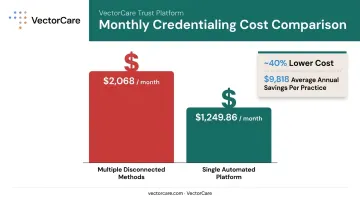
The difference between a basic tracking tool and a real automation platform shows up in the numbers. CAQH found that practices using multiple disconnected credentialing methods spent $2,068 per month on average, compared to $1,249.86 with a single platform: roughly 40% lower, or about $9,818 in annual savings per practice.
On the logistics side, look for platforms that eliminate phone-based dispatch entirely, not just log it faster.
EHR and System Integration
Your network management platform has to talk to what you already run. Epic now holds 42.3% of U.S. acute-care hospitals, so FHIR-based, SMART on FHIR integration isn't optional for most systems. Fragmented data between platforms remains one of the most common root causes of network management failures.
Real-Time Monitoring vs. Periodic Checks
A license that lapsed three weeks ago or an ambulance that's 20 minutes behind schedule — both need to surface the moment they happen, not at the next batch review. Continuous monitoring catches problems before they hit patient care or claims; periodic checks catch them after.
Scalability Across Provider Types and Geography
Networks grow faster than most organizations plan for. A platform that works for 50 providers in one state needs to handle 500 across ten without a re-implementation project. Ask vendors directly how new provider types or states get added.
Compliance and Audit Readiness
- Credentialing-focused networks: NCQA certification, CMS compliance support, automatic audit trail generation
- Logistics-focused networks: HIPAA compliance, documented coordination decisions for regulatory review
- Both: timestamped records that hold up if a regulator or auditor asks questions
How We Chose These Solutions
We evaluated each platform on seven criteria:
- Automation capability
- Provider type coverage
- EHR integration depth
- Real-time monitoring
- Compliance certifications
- Measurable customer outcomes
- Market presence
The most common buyer mistake we see: choosing a platform on brand recognition alone, without checking whether it actually solves the specific network management gap causing pain. A symplr enterprise suite won't help a transfer center dispatch an ambulance faster, just as a dispatch platform won't verify a physician's DEA registration.
The connection to business outcomes matters more than feature checklists:
- Credentialing automation shortens time-to-network for new providers, which accelerates revenue recognition
- Logistics automation reduces patient wait times, length of stay, and communication delays
- Both automation types also cut administrative overhead, so the strongest platforms show ROI across revenue, patient experience, and overhead reduction
Conclusion
The right healthcare provider network management solution depends on your specific operational gap, not a generic best-of list. Credentialing clinical providers, maintaining compliant directories, and coordinating real-time transport all require different tools, even though they fall under the same umbrella term.
When evaluating options, weigh integration depth, automation capability, and scalability more heavily than feature lists. Ask vendors for documented customer outcomes, not just a polished demo environment.
If your gap is coordinating transport, NEMT, air medical, home health, and DME provider networks, VectorCare has built exactly that infrastructure across 2,500+ facilities nationwide, eliminating the phone tag that slows down patient flow. See how it fits your logistics coordination needs.
Frequently Asked Questions
What is healthcare provider network management?
It's the end-to-end process of building, maintaining, and optimizing a provider network. This spans clinical credentialing and compliance oversight, as well as operational coordination of service providers like transport and home health agencies.
What types of organizations need provider network management software?
Hospitals, health systems, health plans, managed care organizations, transfer centers, and county health agencies all need it: any organization managing a provider network, clinical or non-clinical, at scale.
How does automation improve healthcare provider network management?
Automation eliminates manual data entry, dispatch coordination, and credential tracking, cutting errors and speeding workflows. Outcomes include faster credentialing timelines, fewer administrative errors, and quicker patient transport coordination.
What is the difference between credentialing-focused and logistics-focused provider network management?
Credentialing-focused solutions manage clinical qualifications, licensing, and payer enrollment. Logistics-focused solutions, like VectorCare, manage real-time coordination of transport, NEMT, air medical, and home health services. Both are network management, but they solve different problems.
How does provider network management software integrate with EHR systems?
Leading platforms integrate through FHIR-based APIs, including SMART on FHIR for Epic, enabling automatic patient data extraction and bidirectional data flow without manual re-entry.
What should I look for when evaluating provider network management solutions?
Prioritize automation depth, EHR and payer system integration, real-time monitoring, scalability across provider types and states, relevant compliance certifications, and documented ROI from comparable customers.