Introduction
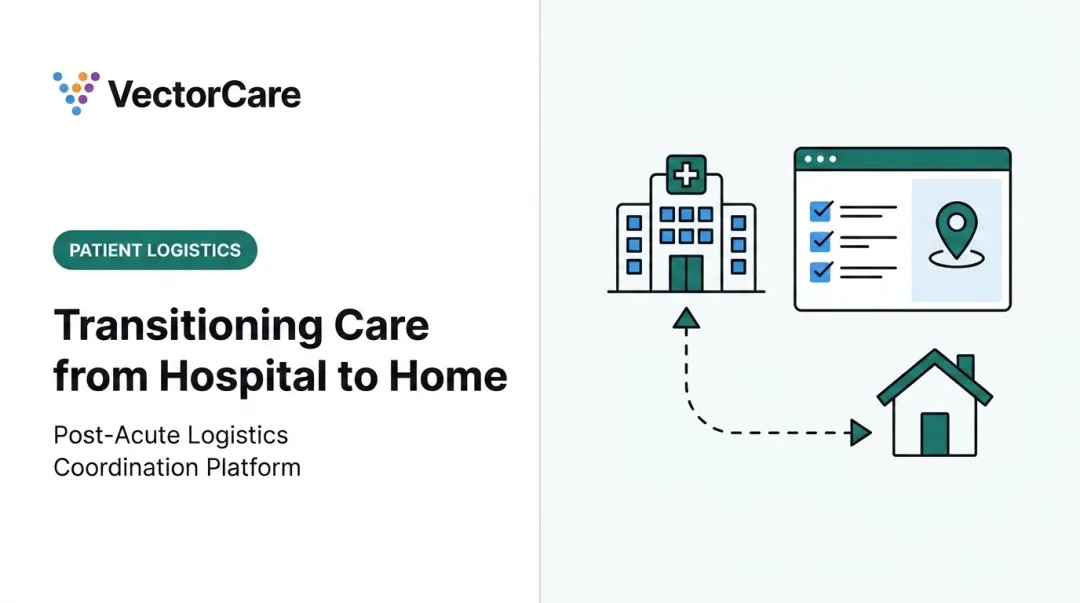
Hospital discharge is not the finish line — for many patients, it's the riskiest moment in their entire care episode. The handoff from acute hospital care to a post-acute setting is where clinical gains get preserved or lost, where medication errors surface, and where readmissions begin their slow build.
The numbers reflect this clearly. According to Vizient's Clinical Data Base, patients discharged to post-acute care (PAC) facilities or home health face an approximately 20% readmission rate within 30 days — compared to just 8.8% for patients discharged to self-care. Meanwhile, MedPAC reports the overall risk-adjusted readmission rate for Medicare fee-for-service beneficiaries reached 15.4% in 2024, edging upward from the prior year.
This article breaks down what transitions of care and post-acute care actually mean, why they fail so often, and what it takes to fix them.
Key Takeaways:
- ~20% of patients discharged to PAC settings are readmitted within 30 days (Vizient)
- Medication errors are among the most common — and preventable — failures at hospital discharge
- Effective transitions rest on three pillars: information transfer, care coordination, and caregiver engagement
- Unified logistics platforms — covering transport, home health, and DME — measurably cut delays
- Real-time visibility across the care continuum is now a core requirement under value-based care models
What Is Transitions of Care in Post-Acute Settings?
Transitions of Care Defined
A transition of care occurs when a patient moves between healthcare units or settings that offer different levels of care — from an ICU to a step-down unit, or from an acute hospital to a skilled nursing facility. Each move is a distinct clinical event, carrying real risk of dropped information, medication discrepancies, and adverse outcomes.
Post-acute care (PAC) refers to the care provided after a hospital stay — spanning intensive rehabilitation, maintenance care, and end-of-life support. Which setting a patient enters depends on their clinical complexity and functional status:
- Skilled nursing facilities (SNFs) for patients needing daily clinical oversight and therapy
- Inpatient rehabilitation facilities (IRFs) for intensive, multi-hour daily therapy
- Home health agencies (HHAs) for patients stable enough to recover at home with periodic visits
- Long-term acute care hospitals (LTACHs) for medically complex patients requiring extended acute-level care
Post-Acute Transitional Care: The High-Risk Window
"Post-acute transitional care" refers to the structured process of discharging a patient with ongoing complex needs to either a home-based or facility-based setting. This window carries elevated risk because:
- Multiple organizations (hospital, transport provider, SNF or HHA, DME supplier, payer) are involved simultaneously
- Communication happens across systems that don't talk to each other
- Clinical information frequently arrives incomplete or late at the receiving setting
The scale of this challenge is significant: 41% of Medicare fee-for-service hospital discharges in 2023 were followed by some form of PAC. That volume makes post-acute transitions one of the highest-stakes workflows in healthcare — and one of the most likely to break down without structured coordination.
The Post-Acute Care Continuum: Understanding Your Options
PAC spans a range of settings, from fully facility-based to fully home-based. Knowing which setting fits a patient's needs is a clinical decision in its own right.
Facility-Based PAC Settings
Two primary options exist for patients who cannot safely return home immediately after discharge:
- Skilled Nursing Facilities (SNFs): The largest share of facility-based PAC, particularly for patients 65 and older. SNFs provide nursing care, physical therapy, and daily medical oversight.
- Long-Term Acute Care Hospitals (LTACHs) and Inpatient Rehabilitation Facilities (IRFs): Higher clinical intensity settings for patients with complex or prolonged recovery needs.
Together, these settings absorb a significant share of post-acute volume: Vizient data shows 12% of inpatient discharges go to facility-based PAC. Septicemia is the single largest driver of PAC discharges — and patients headed to facility-based settings average 8.9 days in the hospital before discharge, versus just 3.7 days for patients going home to self-care.
Home-Based PAC Settings
Home-based PAC is the fastest-growing segment, accounting for 14% of inpatient discharges and expanding faster than facility-based care. Vizient projects 31% PAC volume growth over the next decade, driven largely by home-based services.
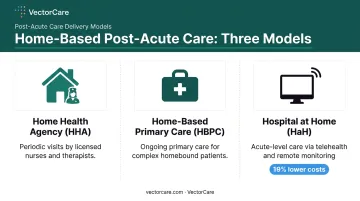
Home-based care breaks into three models:
- Home Health Agency (HHA) care — licensed nurses, therapists, and home health aides who visit patients at home
- Home-Based Primary Care (HBPC) — for medically complex, homebound patients who need ongoing primary care in their residence
- Hospital at Home (HaH) — hospital-level acute care delivered at home using telehealth and remote monitoring; peer-reviewed research (2012) shows 19% lower costs than comparable inpatient care
Why Transitions of Care Break Down — and What It Costs
Fragmented communication sits at the center of almost every transition failure. Hospitals, SNFs, home health agencies, DME suppliers, and payers operate in silos — and discharge planners are left bridging those gaps by phone and fax, managing dozens of patients at once with tools that can't keep up.
The Information Gap
From the patient's perspective, the process is opaque. A paper list of post-acute providers is common — with none of the context patients actually need:
- Quality ratings or performance data
- Real-time bed availability
- Proximity to family or preferred location
That absence of information undermines informed choice and delays placement.
The Clinical Toll
The data on what goes wrong during transitions is stark:
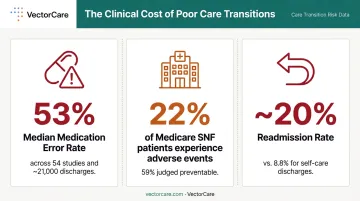
- A systematic review of 54 studies and nearly 21,000 discharges found a median medication error rate of 53% in patients transitioning from hospital to community settings, with unintentional discrepancies at 50% and adverse drug events at 19%
- 22% of Medicare beneficiaries experience an adverse event during a SNF stay, with another 11% experiencing temporary harm — and 59% of those events judged preventable (OIG)
- Readmission rates for PAC patients (~20%) are more than double those for patients discharged to self-care (8.8%)
These aren't random failures. They cluster — and the patients absorbing the worst outcomes are often those with the least capacity to navigate a broken system.
The Equity Dimension
Access gaps deepen clinical risk. Medicare beneficiaries who are Black, Hispanic, or lower income are less likely to receive care from high-quality home health agencies. Uninsured patients have significantly lower odds of SNF discharge after trauma — often not because of clinical reasons, but because of access limitations.
The Operational Cost
Coordination failures aren't just a clinical problem — they're a financial one. VectorCare data indicates that automated patient logistics platforms can deliver over $500,000 annually for a 250-bed hospital with 25 daily transports. Every day a patient waits in an occupied bed for a logistics decision is a day those costs accumulate — and a day that bed isn't available for the next admission.
Three Core Components of a Strong Post-Acute Care Transitions Strategy
Communication and Information Transfer
The first component is structured, standardized handoff. Clinical summaries, medication reconciliation results, pending lab findings, follow-up instructions, and caregiver training requirements all need to accompany the patient to the receiving setting — not follow three days later.
The 53% median medication error rate cited above is largely traceable to gaps here. When the receiving provider doesn't have complete information, they're making decisions blind.
Two things help close this gap:
- Standardized clinical assessment tools reduce variability at the point of discharge referral
- FHIR-based interoperability enables real-time patient data access across settings, though research makes clear that data availability alone doesn't reduce readmissions. It has to be paired with workflow accountability.
Care Coordination and Follow-Up
Active post-discharge follow-up is the second component. Transitional care management (TCM) protocols require:
- Patient contact within 2 business days of discharge (per CMS billing requirements)
- Medication review and reconciliation by the time of the first face-to-face visit
- Symptom monitoring and clear escalation pathways for deteriorating patients
But follow-up is only part of coordination. The logistics have to align, too:
- Transport arranged and confirmed
- DME delivered before the patient arrives home
- Home health start date aligned with discharge date
- Outpatient follow-up appointment scheduled before the patient leaves the hospital
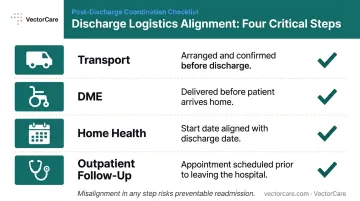
Misalignment in any one of these creates bottlenecks that extend length of stay or trigger preventable readmissions — and high-risk conditions like heart failure, COPD, and septicemia demand the most intensive follow-up protocols of all.
Patient and Caregiver Engagement
Patients and caregivers need to be active participants in the transition plan, not passive recipients of discharge paperwork.
Research found that among 1,217 community-dwelling Medicare home health recipients, those with unmet caregiver training needs were approximately twice as likely to use acute care during home health. Discharge education on medications, warning signs, self-care tasks, and follow-up schedules is a clinical safety intervention with measurable consequences when it's skipped.
The transition plan also needs to account for social determinants:
- Who lives with the patient?
- Can the patient manage daily activities independently?
- Is transportation available for follow-up appointments?
- What is the patient's cognitive status?
Patients with limited social support are among the highest-risk populations for adverse events post-discharge. Any transition strategy that ignores these factors is incomplete.
How Technology Is Redefining PAC Coordination
As VectorCare CEO David Emanuel has observed, patient logistics is an infrastructure problem — not a scheduling problem. Legacy workflows built on phone calls, faxes, and paper lists cannot handle the coordination complexity of routing patients across multiple care settings simultaneously.
EHR Integration as the Foundation
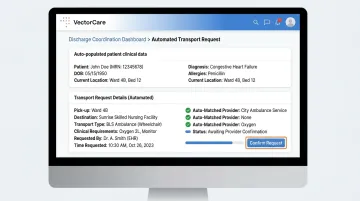
Platforms built on **SMART on FHIR standards** embed directly into clinical workflows. Rather than requiring discharge planners to toggle between four to six systems per transition, they initiate requests from inside the EHR — with patient data automatically extracted and transmitted to receiving providers.
VectorCare's SMART on FHIR integration with Epic, for example, automatically populates transport and transfer requests with demographics, encounter details, diagnoses, vital signs, and insurance coverage — eliminating manual data entry and ensuring the receiving setting has complete clinical information from the moment the request is sent.
In practice, this kind of EHR-embedded automation has reduced transport scheduling time from approximately 31 minutes by phone to under 3 minutes per request — roughly a 90% reduction.
Automation and AI in Dispatch and Coordination
Automated dispatching tools — like VectorCare's Automated Dispatching Intelligence (ADI) — remove the manual burden of selecting providers, broadcasting requests, and confirming logistics. In one documented deployment, a large California payer automated its patient logistics across roughly 800,000 dialysis trips in 2020, realizing over $22 million in annual savings.
By 2025, VectorCare's ADI had saved healthcare systems over 100,000 hours of administrative coordination time — freeing case managers to focus on clinical decision-making rather than phone-based logistics.
Those time savings matter beyond operations. When coordinators aren't managing phone queues, they can engage in the clinical oversight that actually prevents readmissions — including AI-supported risk identification and remote patient monitoring.
Real-Time Visibility as a Value-Based Care Requirement
For health systems operating under value-based care contracts and subject to Hospital Readmissions Reduction Program penalties (which carry a maximum 3% payment reduction), real-time visibility into patient status post-discharge is no longer optional.
Proactive transition oversight requires knowing — in a single system — where each patient is, what the next care step is, and whether every handoff has been confirmed. Reactive readmission management is no longer a viable strategy under these payment models. Vizient identifies AI, remote monitoring, and coordinated PAC capacity as the core components health systems need to compete under value-based contracts.
Frequently Asked Questions
How long do patients stay in post-acute transitional care?
Length of stay varies by setting and clinical need. Medicare covers up to 100 SNF days per benefit period; home health uses 60-day certification periods. Hospital at Home stays are typically shorter, comparable to acute inpatient stays. Clinical complexity — not a fixed timeline — determines the right duration.
What is an example of a post-acute care transition?
A 75-year-old patient undergoes hip replacement, spends four days in an acute hospital, transfers to a skilled nursing facility for three weeks of physical rehabilitation, then transitions to home health for continued therapy. This multi-step sequence is standard for Medicare beneficiaries managing complex recoveries.
Is a Transitional Care Unit (TCU) the same as post-acute rehab?
No. TCUs offer short-term, medically monitored care — often within a SNF — for patients not yet stable enough to go home. Post-acute rehab (IRF or SNF rehab) focuses specifically on functional recovery and therapy goals. Both serve recently discharged patients, but differ in intensity and clinical focus.
What are the three core components of a post-acute care transitions strategy?
Three components drive effective transitions:
- Information transfer: Structured communication and complete documentation at discharge
- Care coordination: Active post-discharge follow-up to catch early warning signs and align logistics
- Patient engagement: Ensuring patients and caregivers can safely execute the care plan
What is the biggest risk for patients during a hospital-to-post-acute care transition?
Medication errors and discrepancies affect more than half of transitioning patients, making them the most common single risk. Incomplete clinical handoffs and failure to establish timely follow-up compound the danger — together, these factors drive the ~20% readmission rate among PAC-discharged patients.
How does technology reduce readmissions during transitions of care?
Technology reduces readmissions by automating coordination tasks (transport, DME, home health scheduling), enabling real-time information sharing through EHR integrations, and providing visibility into patient status post-discharge so care teams can intervene before deterioration becomes an emergency.