Introduction
The moment a patient walks out of a hospital is often treated as the finish line. It's actually the start of the riskiest part of their recovery.
Clinical responsibility shifts from a controlled hospital environment to a home that may not have the equipment, support, or coordination needed for safe recovery. Much of that risk traces back to what happens (or doesn't happen) in the hours surrounding discharge, not during the inpatient stay itself.
This post breaks down the discharge process step by step, covering:
- Types of hospital discharge
- What a safe home transition requires
- Where these transitions typically fall apart
- How coordination technology is closing the gap
Key Takeaways
- Discharge involves a coordinated chain of handoffs across physicians, case managers, transport, home health, and DME teams.
- Poor coordination during discharge, not inpatient care, drives most preventable readmissions.
- Discharge destination, home or facility, determines which logistics need arranging and how quickly.
- Medication errors affect over half of discharged patients, making reconciliation a top priority.
- Digital coordination platforms are replacing phone-based workflows to reduce delays and readmissions.
Why Hospital-to-Home Transitions Are High-Stakes
Discharge is a chain of coordinated actions that has to happen in sequence, on a tight clock:
- Physician sign-off on medical stability
- Case management and social work coordination
- Transport arrangement matched to mobility level
- Home health agency referral and confirmation
- DME ordering and delivery
- Pharmacy fulfillment and medication reconciliation
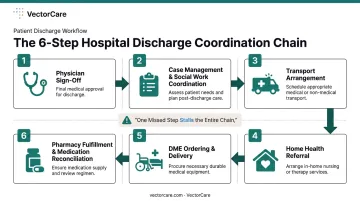
Miss one link, and the entire chain stalls, putting both patient safety and hospital finances on the line.
CMS's Hospital Readmissions Reduction Program (HRRP) caps payment reductions at 3% of a hospital's base operating DRG payments. For FY2022, CMS estimated $521 million in reduced payments across 2,499 hospitals, according to KFF's analysis of a decade of readmissions penalties.
Discharge delays compound this problem in a less obvious way: bed capacity. When a patient who's medically ready to leave can't leave because transport, home health, or DME isn't confirmed, that bed stays occupied. Incoming patients back up in the emergency department, and hold times climb.
Most of this fragmentation traces back to how post-acute logistics get arranged. Transport, home health, and DME are typically coordinated through separate phone calls, faxes, and manual tracking, each managed by a different person with no shared visibility into the others' status.
The Hospital Discharge Process: What Happens Step by Step
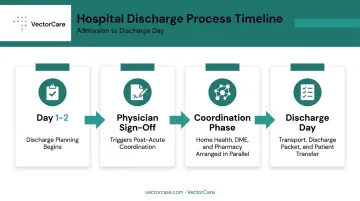
Discharge Planning Begins Before Discharge Day
Effective discharge planning doesn't start on the day of discharge. It starts near admission, often within the first day the patient is in a bed.
Case managers and social workers begin assessing the patient's home situation, support network, and equipment needs days in advance. This early groundwork is what prevents the day-of scramble that leads to delays.
Within the first 24 to 48 hours after admission, these teams start identifying caregiver availability, home safety risks, and equipment needs like ramps or hospital beds. Waiting until the final day to address these gaps is what causes late discharges, extended lengths of stay, and frustrated families.
Physician Sign-Off Triggers Post-Acute Coordination
The formal process kicks off when the attending physician determines the patient is medically stable and signs the discharge order. That single signature triggers a cascade:
- Pharmacy review of discharge medications
- Nursing preparation of discharge instructions
- Transport coordination
- Final confirmation of post-acute services
That same signature also sets post-acute coordination in motion. Before the patient leaves, the hospital arranges:
- Follow-up appointment scheduling
- Home health agency referrals (skilled nursing, PT, OT)
- DME orders such as oxygen, a hospital bed, or mobility aids
- Prescription fulfillment
Patients or families are often asked to choose a certified home health agency (CHHA) before they walk out the door, sometimes with only a short list of options and little time to decide.
Discharge Day Logistics
On discharge day, the nursing team hands over a discharge packet covering medications, follow-up appointments, and wound care instructions. The patient is transported by wheelchair to the exit, then home via family or arranged transport.
Transport is where things frequently go wrong. Wrong vehicle type, late arrivals, or unconfirmed bookings are among the most common causes of discharge-day delays. Case managers who confirm the mobility level (ambulatory, wheelchair, or stretcher) well before discharge tend to avoid this bottleneck entirely.
Confirming these details even one day early, rather than the morning of discharge, often means the difference between smooth transport and a multi-hour wait.
Types of Hospital Discharge: Understanding Your Options
Not every discharge looks the same, and the destination determines almost everything about what needs to be arranged. The main types are:
- Discharge to home, with or without home health services
- Discharge to a skilled nursing facility (SNF)
- Discharge to inpatient rehabilitation
- Discharge to a long-term acute care hospital (LTACH)
- Discharge against medical advice (AMA)
Home discharge and facility discharge move at very different speeds. Home discharge has no receiving-facility paperwork or acceptance process, so it can happen quickly once a physician deems it safe.
Facility discharge is a different animal. It requires paperwork, insurance clearance, and formal acceptance from the receiving facility's admissions team.
| Discharge Type | Acceptance Needed | Transport Requirement | Typical Speed |
|---|---|---|---|
| Home | None | Home health, DME, and transport arranged in parallel | Fast — same day once cleared |
| SNF / Rehab / LTACH | Insurance clearance + facility acceptance | Matched to mobility level (ambulatory, wheelchair, stretcher) with advance notice | Slower — facility-dependent |
The logistics diverge from there, shaping everything from transport type to how far in advance arrangements need to be made.
What a Safe Transition Home Requires
Home Environment Readiness
The home itself has to be prepared, not just the patient. That means identifying fall hazards, confirming adaptive equipment like grab bars or a shower chair is in place, and verifying access to food, medications, and utilities. Rehabilitation staff typically assess equipment needs during the hospital stay, well before discharge.
Home Health and Skilled Care Services
Certified Home Health Agencies (CHHAs) coordinate a nursing evaluation visit the day after discharge to confirm the patient has what they need. They also arrange skilled short-term services:
- Physical therapy
- Occupational therapy
- Speech therapy
- Skilled nursing
This is distinct from personal care (bathing, dressing, meal prep), which runs through a licensed home care services agency (LHCSA) instead.
Medication Management and Follow-Up Care
The hospital sends the patient home with a reconciled medications list, filled prescriptions, and scheduled follow-up appointments. This step matters more than most people realize.
According to a systematic review of postdischarge medication errors published in PMC, the median error rate reaches 53%, and unintentional medication discrepancies affect a median of 50% of patients. Medication mistakes during the transition are among the most preventable and most common contributors to readmission.
Transport Coordination
Transport has to match the patient's actual mobility level (ambulatory, wheelchair, or stretcher) to avoid failed pickups or unsafe transfers. Booking 24 to 48 hours ahead of the anticipated discharge date reduces last-minute scrambling. For private-pay patients, same-day NEMT options exist as a backup when timing is tight.
Why Transitions Break Down: Common Coordination Failures
Most failed transitions trace back to a handful of repeat offenders:
- Discharge summaries that arrive late, or never, at the receiving provider
- Transport booked for the wrong service level
- Home health not confirmed before the patient arrives home
- DME that shows up after the patient already needs it
- Prescriptions that aren't filled before the patient leaves
The common thread is manual, phone-based coordination. A case manager calls transport, then home health, then the DME supplier, each with no shared visibility into the others. Delays and dropped handoffs become nearly impossible to track in real time.
That same lack of shared visibility becomes especially damaging when it disrupts communication between the inpatient team and outpatient providers. If the primary care physician or home health nurse never receives the discharge summary in time, continuity of care breaks, and the risk of a preventable readmission rises sharply.
How Technology Is Streamlining Hospital-to-Home Care Coordination
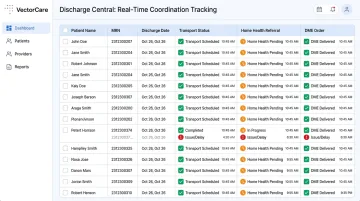
The shift underway is from siloed, phone-based coordination to integrated digital platforms that manage transport, home health referrals, and DME orders in one place. Instead of separate calls and faxes, case managers get real-time visibility into where each piece of the discharge plan actually stands.
EHR integration is central to this. When patient data flows directly from the hospital's EHR into a coordination platform, discharge teams stop re-entering information by hand. This cuts errors and shortens the time from discharge order to patient departure.
VectorCare is one example of this infrastructure in practice. The platform unifies transport coordination, home health, and DME logistics into a single system used across the healthcare industry, with three features doing much of the heavy lifting:
- A.D.I. (Automated Dispatching Intelligence), which automates provider dispatching and reduces scheduling time by roughly 90% — from about 31 minutes by phone to under 3 minutes
- SMART on FHIR Epic integration, which pulls patient data directly into the workflow so coordinators aren't re-keying information they already have on file
- Real-time tracking dashboards, which give case managers instant visibility into every step of the discharge plan
For hospitals, the business case is straightforward: fewer readmission penalties, faster bed turnover, and less administrative burden on case management staff who would otherwise spend their shift on the phone instead of with patients.
Frequently Asked Questions
What is the typical hospital discharge process?
Discharge planning begins before the discharge date, involves physician sign-off, and requires arranging home health, DME, and transport. It ends with the nursing team providing a discharge packet before the patient is safely transported home.
How long can it take to get discharged from the hospital?
The process on discharge day itself can take several hours after the physician signs the order, due to pharmacy, nursing, and transport coordination. Patients discharged to a facility may wait additional days for acceptance and paperwork clearance.
What are the five types of hospital discharge?
The five main types are:
- Discharge to home, with or without home health support
- Discharge to a skilled nursing facility
- Discharge to inpatient rehabilitation
- Discharge to a long-term acute care hospital
- Discharge against medical advice
What services are typically arranged before a patient is discharged home?
Hospitals typically arrange home health agency referrals, DME delivery, medication reconciliation and prescription fulfillment, follow-up appointment scheduling, and transport coordination matched to the patient's mobility level.
What are the most common reasons patients are readmitted after hospital discharge?
Leading contributors include medication errors, inadequate follow-up care, infections, lack of home health support, and the care team not receiving a timely discharge summary.
How can hospitals reduce delays in the hospital-to-home transition?
Starting discharge planning at admission, using integrated coordination platforms such as VectorCare for transport and home health, and ensuring EHR data flows to post-acute providers without manual re-entry are among the most effective strategies.