Introduction
Healthcare workers spend enormous amounts of time on tasks that have nothing to do with patient care. Physicians averaged 57.8 hours of work per week in 2024, with roughly 13 of those hours consumed by indirect care activities like documentation and administrative coordination — not patient contact. Administrative burden ranks as the top cause of burnout for 2 in 5 primary care physicians.
The result is predictable: clinicians buried in paperwork, care coordinators managing disconnected systems, and patients falling through gaps between care settings.
That's the environment AI agents are designed to work in. Unlike tools that generate outputs and wait for someone to act, AI agents take action — autonomously completing multi-step tasks across scheduling, coordination, documentation, and communication without requiring a human prompt at each step.
This article explains what healthcare AI agents are, how they work, where they're being applied, and what distinguishes genuinely agentic systems from the chatbots and copilots often marketed alongside them.
Key Takeaways
- AI agents perceive inputs, reason through them, and take autonomous action across connected systems — no human prompt required at each step
- Healthcare use cases span clinical documentation, patient intake, prior authorization, and post-discharge logistics
- Ambient AI scribes have cut documentation time by 28% in production environments
- Most healthcare AI agents keep humans in the loop at high-stakes decision points; full autonomy is still emerging
- Patient logistics coordination remains one of the highest-impact, lowest-automation opportunities for AI agents in healthcare
What Are AI Agents for Healthcare?
The Core Definition
AI agents for healthcare are software systems that can perceive inputs — text, voice, EHR data, sensor streams — reason through them using large language models or rule-based logic, and take action across integrated systems without requiring human intervention at each step.
That last part is the critical distinction. Traditional software waits for a command. An AI agent monitors its environment, responds to triggers, and executes tasks on its own.
Healthcare AI agents don't function as isolated tools. They embed directly into clinical and operational workflows — patient registration, care coordination, discharge planning, transport logistics — pulling simultaneously from internal sources (EHRs, scheduling systems) and external ones (clinical guidelines, payer databases).
What Makes a System "Agentic"
A static AI model produces an output and stops. An AI agent does more:
- Monitors its environment for relevant changes or triggers
- Adjusts its behavior based on feedback from connected systems
- Chains multiple actions together to complete a goal
A practical example: an AI agent identifies a patient who meets discharge criteria, locates an appropriate transport provider, coordinates timing with the receiving facility, and notifies the care team — all without a coordinator manually managing each handoff.
Supervised Autonomy in Practice
Most current AI agents operate with humans in the loop at key decision points. This is by design. Regulatory frameworks — including FDA guidance on AI/ML medical devices and HIPAA requirements — create legitimate guardrails, and the stakes of clinical decisions make physician or coordinator oversight non-negotiable for most workflows.
Complex deployments layer this further through orchestration: multiple specialized agents work toward a shared goal, with outputs feeding into each other across a unified workflow. A coordinated discharge, for example, might involve:
- One agent handling clinical documentation updates
- Another managing logistics coordination with transport providers
- A third sending patient and family communication at each status change
How Do Healthcare AI Agents Work?
The Operational Loop
When a healthcare AI agent receives an input — a physician voice note, an EHR trigger, a patient form submission — it executes a rapid sequence:
- Perceive — encode the input (audio, text, structured data)
- Query — retrieve relevant data from connected knowledge bases
- Reason — generate a response or action using LLMs or rule-based logic
- Act — write to an EHR, trigger a workflow, send a notification
- Log — maintain an audit trail of every action taken
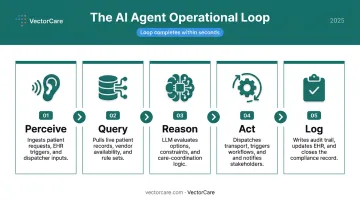
This loop runs within seconds, not minutes.
Six Functional Components
Most healthcare AI agents rely on a common architecture:
| Component | Function |
|---|---|
| Perception | Receives audio, text, or structured data inputs |
| Reasoning | Applies LLMs or rule-based logic to interpret inputs |
| Action | Writes to EHRs, triggers downstream workflows |
| Memory | Stores patient data and context across interactions |
| Learning | Improves over time through clinician validation |
| Utility | Measures performance against defined outcomes |
Infrastructure and Compliance Requirements
Healthcare AI agents require substantial cloud infrastructure. When agents handle protected health information, HIPAA-compliant architecture is non-negotiable. That means:
- Business Associate Agreements with every system component that touches PHI
- Encryption in transit and at rest
- Audit logging that records all system activity
- Documented data retention and disposal policies
HIPAA's Security Rule mandates these audit controls by statute. A proposed 2024 NPRM would extend them further, adding mandatory MFA and explicit encryption standards. Deployments that defer compliance to post-launch face both regulatory exposure and remediation costs that dwarf upfront implementation.
Key Use Cases of AI Agents in Healthcare
Clinical Documentation Automation
Ambient AI scribes listen to physician-patient encounters (with consent), extract key clinical details, and auto-populate structured notes directly into the EHR. A 2026 study published in PubMed documented a 28% reduction in documentation time among clinicians using ambient AI scribes. A separate 2024 study found physician burnout rates dropped from 51.9% to 38.8% following ambient AI adoption.
These aren't marginal gains. For physicians already averaging 13 hours weekly on indirect care, cutting documentation burden by more than a quarter has real impact on both retention and care quality.
Patient Access, Intake, and Scheduling
AI agents can collect patient histories, verify insurance eligibility, manage appointment scheduling and reminders, and route patients to appropriate care settings before they arrive.
Revenue Cycle and Prior Authorization
Prior authorization is a significant drain. According to the AMA's 2025 survey, physicians complete roughly 40 prior authorization requests per week, consuming approximately 13 hours of physician time. Manual PA processing costs around $13.40 per transaction.
AI agents address this by:
- Retrieving required documentation automatically
- Drafting prior authorization submissions
- Suggesting billing codes and flagging missing records
- Drafting denial appeals (81.7% of appeals succeed when pursued)
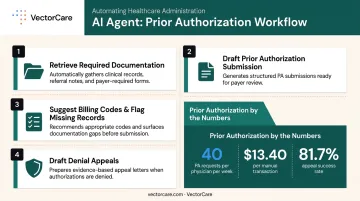
At $13.40 per manual transaction, even modest automation volume compounds into meaningful savings for health systems running on thin margins.
Clinical Decision Support
AI agents can analyze lab results, imaging findings, and patient histories alongside current medical literature to surface relevant recommendations for clinicians. These are decision-support tools — physician judgment remains the final authority. The FDA distinguishes between assistive and autonomous AI, and non-device clinical decision support must allow independent review of recommendations before action.
Patient Logistics and Care Coordination
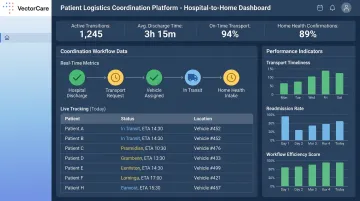
This is one of the highest-impact and least-automated use cases in healthcare. Coordinating patient transport, discharge planning, home health setup, DME delivery, and interfacility transfers involves dozens of sequential steps across disconnected parties — hospitals, transport providers, receiving facilities, payers, and home health agencies.
Manual coordination relies on phone calls, faxes, and status checks that introduce delays and errors at every handoff. AI agents can automate request processing, provider matching, and real-time status updates at a scale and speed that manual workflows can't approach.
VectorCare's A.D.I. (Automated Dispatching Intelligence) is a concrete example of this applied to patient logistics. Key performance benchmarks include:
- Processes 3.23 patient logistics requests per minute (2024)
- Has sent 2.3M provider broadcasts
- Saved healthcare systems over 100,000 hours in 2025 by eliminating manual coordination tasks
VectorCare's platform serves 2,500+ healthcare facilities nationwide. Its SMART on FHIR integration embeds directly inside Epic EHR workflows, pulling patient data automatically and triggering logistics actions without coordinators leaving the clinical system.
The Benefits of AI Agents for Healthcare Organizations
Reduced Administrative Burden and Clinician Burnout
Nurses spend 15% of their shifts on documentation. Physicians devote 13 hours weekly to indirect care. AI agents eliminate the repetitive tasks — data entry, form completion, status calls — that consume this time without contributing to patient outcomes.
Redistributing even a fraction of this time toward direct care improves both care quality and staff retention, two operational challenges that cost the US health system billions annually in turnover and inefficiency.
Improved Care Coordination and Reduced Delays
Automated handoffs between care settings — hospital discharge to transport to home health — reduce the communication gaps that extend length of stay, trigger readmissions, and cause adverse events. Research shows that timely outpatient follow-up within 30 days reduces readmission risk by 32%. AI agents that ensure post-discharge logistics are completed without gaps directly support this outcome.
Cost Savings and Revenue Protection
Administrative spending accounts for 15–30% of total US medical costs, representing $285–570 billion in annual waste according to Health Affairs analysis. Electronic workflows in areas like prior authorization and claims processing offer an estimated $18.3 billion in savings potential.
AI agents work on two fronts simultaneously: protecting revenue by reducing claim denials and coding errors, and reducing operating costs by automating labor-intensive coordination workflows.
Better Patient Outcomes Through Continuity
When post-discharge logistics — transport, equipment, follow-up scheduling — are completed without gaps, patients arrive at the next care setting on time and prepared. For value-based care arrangements, this matters in concrete terms: readmission rates and care continuity directly affect reimbursement.
The downstream effects of automated logistics include:
- Lower readmission rates when patients reach follow-up care on schedule
- Reduced length of stay through faster, coordinated discharge execution
- Fewer adverse events tied to handoff gaps between care settings
- Stronger performance on value-based reimbursement benchmarks
AI Agents vs. Chatbots vs. Copilots: What's the Difference?
Three Distinct Tiers
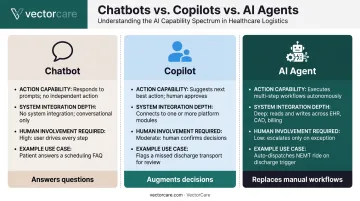
These terms are often used interchangeably in marketing materials, but they describe meaningfully different capabilities:
Chatbots operate within fixed conversational scripts and respond to predefined inputs. They can answer FAQ about clinic hours or collect basic intake information, but they cannot take action across systems.
Copilots assist humans by surfacing information or drafting content, but require human action to execute. A clinical documentation copilot drafts a note for physician review. The physician decides whether to accept, edit, or reject it.
AI agents go further. They autonomously execute multi-step workflows, interact with multiple systems, and adapt behavior based on outcomes. Using the same documentation example: an AI agent listens to the encounter, drafts the note, updates the EHR, codes the visit, and flags a follow-up task — without waiting for human approval at each step.
Why This Distinction Matters for Buyers
That operational gap between tiers is exactly where purchasing decisions go wrong. Organizations investing in copilot technology while expecting AI agent outcomes will be disappointed. The key differentiators are execution autonomy and system integration depth, not conversational fluency.
Many products marketed as "AI agents" function more like copilots. Before purchasing, ask directly: does this solution take autonomous action across systems, or does it generate outputs that a human must then execute? The answer determines whether you're buying automation or an advanced drafting tool.
What to Look for in a Healthcare AI Agent
HIPAA Compliance and Data Governance
Every component of the agent stack that touches PHI must be covered by a Business Associate Agreement. Non-negotiable requirements include:
- Audit logging of all system activity
- Documented data retention and encryption policies
- Clear documentation of where PHI is processed and stored
Ask vendors specifically about PHI handling architecture — not just whether they're "HIPAA compliant" as a general claim.
EHR and System Integration Depth
Start by asking whether the agent connects natively to your specific EHR via FHIR/HL7 APIs or requires custom development per integration. The distinction matters: pre-built connectors reduce deployment time and ongoing maintenance burden — custom builds add cost and timeline risk.
Key integration questions to evaluate:
- Does the vendor support your specific EHR (for example, Epic)?
- Is the connection a genuine SMART on FHIR integration, or a basic API wrapper?
- Does integration require modifying your EHR's core codebase?
Epic holds 51.5% of US acute care beds, so SMART on FHIR support is often table stakes. VectorCare's SMART on FHIR apps for Epic, for instance, enable native Epic integration without touching the EHR's core codebase — a concrete example of what true deep integration looks like in practice.
Human Escalation and Oversight Design
Every credible healthcare AI agent must have a clear escalation path to human review for high-risk or ambiguous situations. Before deployment, understand:
- How does the agent determine when to escalate?
- How is context preserved during handoff to a human?
- What happens if the agent cannot complete a task?
If a vendor can't answer these questions with specifics — defined thresholds, documented handoff protocols, fallback workflows — that's a design gap, not a documentation gap. Escalation architecture should be built in from the start, not retrofitted after deployment.
Frequently Asked Questions
What is the difference between an AI agent and a healthcare chatbot?
Chatbots respond within scripted conversational flows and cannot act on external systems independently. AI agents take autonomous action across integrated platforms, completing multi-step workflows like scheduling, documentation, and logistics coordination without waiting for human input at each stage.
Are AI agents in healthcare HIPAA compliant?
Compliance depends on the vendor and implementation. Agents built specifically for healthcare are typically designed with HIPAA compliance from the ground up, but general-purpose AI platforms may require specific configuration. Always verify BAA availability and confirm exactly where PHI is processed and stored before deployment.
How do AI agents integrate with EHR systems like Epic?
Integration typically occurs via FHIR/HL7 APIs, vendor-specific APIs, or SMART on FHIR apps embedded directly in the EHR. The depth and ease of integration varies significantly by vendor and platform — pre-built SMART on FHIR apps offer faster deployment and lower maintenance overhead than custom integrations.
Can AI agents replace healthcare workers?
Current AI agents automate repetitive, rule-based tasks — not clinical judgment or patient relationships. Human escalation paths are standard across credible implementations. The goal is freeing healthcare workers from administrative burden so they can focus on care, not replacing the people who deliver it.
What are the biggest challenges of implementing AI agents in healthcare?
The primary barriers include integration complexity, HIPAA-compliant architecture across the full agent stack, and validating performance before expanding autonomy. Organizations that underestimate change management with clinical staff typically see slower adoption regardless of technical quality.
How are AI agents specifically used in patient logistics and care coordination?
AI agents can automate the full patient logistics chain: matching patients to transport providers, managing scheduling, tracking real-time status, and coordinating across hospitals and receiving facilities. This eliminates the manual calls and handoffs that cause care transition delays, with direct impact on length of stay and readmission rates.