Introduction
Hospital administrators and transfer center coordinators struggle with a problem most industries never face: every vendor decision — NEMT, DME, home health, care coordination — carries a direct patient consequence. Vendor management process automation in healthcare is the practice of replacing those manual coordination tasks with software across the entire vendor lifecycle. It's a fundamentally different challenge than procurement automation in any other sector.
For hospital administrators, transfer center coordinators, payers, and skilled nursing facilities, a delayed vendor decision isn't a procurement inconvenience. It directly affects whether a patient goes home today or stays another night. That distinction matters enormously when you're weighing whether to invest in automation infrastructure.
This guide explains how vendor management process automation works end-to-end, why healthcare environments demand it specifically, and what separates effective implementations from expensive disappointments.
Key Takeaways
- Automation replaces phone calls, emails, and spreadsheet tracking with software-driven workflows across the full vendor lifecycle
- Poor vendor coordination contributes to prolonged hospital stays, readmissions, and care gaps — not just operational inefficiency
- Four stages drive the most automation value: vendor onboarding, intelligent dispatching, performance monitoring, and contract compliance
- EHR integration — including FHIR-based connections — is the data foundation that makes vendor automation reliable
- Routine tasks get automated; complex or non-standard vendor situations still require human judgment
What Is Vendor Management Process Automation?
Vendor management process automation uses technology to systematically handle every interaction within a vendor network — from intake and credentialing through dispatching, performance tracking, and compliance review — with minimal manual intervention.
The intended outcome is specific: the right vendor gets engaged at the right time, under the right terms, with full visibility into whether obligations are being met. And it does this consistently, at scale.
How This Differs from Procurement Automation
These two concepts are frequently conflated, and confusing the two leads to scoping failures and misaligned implementations.
| Focus Area | |
|---|---|
| Procurement automation | Purchasing decisions: sourcing goods, routing approvals, generating purchase orders |
| Vendor management process automation | Ongoing operational relationships after selection — performance accountability, compliance currency, contract management |
In healthcare, vendors don't deliver products. They deliver patient care services. The operational stakes are categorically different from standard procurement:
- A transport vendor arrives late and a patient misses a procedure
- A DME vendor ships the wrong equipment and a discharge is delayed
These aren't inconveniences — they're clinical failures with real consequences for patients and facilities.
Why Healthcare Organizations Need to Automate Vendor Management
The operational math alone makes manual vendor management untenable. A fully automated inpatient transport system piloted in 2020 processed 15,581 transfer requests in just 46 days — roughly 339 requests daily. No team of coordinators managing a phone list keeps pace with that volume without systematic support.
What Breaks Without Automation
Manual vendor management in healthcare produces predictable failures:
- Phone tag between discharge planners and transport vendors delays time-sensitive decisions
- Missed SLA windows go undocumented because no system captures them automatically
- Vendor performance issues accumulate untracked until they become serious relationship failures
- Staff time drains to administrative back-and-forth rather than patient care
A centralized coordination study published in 2023 found that structured flow management produced measurably more patient transfers and shorter lengths of stay — illustrating the downstream impact of better-coordinated vendor engagement.
The Compliance Burden Healthcare Creates
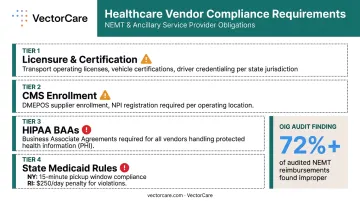
Healthcare vendor management carries a compliance dimension that other industries don't face:
- Transport vendors must maintain current licensure and vehicle certification
- DME suppliers require CMS DMEPOS enrollment, accreditation, and an NPI for each practice location
- Any vendor handling protected health information must operate under a signed HIPAA Business Associate Agreement
- State-specific Medicaid rules add another layer — Some state Medicaid programs define on-time NEMT pickup as within 15 minutes of schedule; other state brokerage contracts apply financial penalties per business day in liquidated damages for on-time failures
Manual tracking of these requirements across a large vendor network creates genuine audit exposure. An OIG audit of a large city's NEMT payments found that over 72% of the audited federal reimbursement amount was improper or undetermined — a direct consequence of inadequate documentation and authorization controls.
The Financial Case
Poor vendor coordination carries direct financial consequences beyond operational cost:
- The average hospital readmission costs $16,300 — 12.4% more than the average index admission
- CMS can reduce hospital payments by up to 3% under the Hospital Readmissions Reduction Program
VectorCare's A.D.I. (Automated Dispatching Intelligence) reduced transport request processing time from 31 minutes to under 3 minutes per request across documented customer deployments, saving more than 100,000 hours for healthcare systems and suppliers in 2025. At the volume healthcare organizations actually handle, those savings translate directly to staff capacity and care throughput.
When a patient needs transport within two hours, vendor selection cannot wait for a three-day approval chain. Automation replaces human-initiated workflows with event-driven triggers — a mechanism suited to real-world discharge coordination speed.
How Vendor Management Process Automation Works
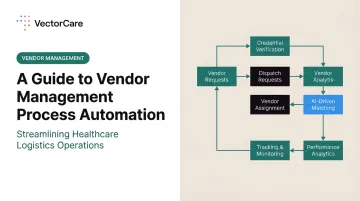
Most vendor management failures don't stem from bad vendors — they stem from fragmented handoffs between onboarding, selection, monitoring, and contract management. Automation connects these into a continuous, monitored loop. Here's how each stage works.
Step 1: Vendor Onboarding and Credentialing
Manual credentialing is a known bottleneck. Automation addresses it by:
- Collecting vendor documentation (licenses, insurance certificates, HIPAA agreements, accreditations) through a structured digital intake process
- Validating completeness and triggering approval workflows to appropriate stakeholders automatically
- Flagging expiry dates for renewal before documents lapse
- Maintaining an auditable record of every verification step
VectorCare's Trust module treats credentialing as a continuously monitored control set, not a one-time onboarding exercise. That distinction matters when vendor qualification is directly tied to regulatory compliance.
Step 2: Intelligent Vendor Selection and Dispatching
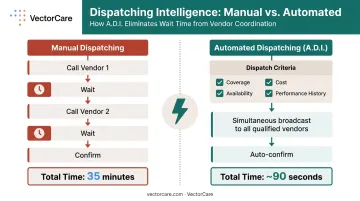
Once a service request enters the system, automation matches it to qualified vendors using predefined criteria:
- Geographic coverage
- Service type and vehicle capability
- Real-time availability
- Cost and contracted rates
- Historical performance
Manual dispatching works sequentially — one call, wait, next call. Automation broadcasts simultaneously to every qualified vendor in the network. VectorCare's A.D.I. processes requests and broadcasts to vendor networks, enabling genuine real-time engagement at scale. In documented use cases, this reduced scheduling from approximately 31 minutes by phone to under 3 minutes — a 90% reduction.
Step 3: Real-Time Performance Monitoring
Automation continuously captures vendor performance data against contractual benchmarks:
- On-time rates by vendor and service type
- SLA adherence across state-specific thresholds
- Response times and completion rates
- Exception and cancellation patterns
Scorecards generate without manual data entry. Alerts trigger when performance falls below threshold — before repeated exceptions become a vendor relationship failure or a compliance problem.
Step 4: Contract and Compliance Management
Automated contract management tracks:
- Renewal windows and rate review milestones
- Document expiry (insurance certificates, licenses, BAAs)
- Digital routing for contract reviews and approvals
- Centralized repository access for audit readiness
No contract lapses unnoticed. When documentation stays current automatically, audit readiness shifts from a quarterly scramble to an always-on state.
Key Factors That Affect Automation Effectiveness in Healthcare
Automation doesn't fail at the technology level — it fails at the implementation level. Three factors consistently determine whether a deployment gains efficiency or creates new bottlenecks.
EHR Integration Capability
Automation disconnected from the EHR forces manual data re-entry, which negates most of the efficiency gain.
HL7 SMART on FHIR defines the standard for secure, OAuth-based authorization and data exchange with EHR FHIR resources. When VectorCare's platform operates natively inside Epic via SMART on FHIR, patient demographics, encounter details, insurance coverage, and clinical conditions populate automatically at the point of service request — eliminating manual transcription and enabling A.D.I. to execute intelligent vendor selection without human data entry.
Without this integration layer, the platform would require significant manual input at every handoff, undermining speed, accuracy, and your ability to scale the program.
Data Quality and Vendor Network Standardization
Automation depends on structured, clean data. Organizations with inconsistent vendor records, missing credentialing information, or informal contracting practices must standardize those inputs before automation can function reliably.
According to Joint Commission and NQF quality measurement standards, automated reporting depends entirely on accurate, structured data inputs. In vendor management terms, the stakes are concrete:
- Duplicate vendor records cause split routing and inconsistent performance tracking
- Expired credentials bypass compliance checks when automation can't flag them
- Missing service territory definitions send requests to vendors who can't fulfill them
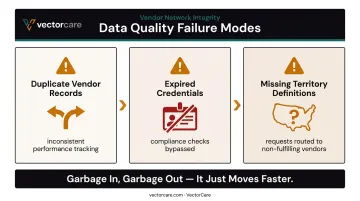
The "garbage in, garbage out" problem doesn't disappear with software. It moves faster.
Workflow Design and Configurability
Automation is only as good as the logic it enforces. Key questions:
- Can approval hierarchies be configured to match your organization's actual decision structure?
- Can vendor tiers and escalation rules be set without an IT ticket?
- Can operations teams modify workflows as contracts change?
No-code platforms that let operations staff design and adjust workflows directly reduce IT dependency and allow automation logic to stay current as vendor relationships evolve. Organizations that must route every workflow change through IT tend to end up with automation that reflects last year's contract terms, not current ones.
Common Issues and Misconceptions About Vendor Management Process Automation
Misconception: Automation Eliminates Human Judgment
Automation handles routine, repeatable tasks. It does not handle:
- Complex patient situations requiring clinical judgment about transport mode
- Vendor relationship issues that require conversation and negotiation
- Non-standard service requests that fall outside defined workflow parameters
- Exception management when primary vendors fail and escalation requires context
The goal is to free staff from administrative burden so they can focus on these higher-value decisions. When A.D.I. reduces scheduling from approximately 31 minutes to under 3 minutes per request — a 90% reduction — that time goes back to care coordination, not to processing the next broadcast manually.
Misconception: Automating One Stage Is Enough
Many organizations automate only onboarding and call it vendor management automation. It isn't. Partial automation creates new handoff problems at the boundaries between automated and manual steps.
For example: if onboarding is automated but dispatching remains manual, coordinators still spend time triaging requests against vendor lists they can't easily query for availability or performance history. The onboarding automation doesn't reduce that burden at all.
That's the core problem with piecemeal implementation: each stage touches the next, and manual gaps propagate downstream regardless of where automation starts. Effective vendor management automation requires whole-workflow analysis, not task-level fixes applied selectively.
When Automation Is the Wrong Immediate Answer
Automation is not always the right first step. Organizations that should pause before implementing:
- Manage fewer than a handful of vendors, where manual coordination is sufficient
- Have no defined vendor management process — staff handle vendors informally and inconsistently
- Operate with inconsistent contract terms across the vendor network, making SLA monitoring unreliable
- Have incomplete or outdated credentialing records that don't reflect the current vendor roster
Automating an undefined process doesn't resolve the dysfunction — it encodes it into the system at scale. The signal that automation is being implemented by default rather than design: when no one can describe the current vendor management workflow in concrete steps.
Frequently Asked Questions
What is a vendor management process?
A vendor management process is the structured set of activities an organization uses to identify, onboard, monitor, and manage vendor relationships — covering selection, compliance verification, performance monitoring, and contract renewal or offboarding.
What are the four stages of vendor management?
The four core stages are: vendor selection and onboarding, contract negotiation and execution, ongoing performance and compliance monitoring, and contract renewal or offboarding. Each stage has specific tasks well-suited to automation, from document collection at onboarding to renewal alerts at contract end.
What tasks can be automated in a vendor management process?
The most commonly automated tasks include: document collection and validation, vendor matching and dispatching, performance data capture and scorecard generation, contract milestone tracking, compliance alerts, and renewal reminders.
How does vendor management automation reduce risk in healthcare?
Automation reduces risk by keeping credentialing and compliance documentation current, surfacing performance problems early through continuous monitoring, and closing the gap on manual errors and missed deadlines that create audit exposure. Those gaps are where liability tends to accumulate.
What is the difference between vendor management and procurement automation?
Procurement automation handles purchasing decisions — sourcing, approvals, purchase orders. Vendor management automation governs the ongoing operational relationship after vendor selection, covering performance accountability, keeping compliance documentation current, and contract management.